Bertram Pia, Oppelaar Martinus C, Bannier Michiel Age, Reijers Monique He, van der Vaart Hester, van der Meer Renske, Altenburg Josje, Conemans Lennart, Rottier Bart L, Nuijsink Marianne, van den Wijngaart Lara S, Merkus Peter Jfm, Roukema Jolt
Department of Pediatric Pulmonology, Amalia Children's Hospital, Radboud University Medical Center, Nijmegen, Netherlands.
Department of Pediatric Pulmonology, MosaKids Children's Hospital, Maastricht University Medical Centre+, Maastricht, Netherlands.
J Med Internet Res. 2025 Jan 9;27:e60689. doi: 10.2196/60689.
Home spirometers have been widely implemented in the treatment of people with cystic fibrosis (CF). Frequent spirometry measurements at home could lead to earlier detection of exacerbations. However, previous research indicates that the long-term use of home spirometry is not well maintained by people with CF.
We aimed to gain insight into the long-term uptake of home spirometry in regular multicenter CF care.
Home spirometers combined with a remote monitoring platform were introduced in the treatment of people with CF in 5 Dutch CF centers starting in April 2020. Usage data from April 2020 to December 2022 were analyzed retrospectively. Survival analyses were conducted to assess use consistency over time, and t tests were used to evaluate the impact of increased pulmonary symptoms on home spirometry frequency. The effect of the initiation of a new treatment, Elexacaftor/Tezacaftor/Ivacaftor, on use frequency over time was assessed in a subgroup of participants with repeated measures ANOVA.
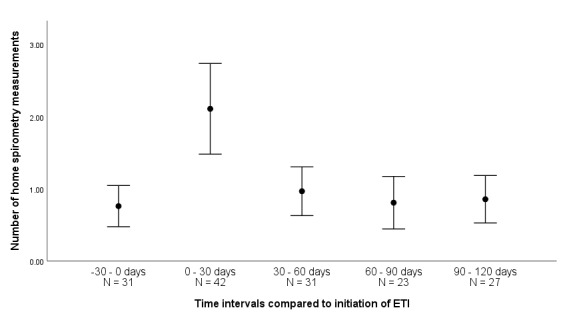
During the observation period, a total of 604 people with CF were enrolled in the remote monitoring platform and 9930 home spirometry measurements were performed. After the initiation of home spirometry use, the number of users declined rapidly. One year after the initiation, 232 (54.2%) people with CF stopped using home spirometry. During the observation period, 67 (11.1%) users performed more than 20 measurements. Furthermore, the number of consistent home spirometry users decreased over time. After 600 days, only 1% of users had measured their lung function consistently every 31 days. Use frequency slightly increased during periods with increased pulmonary symptoms (ΔMean=0.45, t=-4,197; P<.001) and showed an initial rise followed by a decrease after starting treatment with Elexacaftor/Tezacaftor/Ivacaftor (ΔMean=0.45, t=-4,197; P<.001).
Consistent uptake of home spirometry in people with CF is low but increases around periods of changing symptoms. A clear strategy for the organization of remote care seemed to improve the long-term uptake of home spirometry. Nevertheless, home spirometry and its intensity are not a goal on their own but should be used as a tool to reach individual goals within local contexts.
家用肺活量计已广泛应用于囊性纤维化(CF)患者的治疗。在家中频繁进行肺活量测定可更早发现病情加重。然而,先前的研究表明,CF患者对长期使用家用肺活量计的依从性不佳。
我们旨在深入了解在常规多中心CF护理中家用肺活量计的长期使用情况。
从2020年4月起,在荷兰的5个CF中心,将家用肺活量计与远程监测平台相结合用于CF患者的治疗。回顾性分析了2020年4月至2022年12月的使用数据。进行生存分析以评估随时间推移的使用一致性,并使用t检验评估肺部症状加重对家用肺活量计使用频率的影响。在重复测量方差分析的参与者亚组中,评估新治疗药物埃莱沙卡托/替扎卡托/依伐卡托的起始使用对随时间推移的使用频率的影响。
在观察期内,共有604名CF患者登记使用远程监测平台,进行了9930次家用肺活量测定。开始使用家用肺活量计后,用户数量迅速下降。开始使用一年后,232名(54.2%)CF患者停止使用家用肺活量计。在观察期内,67名(11.1%)用户进行了超过20次测量。此外,持续使用家用肺活量计的用户数量随时间减少。600天后,只有1%的用户每31天持续测量一次肺功能。在肺部症状加重期间,使用频率略有增加(平均变化量=0.45,t=-4.197;P<0.001),并且在开始使用埃莱沙卡托/替扎卡托/依伐卡托治疗后,使用频率最初上升,随后下降(平均变化量=0.45,t=-4.197;P<0.001)。
CF患者对家用肺活量计的持续使用情况较低,但在症状变化期间会有所增加。明确的远程护理组织策略似乎可提高家用肺活量计的长期使用情况。然而,家用肺活量计及其使用强度本身并非目标,而应作为在当地环境中实现个体目标的工具。