Russell Shannon Nicole, Demetriou Constantinos, Valenzano Giampiero, Evans Alice, Go Simei, Stanly Tess, Hazini Ahmet, Willenbrock Frances, Gordon-Weeks Alex Nicolas, Mukherjee Somnath, Tesson Matthias, Morton Jennifer P, O'Neill Eric, Jones Keaton Ian
Department of Oncology, University of Oxford, Oxford, UK.
Nuffield Department of Surgical Sciences, University of Oxford, Oxford, UK.
Gut. 2025 Apr 7;74(5):825-839. doi: 10.1136/gutjnl-2024-333492.
The immune suppression mechanisms in pancreatic ductal adenocarcinoma (PDAC) remain unknown, but preclinical studies have implicated macrophage-mediated immune tolerance. Hence, pathways that regulate macrophage phenotype are of strategic interest, with reprogramming strategies focusing on inhibitors of phosphoinositide 3-kinase-gamma (PI3Kγ) due to restricted immune cell expression. Inhibition of PI3Kγ alone is ineffective in PDAC, despite increased infiltration of CD8+ T cells.
We hypothesised that the immune stimulatory effects of radiation, and its ability to boost tumour antigen availability could synergise with PI3Kγ inhibition to augment antitumour immunity.
We used orthoptic and genetically engineered mouse models of pancreatic cancer (LSL-Kras;Trp53;Pdx1-Cre). Stereotactic radiotherapy was delivered using contrast CT imaging, and PI3Kγ inhibitors by oral administration. Changes in the tumour microenvironment were quantified by flow cytometry, multiplex immunohistochemistry and RNA sequencing. Tumour-educated macrophages were used to investigate efferocytosis, antigen presentation and CD8+ T cell activation. Single-cell RNA sequencing data and fresh tumour samples with autologous macrophages to validate our findings.
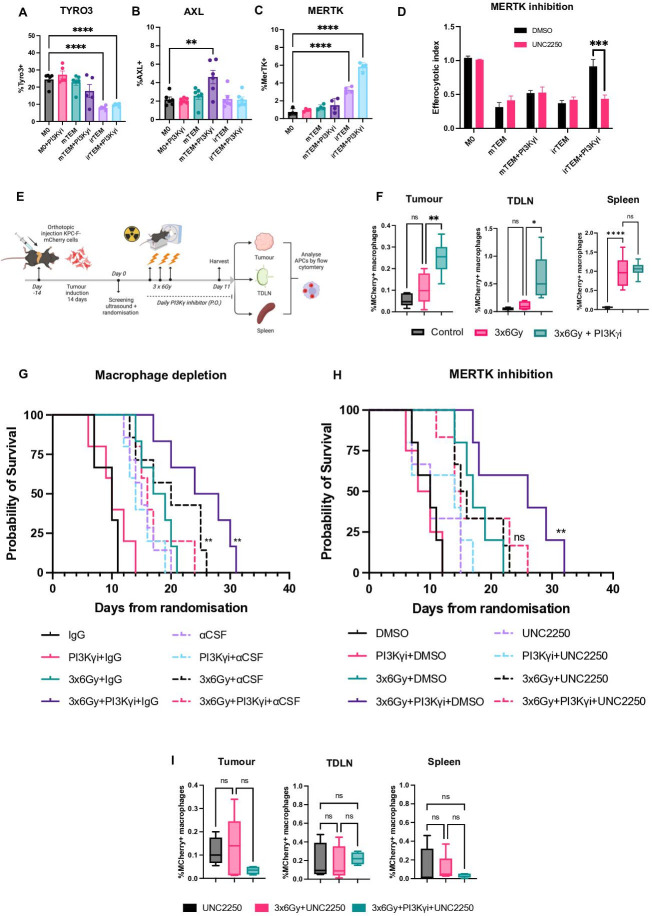
Tumour-associated macrophages that employ efferocytosis to eradicate apoptotic cells can be redirected to present tumour antigens, stimulate CD8+ T cell responses and increase local tumour control. Specifically, we demonstrate how PI3Kγ signalling restricts inflammatory macrophages and that inhibition supports MERTK-dependent efferocytosis. We further find that the combination of PI3Kγ inhibition with targeted radiotherapy stimulates inflammatory macrophages to invoke a pathogen-induced like efferocytosis that switches from immune tolerant to antigen presenting.
Our data supports a new immunotherapeutic approach and a translational rationale to improve survival in PDAC.
胰腺导管腺癌(PDAC)中的免疫抑制机制尚不清楚,但临床前研究表明巨噬细胞介导的免疫耐受与之相关。因此,调节巨噬细胞表型的途径具有重要的战略意义,由于免疫细胞表达受限,重编程策略聚焦于磷酸肌醇3激酶γ(PI3Kγ)抑制剂。尽管CD8 + T细胞浸润增加,但单独抑制PI3Kγ在PDAC中无效。
我们假设放疗的免疫刺激作用及其提高肿瘤抗原可用性的能力可与PI3Kγ抑制协同作用,以增强抗肿瘤免疫力。
我们使用了胰腺癌的原位和基因工程小鼠模型(LSL-Kras;Trp53;Pdx1-Cre)。使用对比CT成像进行立体定向放疗,并通过口服给予PI3Kγ抑制剂。通过流式细胞术、多重免疫组织化学和RNA测序对肿瘤微环境的变化进行定量。使用受过肿瘤教育的巨噬细胞来研究吞噬作用、抗原呈递和CD8 + T细胞活化。利用单细胞RNA测序数据和带有自体巨噬细胞的新鲜肿瘤样本验证我们的发现。
采用吞噬作用清除凋亡细胞的肿瘤相关巨噬细胞可被重定向以呈递肿瘤抗原、刺激CD8 + T细胞反应并增强局部肿瘤控制。具体而言,我们证明了PI3Kγ信号传导如何限制炎性巨噬细胞,以及抑制作用如何支持依赖MERTK的吞噬作用。我们进一步发现,PI3Kγ抑制与靶向放疗的联合可刺激炎性巨噬细胞引发一种病原体诱导的类似吞噬作用,这种作用从免疫耐受转变为抗原呈递。
我们的数据支持一种新的免疫治疗方法以及改善PDAC患者生存率的转化理论依据。