Peverill Matthew, Russell Justin D, Keding Taylor J, Rich Hailey M, Halvorson Max A, King Kevin M, Birn Rasmus M, Herringa Ryan J
Department of Psychiatry, University of Wisconsin-Madison, Madison, WI, USA.
Department of Psychology, Yale University, New Haven, CT, USA.
Hum Brain Mapp. 2025 Jan;46(1):e70094. doi: 10.1002/hbm.70094.
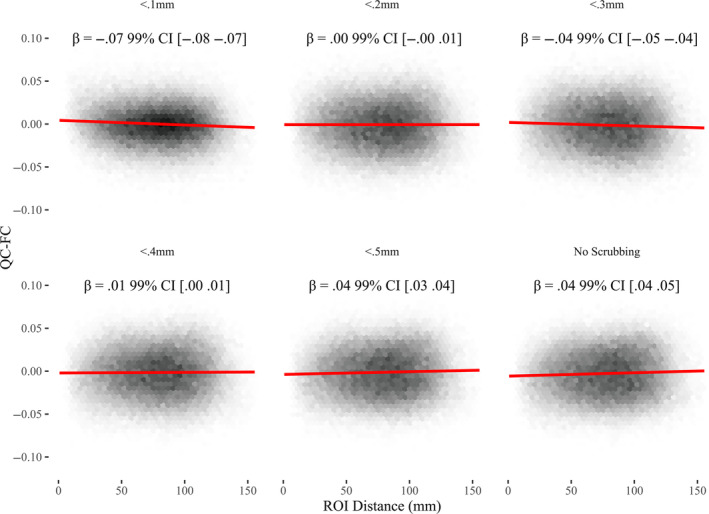
Analysis of resting state fMRI (rs-fMRI) typically excludes images substantially degraded by subject motion. However, data quality, including degree of motion, relates to a broad set of participant characteristics, particularly in pediatric neuroimaging. Consequently, when planning quality control (QC) procedures researchers must balance data quality concerns against the possibility of biasing results by eliminating data. In order to explore how researcher QC decisions might bias rs-fMRI findings and inform future research design, we investigated how a broad spectrum of participant characteristics in the Adolescent Brain and Cognitive Development (ABCD) study were related to participant inclusion/exclusion across versions of the dataset (the ABCD Community Collection and ABCD Release 4) and QC choices (specifically, motion scrubbing thresholds). Across all these conditions, we found that the odds of a participant's exclusion related to a broad spectrum of behavioral, demographic, and health-related variables, with the consequence that rs-fMRI analyses using these variables are likely to produce biased results. Consequently, we recommend that missing data be formally accounted for when analyzing rs-fMRI data and interpreting results. Our findings demonstrate the urgent need for better data acquisition and analysis techniques which minimize the impact of motion on data quality. Additionally, we strongly recommend including detailed information about quality control in open datasets such as ABCD.
静息态功能磁共振成像(rs-fMRI)分析通常会排除因受试者运动而严重退化的图像。然而,数据质量,包括运动程度,与一系列广泛的参与者特征相关,尤其是在儿科神经影像学中。因此,在规划质量控制(QC)程序时,研究人员必须在关注数据质量与因剔除数据而导致结果偏差的可能性之间取得平衡。为了探究研究人员的质量控制决策如何可能使rs-fMRI研究结果产生偏差并为未来的研究设计提供参考,我们调查了青少年大脑与认知发展(ABCD)研究中广泛的参与者特征是如何与不同版本数据集(ABCD社区数据集和ABCD版本4)中的参与者纳入/排除情况以及质量控制选择(具体而言,运动校正阈值)相关联的。在所有这些情况下,我们发现参与者被排除的几率与一系列广泛的行为、人口统计学和健康相关变量有关,结果是使用这些变量进行的rs-fMRI分析可能会产生有偏差的结果。因此,我们建议在分析rs-fMRI数据和解释结果时正式考虑缺失数据。我们的研究结果表明迫切需要更好的数据采集和分析技术,以尽量减少运动对数据质量的影响。此外,我们强烈建议在诸如ABCD这样的开放数据集中纳入有关质量控制的详细信息。