Department of Psychology, University of Oregon, Eugene, Oregon, USA.
Brain Behav. 2023 Jun;13(6):e3015. doi: 10.1002/brb3.3015. Epub 2023 Apr 16.
Resting-state functional magnetic resonance imaging (fMRI) is widely used for measuring functional interactions between brain regions, significantly contributing to our understanding of large-scale brain networks and brain-behavior relationships. Furthermore, idiosyncratic patterns of resting-state connections can be leveraged to identify individuals and predict individual differences in clinical symptoms, cognitive abilities, and other individual factors. Idiosyncratic connectivity patterns are thought to persist across task states, suggesting task-based fMRI can be similarly leveraged for individual differences analyses.
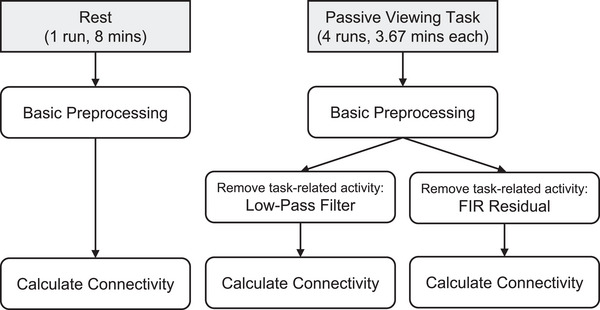
Here, we tested the degree to which functional interactions occurring in the background of a task during slow event-related fMRI parallel or differ from those captured during resting-state fMRI. We compared two approaches for removing task-evoked activity from task-based fMRI: (1) applying a low-pass filter to remove task-related frequencies in the signal, or (2) extracting residuals from a general linear model (GLM) that accounts for task-evoked responses.
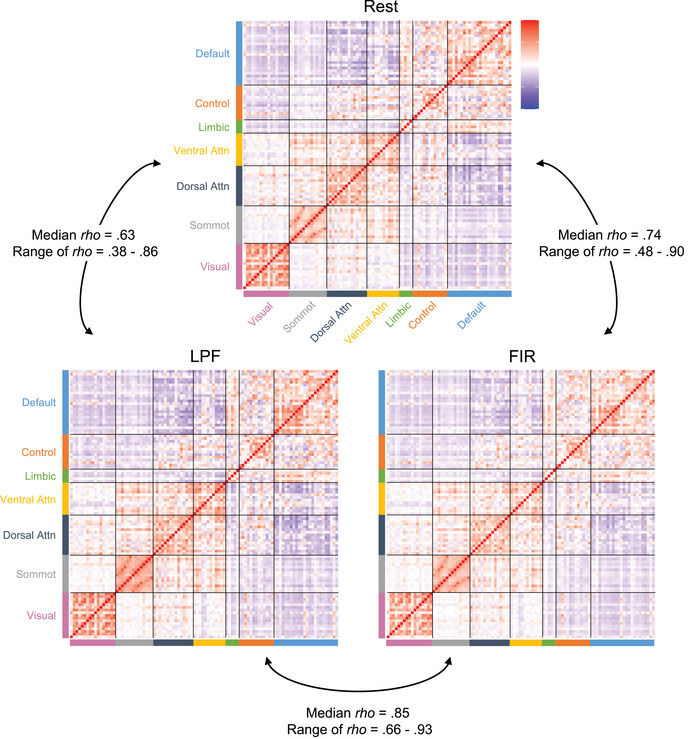
We found that the organization of large-scale cortical networks and individual's idiosyncratic connectivity patterns are preserved during task-based fMRI. In contrast, individual differences in connection strength can vary more substantially between rest and task. Compared to low-pass filtering, background connectivity obtained from GLM residuals produced idiosyncratic connectivity patterns and individual differences in connection strength that more resembled rest. However, all background connectivity measures were highly similar when derived from the low-pass-filtered signal or GLM residuals, indicating that both methods are suitable for measuring background connectivity.
Together, our results highlight new avenues for the analysis of task-based fMRI datasets and the utility of each background connectivity method.
静息态功能磁共振成像(fMRI)广泛用于测量脑区之间的功能相互作用,极大地促进了我们对大脑网络和大脑-行为关系的理解。此外,静息态连接的特质模式可用于识别个体,并预测个体的临床症状、认知能力和其他个体差异。特质连接模式被认为在任务状态之间保持不变,这表明任务态 fMRI 可类似地用于个体差异分析。
在这里,我们测试了在慢事件相关 fMRI 中任务背景下发生的功能相互作用在多大程度上与静息态 fMRI 中捕获的相互作用平行或不同。我们比较了两种从任务态 fMRI 中去除任务诱发活动的方法:(1)应用低通滤波器去除信号中的任务相关频率,或(2)从考虑任务诱发反应的广义线性模型(GLM)中提取残差。
我们发现,在任务态 fMRI 中,大尺度皮质网络的组织和个体的特质连接模式得以保留。相比之下,连接强度的个体差异在休息和任务之间可能有更大的变化。与低通滤波相比,从 GLM 残差中获得的背景连接产生了更类似于静息状态的特质连接模式和连接强度的个体差异。然而,从低通滤波信号或 GLM 残差中得出的所有背景连接测量值都非常相似,这表明两种方法都适合测量背景连接。
总之,我们的结果为分析任务态 fMRI 数据集和每种背景连接方法的实用性提供了新的途径。