Zhao Mengjie, Sun Ning, Cheng Yurong, Zhang Wantong, Ji Jinjin, Li Qiuyan, Lu Fang, Weng Weiliang
Xiyuan Hospital, China Academy of Chinese Medicine Sciences, Beijing, 100091, China.
Beijing University of Chinese Medicine, Beijing, 100029, China.
Sci Rep. 2025 Jan 9;15(1):1465. doi: 10.1038/s41598-024-82034-1.
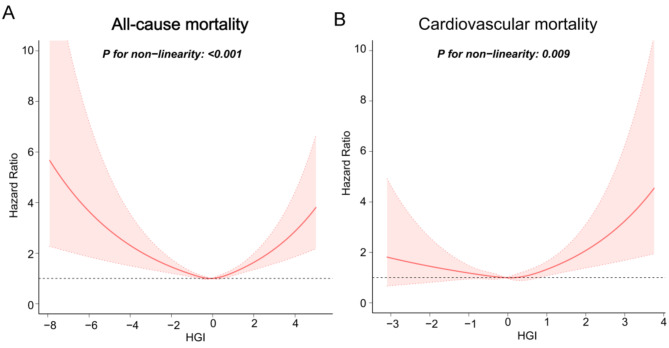
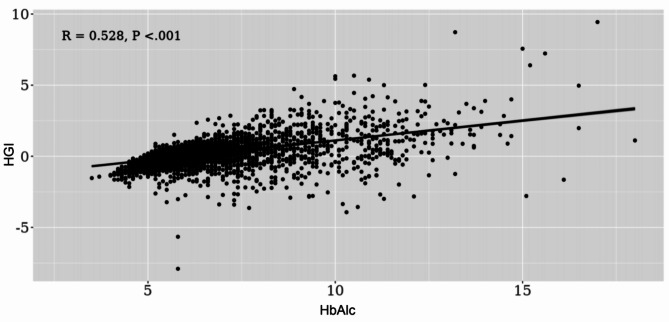
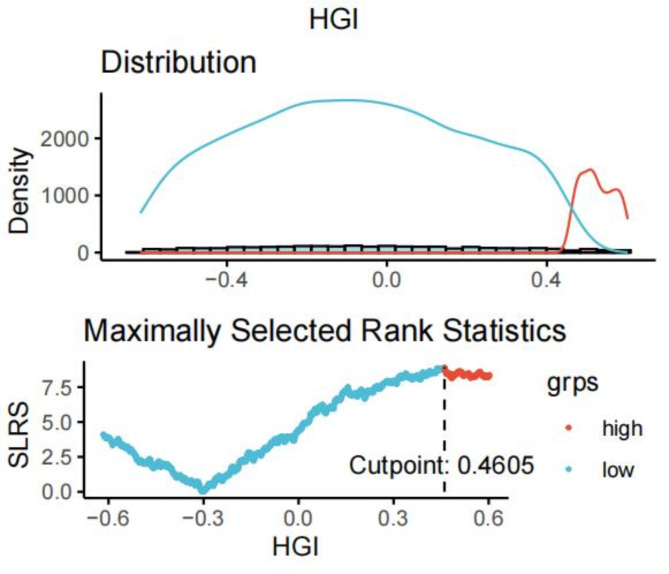
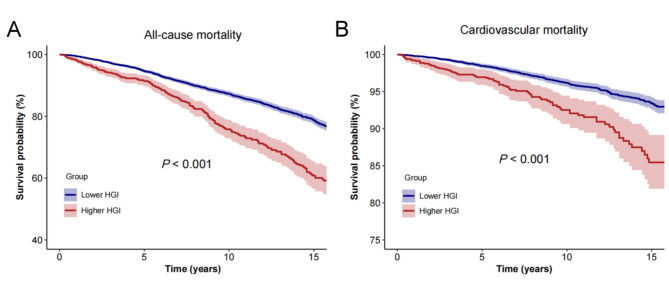
Identifying dependable prognostic indicators is essential for the efficient management of metabolic dysfunction-associated steatotic liver disease (MASLD). The index of hemoglobin glycation (HGI) has been demonstrated to be closely linked to the onset and advancement of MASLD. Currently, no studies have investigated the relationship between HGI and mortality rates among MASLD patients. This study analyzed data from the National Health and Nutrition Examination Surveys (NHANES) covering 1999 to 2018, involving 8,257 adult patients diagnosed with MASLD. The HGI was determined using a linear regression model that correlated hemoglobin A1c (HbA1c) with fasting plasma glucose (FPG). The study employed Kaplan-Meier survival curves and weighted Cox proportional hazards models to evaluate the independent association between HGI and mortality risk. The study utilized restricted cubic splines (RCS) to visually depict the relationship between HGI and mortality risk. Over a median follow-up duration of 97.0 months, there were 1,352 recorded deaths, among which 386 were attributed to cardiovascular disease (CVD). Participants were classified into two groups based on their HGI values: the high HGI group (≥ 0.4605) and the low HGI group (< 0.4605). The results from the weighted Cox proportional hazards model indicated that individuals in the high HGI group faced a significantly higher risk of all-cause mortality (HR 1.47, 95% CI 1.19-1.82, P < 0.001). However, no significant increase in CVD mortality risk was observed (HR 1.38, 95% CI 0.95-1.99, P = 0.090). The RCS analysis identified a U-shaped association between HGI and both all-cause mortality and CVD mortality, with critical points at -0.0564 and - 0.0573, respectively. Below the critical points, HGI was negatively correlated with all-cause mortality (HR 0.82, 95% CI: 0.72-0.92, P < 0.001) and not significantly associated with CVD mortality (HR 0.78, 95% CI: 0.57-1.07, P = 0.126). Above the critical points, HGI was significantly positively correlated with both all-cause mortality (HR 1.36, 95% CI: 1.20-1.53, P < 0.001) and CVD mortality (HR 1.44, 95% CI: 1.11-1.88, P = 0.007). Further subgroup and interaction analyses corroborated the reliability of these findings. HGI could potentially function as a useful and dependable marker for evaluating all-cause mortality and cardiovascular mortality in MASLD patients.
识别可靠的预后指标对于代谢功能障碍相关脂肪性肝病(MASLD)的有效管理至关重要。血红蛋白糖化指数(HGI)已被证明与MASLD的发生和进展密切相关。目前,尚无研究调查HGI与MASLD患者死亡率之间的关系。本研究分析了1999年至2018年国家健康与营养检查调查(NHANES)的数据,涉及8257名被诊断为MASLD的成年患者。使用将糖化血红蛋白(HbA1c)与空腹血糖(FPG)相关联的线性回归模型来确定HGI。该研究采用Kaplan-Meier生存曲线和加权Cox比例风险模型来评估HGI与死亡风险之间的独立关联。该研究利用受限立方样条(RCS)直观地描绘HGI与死亡风险之间的关系。在中位随访期97.0个月内,记录了1352例死亡病例,其中386例归因于心血管疾病(CVD)。参与者根据其HGI值分为两组:高HGI组(≥0.4605)和低HGI组(<0.4605)。加权Cox比例风险模型的结果表明,高HGI组个体面临的全因死亡风险显著更高(HR 1.47,95%CI 1.19-1.82,P<0.001)。然而,未观察到CVD死亡风险有显著增加(HR 1.38,95%CI 0.95-1.99,P=0.090)。RCS分析确定HGI与全因死亡率和CVD死亡率之间均呈U形关联,临界点分别为-0.0564和-0.0573。在临界点以下,HGI与全因死亡率呈负相关(HR 0.82,95%CI:0.72-0.92,P<0.001),与CVD死亡率无显著关联(HR 0.78,95%CI:0.57-1.07,P=0.126)。在临界点以上,HGI与全因死亡率(HR 1.36,95%CI:1.20-1.53,P<0.001)和CVD死亡率(HR 1.44,95%CI:1.11-1.88,P=0.007)均呈显著正相关。进一步的亚组和交互分析证实了这些发现的可靠性。HGI可能作为评估MASLD患者全因死亡率和心血管死亡率的有用且可靠的标志物。