
自组织映射神经网络下学前儿童体质评价的影响
The impact of preschool children's physical fitness evaluation under self organizing maps neural network.
作者信息
Wang Lili, Zou Wenjun, Wang Yuxuan, Koh Denise, Munsif Bin Wan Pa Wan Ahmad, Gao Rujiu
机构信息
Faculty of Education, Universiti Kebangsaan Malaysia, Bangi, Selangor, 43600, Malaysia.
School of Physical Education, East China University of Technology, Nanchang, 330013, China.
出版信息
Sci Rep. 2025 Jan 9;15(1):1461. doi: 10.1038/s41598-025-85725-5.
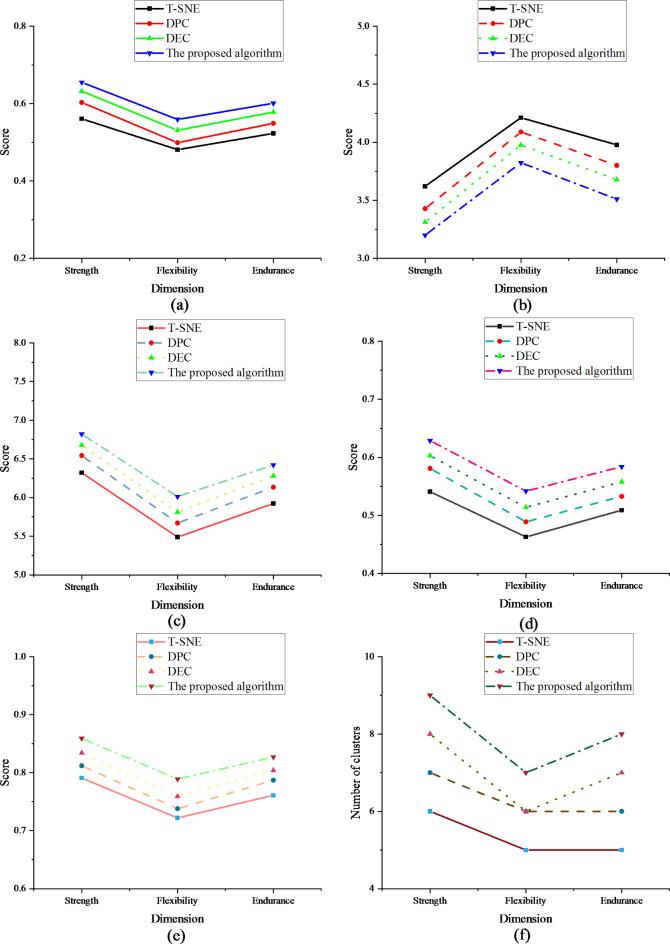
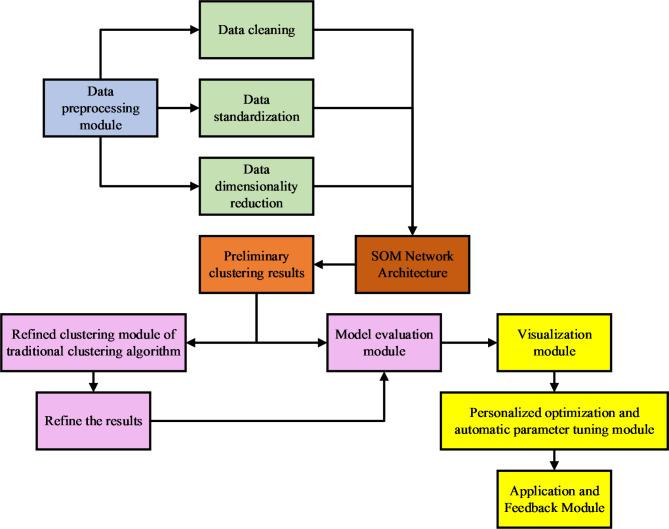
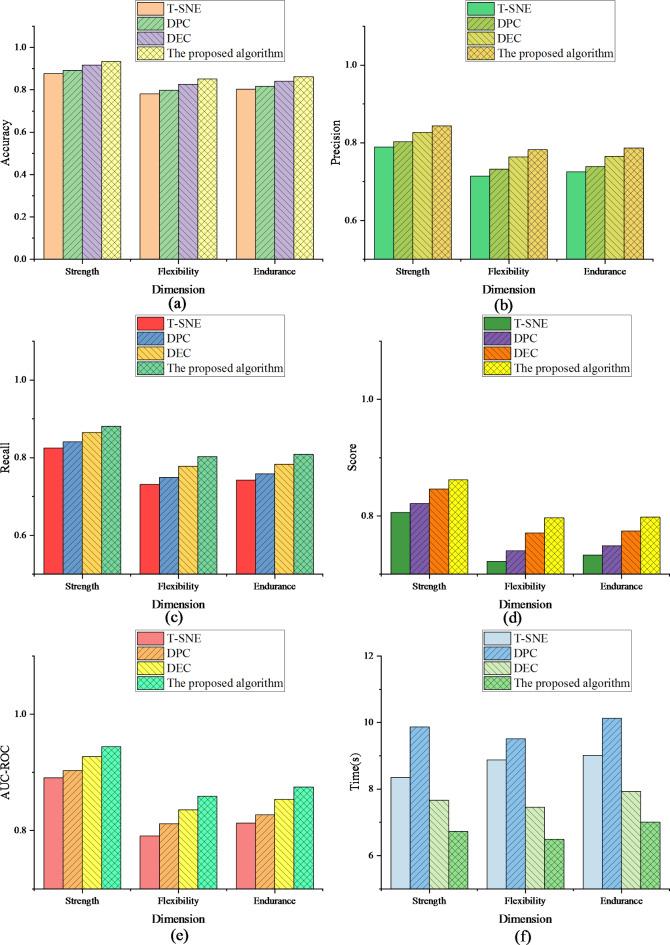
To improve the scientific accuracy and precision of children's physical fitness evaluations, this study proposes a model that combines self-organizing maps (SOM) neural networks with cluster analysis. Existing evaluation methods often rely on traditional, single statistical analyses, which struggle to handle the complexity of high-dimensional, nonlinear data, resulting in a lack of precision and personalization. This study uses the SOM neural network to reduce the dimensionality of high-dimensional health data. Moreover, it integrates cluster analysis to categorize and analyze key physical fitness attributes, such as strength, flexibility, and endurance. Experimental results show that the proposed optimized model outperforms comparison models such as T-distributed stochastic neighbor embedding, density peak clustering, and deep embedded clustering in terms of performance. The accuracy for the strength dimension reaches 0.934, the F1 score is 0.862, and the area under the curve of receiver operating characteristic is 0.944. The silhouette coefficients for cluster analysis in strength, flexibility, and endurance dimensions are 0.655, 0.559, and 0.601, respectively, demonstrating good intra-class and inter-class distances. The proposed model enhances the comprehensive analysis of children's physical fitness and provides a scientific basis for personalized health interventions, making an important contribution to research in this field.
为提高儿童身体素质评估的科学准确性和精确性,本研究提出一种将自组织映射(SOM)神经网络与聚类分析相结合的模型。现有的评估方法往往依赖于传统的单一统计分析,难以处理高维、非线性数据的复杂性,导致缺乏精确性和个性化。本研究使用SOM神经网络降低高维健康数据的维度。此外,它整合聚类分析以对力量、柔韧性和耐力等关键身体素质属性进行分类和分析。实验结果表明,所提出的优化模型在性能方面优于T分布随机邻域嵌入、密度峰值聚类和深度嵌入聚类等比较模型。力量维度的准确率达到0.934,F1分数为0.862,接收者操作特征曲线下面积为0.944。力量、柔韧性和耐力维度聚类分析的轮廓系数分别为0.655、0.559和0.601,表明类内和类间距离良好。所提出的模型增强了对儿童身体素质的综合分析,并为个性化健康干预提供了科学依据,为该领域的研究做出了重要贡献。

 Zotero 插件