Ma Xin-Xin, Xiao Zheng-Hua, Chen Wei, Zhao Shou-Ying
School of Psychology, Guizhou Normal University, Guizhou, China.
The Second Affiliated Hospital of Guizhou University of Traditional Chinese Medicine, Guizhou, China.
BMC Public Health. 2025 Jan 9;25(1):114. doi: 10.1186/s12889-024-21205-1.
Functional Gastrointestinal Disorders (FGIDs) constitute a group of psychosomatic diseases characterized primarily by disruptions in the functioning of the digestive system, profoundly impacting the lives of affected individuals.
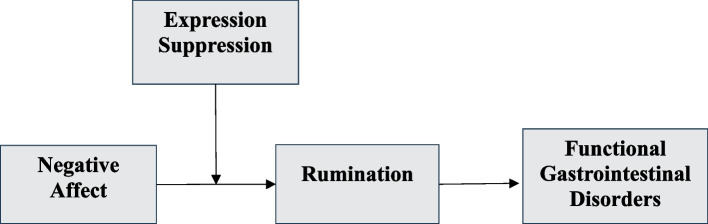
This study aims to investigate the influence of negative affect (NA) on the gastrointestinal symptoms of FGID patients, as well as the mediating role of rumination and the regulatory effects of expression suppression (ES) as an emotional regulation strategy.
A survey was conducted on 1000 patients (403M, 597F) with gastrointestinal disorders at a tertiary hospital using the negative affect subscale from the DS-14 (Type D Personality Scale), the Gastrointestinal Symptom Rating Scale (GSRS), the Rumination Response Scale (RRS), and the expression suppression subscale from the Gross-John Emotion Regulation Strategy.
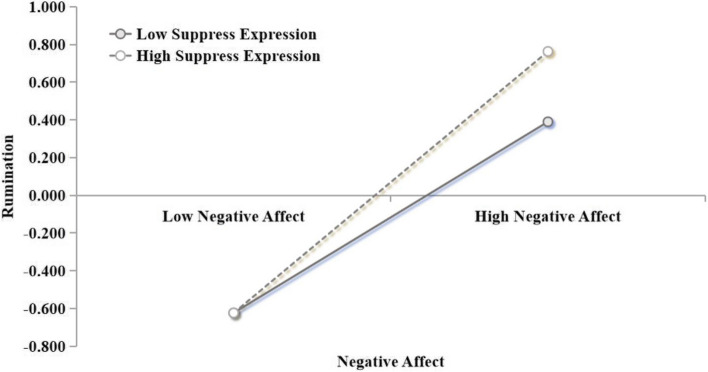
Negative affect positively predicts FGIDs, with rumination mediating the relationship between NA and FGIDs. The emotional regulation strategy of expression suppression moderates the positive relationship between NA and rumination and the mediating effect of rumination.
NA exacerbates symptoms of FGIDs in individuals, and rumination further amplifies this effect, with the mediating influence evident across both high and low ES emotion regulation strategy groups.
功能性胃肠疾病(FGIDs)是一组心身疾病,主要特征是消化系统功能紊乱,对患者的生活产生深远影响。
本研究旨在探讨消极情绪(NA)对FGID患者胃肠道症状的影响,以及沉思的中介作用和作为情绪调节策略的表达抑制(ES)的调节作用。
在一家三级医院对1000例胃肠疾病患者(403例男性,597例女性)进行调查,使用DS-14(D型人格量表)中的消极情绪分量表、胃肠道症状评定量表(GSRS)、沉思反应量表(RRS)以及格罗斯-约翰情绪调节策略中的表达抑制分量表。
消极情绪正向预测FGIDs,沉思在消极情绪与FGIDs之间起中介作用。表达抑制的情绪调节策略调节了消极情绪与沉思之间的正向关系以及沉思的中介作用。
消极情绪会加重个体的FGIDs症状,沉思会进一步放大这种影响,在高表达抑制和低表达抑制情绪调节策略组中,中介影响均很明显。