Camacho-Ruiz Julio A, Galvez-Sánchez Carmen M, Galli Federica, Limiñana-Gras Rosa M
Foundation Project Man Jaén, 23002 Jaén, Spain.
Department of Personality, Evaluation and Psychological Treatment, Faculty of Psychology and Speech Therapy, University of Murcia, Building 31, 30100 Murcia, Spain.
Healthcare (Basel). 2024 Dec 24;13(1):5. doi: 10.3390/healthcare13010005.
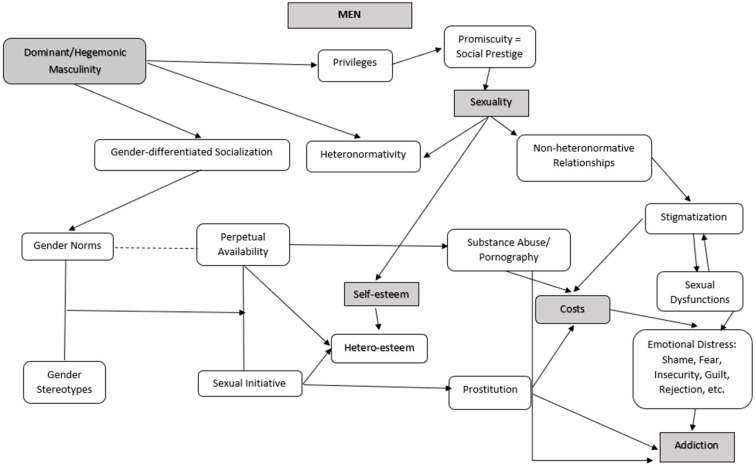
In our society, as well as in many other parts of the world, sexuality is shaped through gender-differentiated socialization. This process compels individuals to align their desires, behaviors, emotions, and thoughts with the expectations of normative sexuality, especially hegemonic heterosexuality. The primary objective of this current research was to examine the influence of hegemonic masculinity on the sexuality of men struggling with addiction. This study employed a qualitative approach, specifically using conventional content analysis. To ensure research quality and transparency, the study adhered to the Standards for Reporting Qualitative Research (SRQR) and the Consolidated Criteria for Reporting Qualitative Studies (COREQ). Fourteen participants from a therapeutic community for addiction treatment in Spain were selected through purposive sampling. Data collection involved semi-structured interviews, supplemented by participant observation. The sample size was determined based on the principle of data saturation. The findings reveal that factors such as gender-differentiated socialization, particularly the values associated with hegemonic masculinity (e.g., the pressure to maintain constant sexual availability and sexual initiative), alongside excessive engagement with prostitution and pornography, are closely linked to substance abuse, the development of addictions, and the emergence of sexual dysfunctions in men. The study also highlights the role of challenges related to oppression rooted in heteronormativity-understood as the imposition of rigid norms governing sexual orientation and behavior-in shaping sexual problems and in the origin and maintenance of addictions in men. It is essential to implement an intervention strategy that promotes egalitarian masculinities within the treatment of men with addiction issues, emphasizing a biopsychosocial approach to sexuality that integrates a gender perspective. Additionally, it is crucial to incorporate gender-sensitive interventions into rehabilitation programs for both men and women, ensuring a comprehensive understanding of each group's specific needs and fostering the development of healthy, equitable relationships in the context of addiction treatment.
在我们的社会以及世界上许多其他地方,性取向是通过性别差异化的社会化过程形成的。这一过程迫使个体使其欲望、行为、情感和思想与规范性取向的期望保持一致,尤其是霸权异性恋的期望。本研究的主要目的是考察霸权男性气质对成瘾男性性取向的影响。本研究采用定性研究方法,具体运用传统内容分析法。为确保研究质量和透明度,该研究遵循了定性研究报告标准(SRQR)和定性研究报告综合标准(COREQ)。通过目的抽样从西班牙一个成瘾治疗的治疗社区中选取了14名参与者。数据收集包括半结构化访谈,并辅以参与观察。样本量根据数据饱和原则确定。研究结果表明,性别差异化的社会化因素,特别是与霸权男性气质相关的价值观(例如,保持持续的性可及性和性主动性的压力),以及过度涉足卖淫和色情活动,与男性的药物滥用、成瘾的发展以及性功能障碍的出现密切相关。该研究还强调了与异性恋规范所导致的压迫相关的挑战的作用——异性恋规范被理解为对性取向和行为的严格规范的强加——在塑造男性性问题以及成瘾的起源和维持方面的作用。在对成瘾男性的治疗中实施促进平等男性气质的干预策略至关重要,强调一种将性别视角纳入其中的性取向的生物心理社会方法。此外,将对性别敏感的干预措施纳入男性和女性的康复项目中也至关重要,确保全面了解每个群体的具体需求,并在成瘾治疗的背景下促进健康、平等关系的发展。