Coley Kayesha, Wang Qingning, Packer Richard, John Catherine, Abner Erik, Reis Kadri, Bedair Khaled F, Srinivasan Sundararajan, Paciga Sara, Hyde Craig, Free Robert C, Reeve Nicola F, Shepherd David J, Esko Tõnu, Palmer Colin, Pearson Ewan, Malarstig Anders, Tobin Martin D, Batini Chiara
Department of Population Health Sciences, University of Leicester, Leicester, UK.
University Hospitals of Leicester NHS Trust, Groby Road, Leicester, UK.
Nicotine Tob Res. 2025 Jan 10;27(10):1684-94. doi: 10.1093/ntr/ntaf009.
Varenicline is an α4β2 nicotinic acetylcholine receptor partial agonist with the highest therapeutic efficacy of any pharmacological smoking cessation aid and a 12-month cessation rate of 26%. Genetic variation may be associated with varenicline response, but to date no genome-wide association studies of varenicline response have been published.
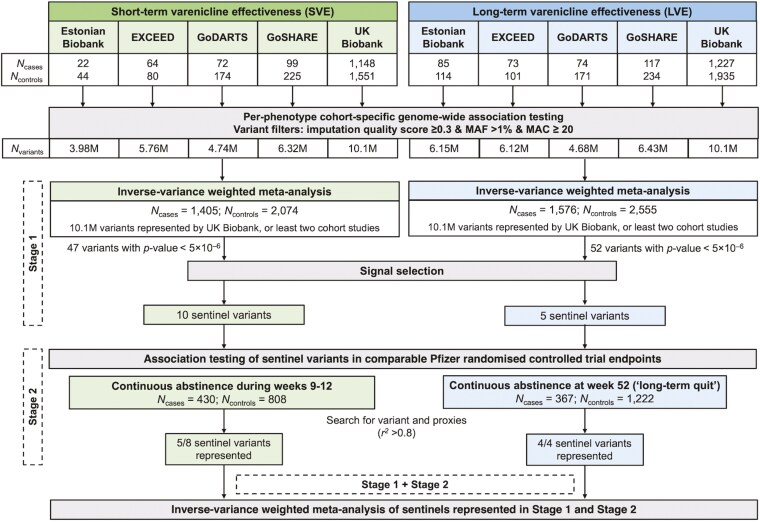
In this study, we investigated the genetic contribution to varenicline effectiveness using two electronic health record-derived phenotypes. We defined short-term varenicline effectiveness (SVE) and long-term varenicline effectiveness (LVE) by assessing smoking status at 3 and 12 months, respectively, after initiating varenicline treatment. In Stage 1, comprising five European cohort studies, we tested genome-wide associations with SVE (1,405 cases, 2,074 controls) and LVE (1,576 cases, 2,555 controls), defining sentinel variants (the most strongly associated variant within 1 megabase) with p-value <5×10⁻⁶ to follow up in Stage 2. In Stage 2, we tested association between sentinel variants and comparable smoking cessation endpoints in varenicline randomised controlled trials. We subsequently meta-analysed Stages 1 and 2.
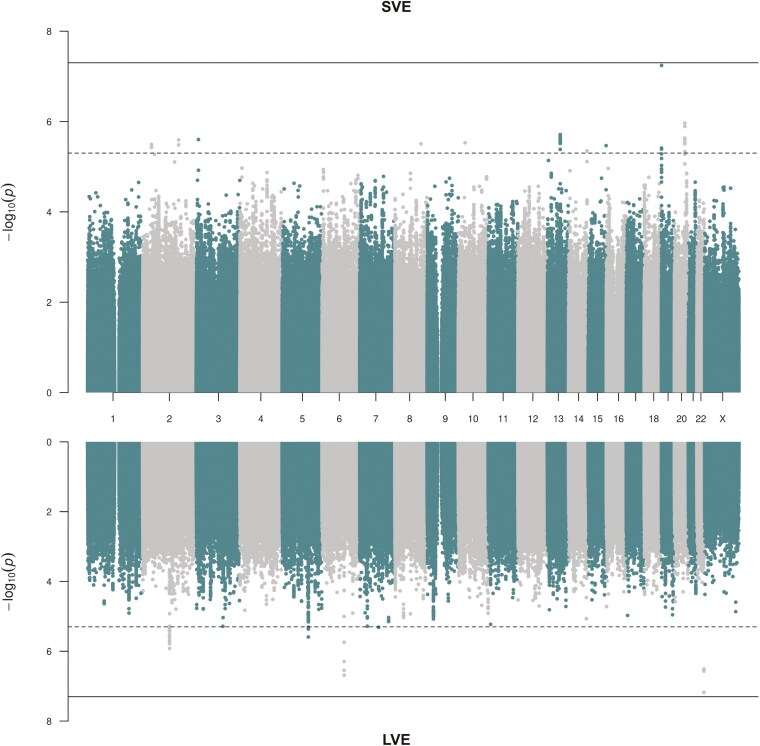
No variants reached genome-wide significance in the meta-analysis. In Stage 1, 10 sentinel variants were associated with SVE and five with LVE at a suggestive significance threshold (p-value <5×10⁻⁶); none of these sentinels were previously implicated in varenicline-aided smoking cessation or in genetic studies of smoking behaviour.
We provide initial insights into the biological underpinnings of varenicline-aided smoking cessation, through implicating genes involved in various processes, including gene expression, cilium assembly and early-stage development.
Leveraging electronic health records, we undertook the largest genetic study of varenicline-aided smoking cessation to date, and the only such study to test genome-wide associations. We showed distinct genetic variants associated (p-value <5×10⁻⁶) with varenicline-aided smoking cessation which implicate diverse cellular functions, including transcriptional regulation, RNA modification and cilium assembly. These provide insights which, if independently corroborated, will improve understanding of varenicline response. The growing availability of biobank resources with genetic and varenicline response data will provide future opportunities for larger studies using the approach we developed.
伐尼克兰是一种α4β2烟碱型乙酰胆碱受体部分激动剂,是所有药物戒烟辅助剂中治疗效果最佳的,其12个月戒烟率为26%。基因变异可能与伐尼克兰的反应有关,但迄今为止,尚未发表关于伐尼克兰反应的全基因组关联研究。
在本研究中,我们使用两种源自电子健康记录的表型来研究基因对伐尼克兰有效性的影响。我们通过分别评估开始伐尼克兰治疗后3个月和12个月的吸烟状况来定义短期伐尼克兰有效性(SVE)和长期伐尼克兰有效性(LVE)。在第1阶段,包括五项欧洲队列研究,我们测试了与SVE(1405例病例,2074例对照)和LVE(1576例病例,2555例对照)的全基因组关联,定义了p值<5×10⁻⁶的哨兵变异(1兆碱基内最强烈关联的变异),以便在第2阶段进行随访。在第2阶段,我们在伐尼克兰随机对照试验中测试了哨兵变异与可比戒烟终点之间的关联。随后,我们对第1阶段和第2阶段进行了荟萃分析。
在荟萃分析中,没有变异达到全基因组显著性。在第1阶段,10个哨兵变异与SVE相关,5个与LVE相关,达到提示性显著性阈值(p值<5×10⁻⁶);这些哨兵变异以前均未涉及伐尼克兰辅助戒烟或吸烟行为的基因研究。
我们通过涉及参与各种过程的基因,包括基因表达、纤毛组装和早期发育,对伐尼克兰辅助戒烟的生物学基础提供了初步见解。
利用电子健康记录,我们开展了迄今为止最大规模的伐尼克兰辅助戒烟基因研究,也是唯一一项测试全基因组关联的此类研究。我们发现了与伐尼克兰辅助戒烟相关(p值<5×10⁻⁶)的不同基因变异,这些变异涉及多种细胞功能,包括转录调控、RNA修饰和纤毛组装。这些发现提供了见解,如果得到独立证实,将有助于提高对伐尼克兰反应的理解。拥有基因和伐尼克兰反应数据的生物样本库资源越来越多,将为使用我们开发的方法进行更大规模的研究提供未来机会。