Yuan Jialin, Liu Cong, Jiang Chengwei, Liu Ning, Yang Zhaoying, Xing Hua
Department of Breast Surgery, China-Japan Union Hospital of Jilin University, Changchun, China.
Department of Pathology, China-Japan Union Hospital of Jilin University, Changchun, China.
Sci Rep. 2025 Jan 11;15(1):1654. doi: 10.1038/s41598-025-85774-w.
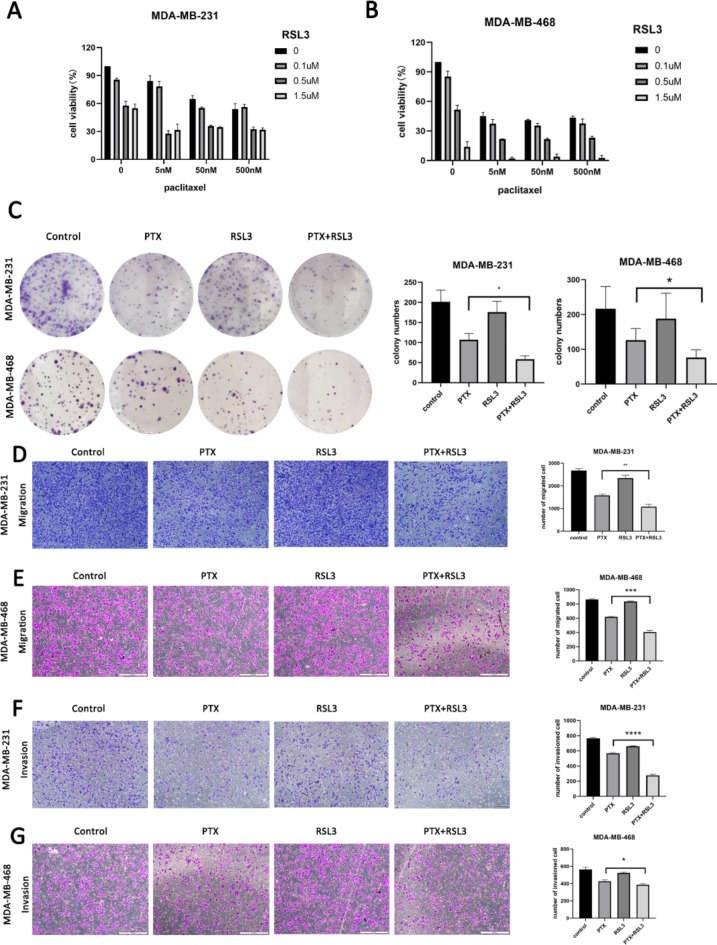
Chemotherapy resistance in triple-negative breast cancer (TNBC) leads to poor therapeutic effects and a poor prognosis. Given that paclitaxel-based chemotherapy is the main treatment method for TNBC, enhancing its chemosensitivity has been a research focus. Induced ferroptosis of tumour cells has been proven to increase chemosensitivity, but its ability to sensitize TNBC cells to paclitaxel (PTX) is unknown. In our experiments, measurements of viability and proliferation validated the synergistic effect of PTX combined with RSL3 on TNBC cells. The accumulation of intracellular Fe and lipid reactive oxygen species, as well as the expression of malondialdehyde, illustrated that RSL3 enhanced the chemosensitivity of TNBC to PTX by inducing ferroptosis. Through transcriptome sequencing, a series of differentially expressed genes were identified, in which the expression of cytokines, such as CXCLs, was significantly increased in the treatment group, and the effect of combination therapy on TNBC was enriched mainly in the NFκB signalling pathway. In subsequent validation experiments, the use of the NF-κB inhibitor BAY11-7082 reversed the inhibitory effects of PTX and RSL3 on TNBC cell activity. In a xenograft immunodeficient mouse model, the inhibitory effects of PTX and RSL3 on TNBC in vivo were further verified. Our research validated the synergistic effects of PTX and RSL3 both in vivo and in vitro, with RSL3 inducing ferroptosis by activating the NF-κB signalling pathway, thereby increasing the chemosensitivity of TNBC to PTX. This study provides new insights for improving the therapeutic efficacy of treatment strategies.
三阴性乳腺癌(TNBC)中的化疗耐药导致治疗效果不佳和预后不良。鉴于基于紫杉醇的化疗是TNBC的主要治疗方法,提高其化疗敏感性一直是研究重点。已证明诱导肿瘤细胞铁死亡可增加化疗敏感性,但其使TNBC细胞对紫杉醇(PTX)敏感的能力尚不清楚。在我们的实验中,通过活力和增殖测定验证了PTX与RSL3联合对TNBC细胞的协同作用。细胞内铁和脂质活性氧的积累以及丙二醛的表达表明,RSL3通过诱导铁死亡增强了TNBC对PTX的化疗敏感性。通过转录组测序,鉴定出一系列差异表达基因,其中治疗组中细胞因子如CXCLs的表达显著增加,联合治疗对TNBC的作用主要富集在NFκB信号通路中。在随后的验证实验中,使用NF-κB抑制剂BAY11-7082可逆转PTX和RSL3对TNBC细胞活性的抑制作用。在异种移植免疫缺陷小鼠模型中,进一步验证了PTX和RSL3在体内对TNBC的抑制作用。我们的研究验证了PTX和RSL3在体内和体外的协同作用,RSL3通过激活NF-κB信号通路诱导铁死亡,从而增加TNBC对PTX的化疗敏感性。本研究为提高治疗策略的疗效提供了新的见解。