Vîrlan Anna, Coșciug Lidia, Țurcanu Dinu, Siminiuc Rodica
Faculty of Food Technology, Technical University of Moldova, 168, Stefan cel Mare bd, MD-2004 Chisinau, Moldova.
Foods. 2024 Dec 25;14(1):12. doi: 10.3390/foods14010012.
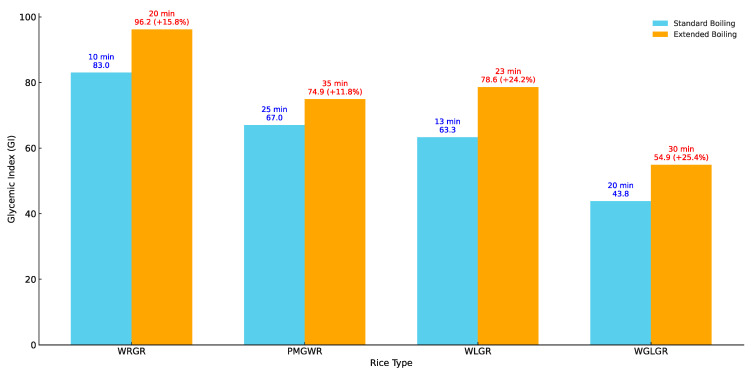
Effective blood glucose management is essential for individuals with type 1 diabetes, particularly when dietary adjustments involve staple foods like rice. As a primary carbohydrate worldwide, rice significantly influences the glycemic index (GI) based on its type and cooking method. This study investigated the impact of rice type and boiling duration on the GI in healthy adults using an in vivo approach aligned with ISO 2010 standards. The glycemic response to four rice types (white round-grain, parboiled medium-grain, white long-grain, and whole-grain long-grain) was measured through postprandial blood glucose levels under both standard and extended boiling conditions to assess their implications for dietary glycemic control. Ten healthy participants (mean age 25 years, body mass index (BMI) 23.0 ± 1.6 kg/m) consumed rice samples containing 50 g of available carbohydrates, prepared under controlled boiling conditions. Postprandial glycemic response was measured at regular intervals over 2 h following ingestion, with glucose solution as a reference food. The GI was calculated based on the incremental area under the glycemic response curve for each rice sample. Extended boiling significantly increased the GI across all rice types. White round-grain rice exhibited the highest relative increase (+15.8%) in the GI, while whole-grain long-grain rice, despite showing a greater percentage increase (+25.4%), maintained the lowest overall GI due to its high amylose and fiber content. Rice types with higher amylopectin content demonstrated faster glycemic responses and higher GI compared to high-amylose types. This study highlights rice type and cooking time as critical factors influencing postprandial glycemic response. Shorter boiling durations may benefit individuals requiring strict glycemic control, particularly those with diabetes, underscoring the importance of personalized dietary guidance for managing glycemic outcomes effectively.
有效的血糖管理对于1型糖尿病患者至关重要,尤其是当饮食调整涉及大米等主食时。作为全球主要的碳水化合物,大米因其类型和烹饪方法对血糖指数(GI)有显著影响。本研究采用符合ISO 2010标准的体内方法,调查了大米类型和煮沸时间对健康成年人血糖指数的影响。通过在标准和延长煮沸条件下测量餐后血糖水平,评估了四种大米类型(白圆粒米、半熟中粒米、白长粒米和全谷物长粒米)的血糖反应,以了解它们对饮食血糖控制的影响。十名健康参与者(平均年龄25岁,体重指数(BMI)23.0±1.6kg/m)食用了在控制煮沸条件下制备的含有50g可利用碳水化合物的大米样本。摄入后2小时内定期测量餐后血糖反应,以葡萄糖溶液作为参考食物。根据每个大米样本血糖反应曲线下的增量面积计算血糖指数。延长煮沸时间显著提高了所有大米类型的血糖指数。白圆粒米的血糖指数相对增幅最高(+15.8%),而全谷物长粒米尽管增幅百分比更大(+25.4%),但由于其高直链淀粉和纤维含量,总体血糖指数保持最低。与高直链淀粉类型相比,支链淀粉含量较高的大米类型显示出更快的血糖反应和更高的血糖指数。本研究强调大米类型和烹饪时间是影响餐后血糖反应的关键因素。较短的煮沸时间可能有益于需要严格血糖控制的个体,尤其是糖尿病患者,这凸显了个性化饮食指导对有效管理血糖结果的重要性。