Garg Dresshti, Smith Evelyn, Attuquayefio Tuki
School of Psychology, Western Sydney University, Sydney, NSW 2751, Australia.
Translational Health Research Institute, Western Sydney University, Sydney, NSW 2751, Australia.
Nutrients. 2025 Jan 2;17(1):166. doi: 10.3390/nu17010166.
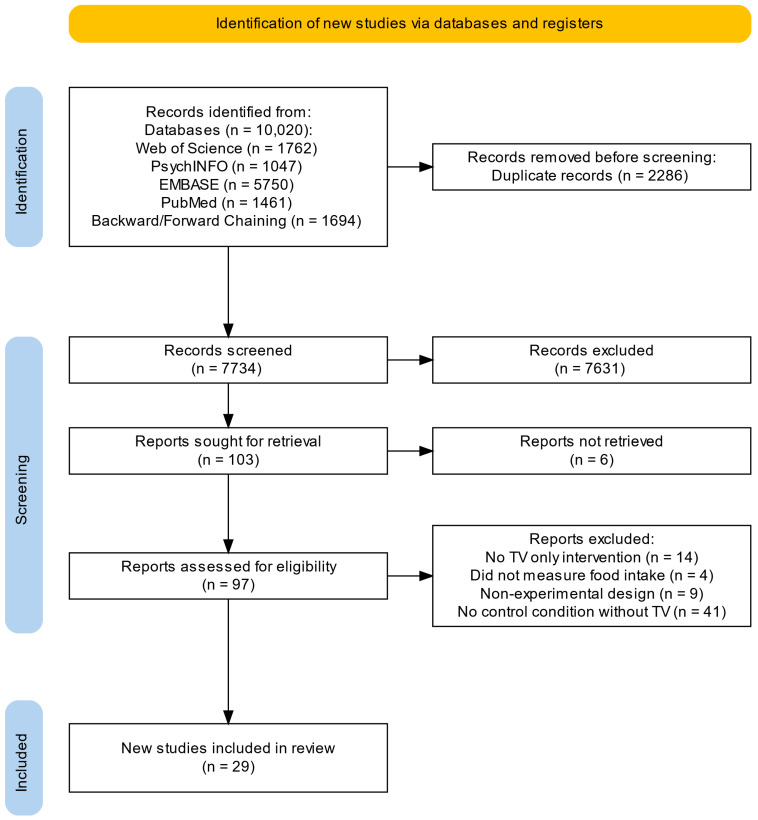
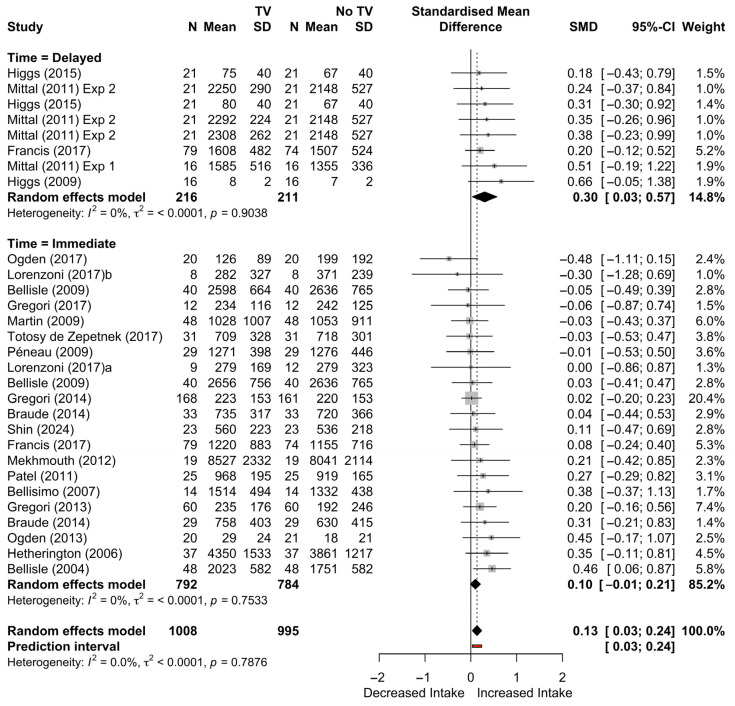
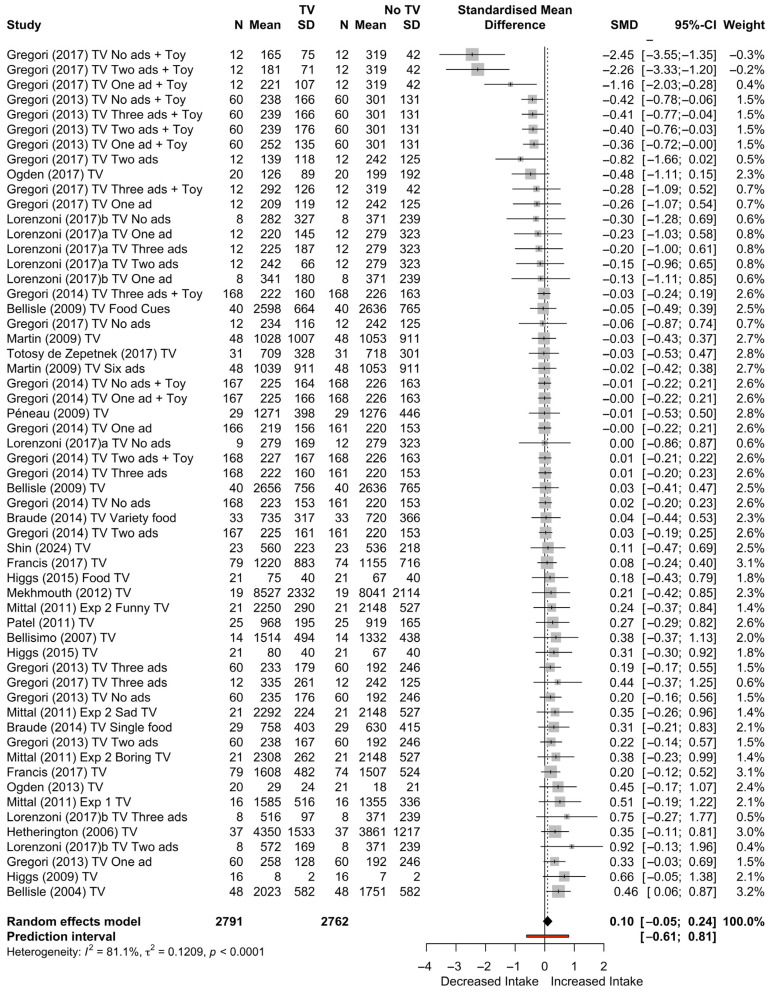
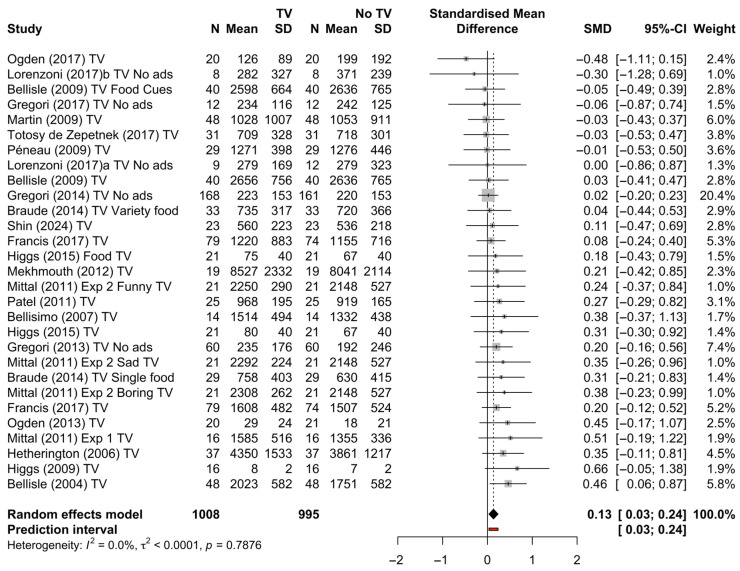
: Television viewing has been linked with increased weight and obesity, likely through decreased physical activity associated with sitting and viewing television, as well as increased intake of food, likely through reduced awareness of eating and intake behaviours. This review sought to determine the effects of television viewing on energy intake relative to the absence of television. : We adhered to the PRISMA guidelines and pre-registered this review in PROSPERO (CRD42023493092). The PICOS strategy included children, adolescents and adults of all ages (P), exposed to television viewing only during meals (I) compared to no television and no other distractors (C), with the outcome as energy intake or consumption (O) for both within-subject and between-subject randomised controlled trial (RCT) designs (S). : Robust-variance meta-analyses of k = 57 effect sizes from 23 studies showed no overall effect, noting high heterogeneity. When analyses were limited to television alone with k = 29 effect sizes from 23 studies, we revealed a small significant effect of television viewing on intake ( = 0.13, 95% CI [0.03-0.24]) compared to no television. Moderation analysis showed that television viewing strongly increased intake at the next meal ( = 0.30, 95% CI [0.03-0.57]) but not immediate intake ( = 0.10, 95% CI [-0.01-0.21]). : This review showed that television viewing increases food intake, especially at the next meal. This effect was evident across both children and adults. This review highlights how television viewing impacts intake and offers potential avenues for intervention based on our findings.
看电视与体重增加和肥胖有关,可能是因为坐着看电视会减少身体活动,以及可能由于对进食和摄入行为的意识降低而导致食物摄入量增加。本综述旨在确定与不看电视相比,看电视对能量摄入的影响。:我们遵循PRISMA指南,并在PROSPERO(CRD42023493092)中对本综述进行了预注册。PICOS策略包括所有年龄段的儿童、青少年和成年人(P),仅在进餐时接触电视(I),与不看电视且无其他干扰因素(C)相比,结局为能量摄入或消耗(O),采用受试者内和受试者间随机对照试验(RCT)设计(S)。:对23项研究的k = 57个效应量进行稳健方差荟萃分析,结果显示无总体效应,注意到异质性较高。当分析仅限于电视单独作用,来自23项研究的k = 29个效应量时,我们发现与不看电视相比,看电视对摄入量有小的显著影响(= 0.13,95% CI [0.03 - 0.24])。调节分析表明,看电视会显著增加下一餐的摄入量(= 0.30,95% CI [0.03 - 0.57]),但不会增加即时摄入量(= 0.10,95% CI [-0.01 - 0.21])。:本综述表明,看电视会增加食物摄入量,尤其是下一餐的摄入量。这种效应在儿童和成年人中都很明显。本综述强调了看电视如何影响摄入量,并根据我们的研究结果提供了潜在的干预途径。