Garg Priyanka, Krishnamoorthy Yuvaraj, Halder Pritam, Rajaa Sathish, Verma Madhur, Kankaria Ankita, Goel Anil, Kakkar Rakesh
Department of Obstetrics and Gynecology, All India Institute of Medical Sciences Bathinda, Bathinda, Punjab, 151001, India.
Evidence Synthesis Unit, Partnership for Research, Oppurtunities, Planning, Upskilling and Leadership (PROPUL) Evidence, Chennai, India.
BMC Cancer. 2025 Jan 11;25(1):67. doi: 10.1186/s12885-025-13446-z.
Existing evidence suggests a lower uptake of cervical cancer screening among Indian women. Coverage is lower in rural than urban women, but such disparities are less explored. So, the present study was conducted to explore the self-reported coverage of cervical cancer screening in urban and rural areas stratified by socio-demographic characteristics, determine the spatial patterns and identify any regional variations, ascertain the factors contributing to urban-rural disparities and those influencing the likelihood of screening among women aged 30-49 years factors residing in urban, rural, and overall Indian settings.
We did a secondary analysis of the fifth round of the National Family Health Survey in India (2019-21) data with a sample size of 3,48,882 women. The coverage of cervical cancer screening was estimated using sampling weights. Urban-rural differences were compared using the chi-square test. Spatial patterns were analysed using aggregated district-level data, and the contribution of different independent variables to the urban-rural disparities was estimated using multivariate decomposition analysis. Multivariable logistic regression was conducted using STATA 17 to obtain the significant factors of reported screening in urban and rural areas.
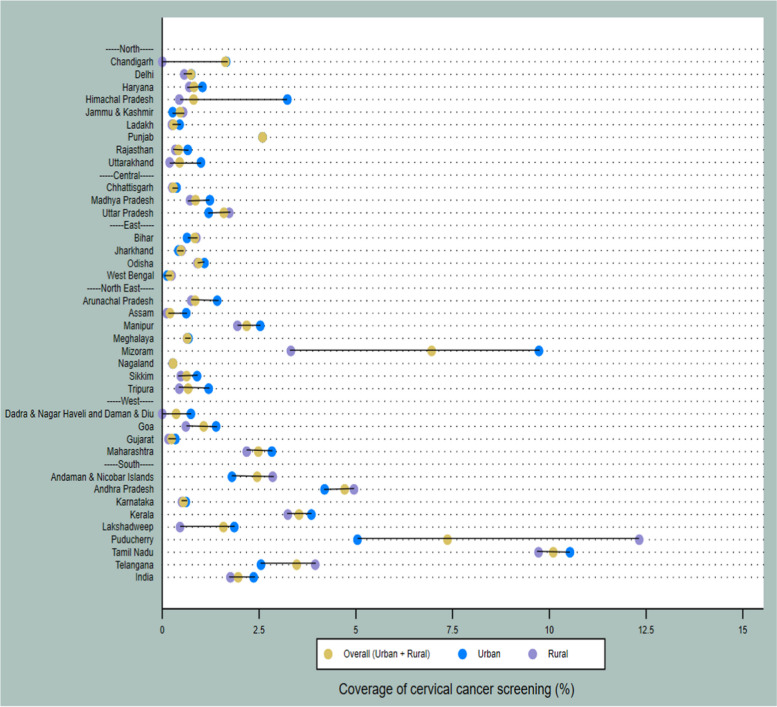
The nationwide coverage of cervical cancer screening was 2.0% (95% CI: 1.9-2.0). The urban (2.4%; 2.3-2.5) participants had higher screening coverage than their rural (1.8%; 1.7-1.8) counterparts. Moran's I statistic confirmed the presence of spatial dependence and geographical gradient. Decomposition analysis depicted small urban-rural differences in the screening coverage of 0.60% (0.4-0.8). Endowment and coefficient contributed to 88.15% and 11.85% of the disparities. Compositional changes were contributed majorly by regional differences, low education, scheduled tribes, and having living children > 2. Higher odds of having screening were associated with older age (AOR 1.45, 95% CI: 1.03-1.28), higher education (1.32; 1.13-1.55), higher age of first intercourse (1.60; 1.43-1.79), married (1.25; 1.08-1.45) and diabetic (1.39; 1.17-1.65) women, and those from South India (6.76; 5.90-7.75). The odds were lower among Muslims, scheduled tribes and participants using hormonal contraceptives.
There are significant urban-rural disparities in cervical cancer screening uptake that can be attributed to regional variation, educational inequalities, tribal groups, socio-economic inequalities and parity, necessitating the need to comprehensively design tailor-made advocacy initiatives and simultaneously address the broader determinants of health.
现有证据表明,印度女性宫颈癌筛查的参与率较低。农村女性的筛查覆盖率低于城市女性,但这种差异较少被探讨。因此,本研究旨在探讨按社会人口学特征分层的城乡地区宫颈癌筛查的自我报告覆盖率,确定空间模式并识别任何区域差异,查明导致城乡差异的因素以及影响30 - 49岁城市、农村及印度整体女性筛查可能性的因素。
我们对印度第五轮全国家庭健康调查(2019 - 2021年)的数据进行了二次分析,样本量为348,882名女性。使用抽样权重估计宫颈癌筛查的覆盖率。使用卡方检验比较城乡差异。利用汇总的地区层面数据分析空间模式,并使用多变量分解分析估计不同自变量对城乡差异的贡献。使用STATA 17进行多变量逻辑回归,以获得城乡地区报告筛查的显著因素。
全国宫颈癌筛查的覆盖率为2.0%(95%置信区间:1.9 - 2.0)。城市参与者(2.4%;2.3 - 2.5)的筛查覆盖率高于农村参与者(1.8%;1.7 - 1.8)。莫兰指数证实了空间依赖性和地理梯度的存在。分解分析显示筛查覆盖率的城乡差异较小,为0.60%(0.4 - 0.8)。禀赋和系数分别导致差异的88.15%和11.85%。构成变化主要由地区差异、低教育水平、在册部落以及生育子女数>2所致。筛查几率较高与年龄较大(调整后比值比1.45,95%置信区间:1.03 - 1.28)、教育程度较高(1.32;1.13 - 1.55)、初次性交年龄较大(1.60;1.43 - 1.79)、已婚(1.25;1.08 - 1.45)和患有糖尿病(1.39;1.17 - 1.65)的女性以及来自印度南部的女性(6.76;5.90 - 7.75)有关。穆斯林、在册部落以及使用激素避孕药的参与者筛查几率较低。
宫颈癌筛查的参与率存在显著的城乡差异,这可归因于地区差异、教育不平等、部落群体、社会经济不平等和生育状况,因此有必要全面设计量身定制的宣传举措,并同时解决更广泛的健康决定因素。