• 文献检索
  • 文档翻译
  • 深度研究
  • 学术资讯
  • Suppr Zotero 插件Zotero 插件
  • 邀请有礼
  • 套餐&价格
  • 历史记录
应用&插件
Suppr Zotero 插件Zotero 插件浏览器插件Mac 客户端Windows 客户端微信小程序
定价
高级版会员购买积分包购买API积分包
服务
文献检索文档翻译深度研究API 文档MCP 服务
关于我们
关于 Suppr公司介绍联系我们用户协议隐私条款
关注我们

Suppr 超能文献

核心技术专利:CN118964589B侵权必究
粤ICP备2023148730 号-1Suppr @ 2026

文献检索

告别复杂PubMed语法,用中文像聊天一样搜索,搜遍4000万医学文献。AI智能推荐,让科研检索更轻松。

立即免费搜索

文件翻译

保留排版,准确专业,支持PDF/Word/PPT等文件格式,支持 12+语言互译。

免费翻译文档

深度研究

AI帮你快速写综述,25分钟生成高质量综述,智能提取关键信息,辅助科研写作。

立即免费体验

世界上最具毒性的蜘蛛是一个物种复合体:悉尼漏斗网蜘蛛(穴居狼蛛科:粗壮漏斗蛛)的系统分类学。

The world's most venomous spider is a species complex: systematics of the Sydney funnel-web spider (Atracidae: Atrax robustus).

作者信息

Loria Stephanie F, Frank Svea-Celina, Dupérré Nadine, Smith Helen M, Jones Braxton, Buzatto Bruno A, Harms Danilo

机构信息

Museum of Nature - Hamburg, Leibniz Institute for the Analysis of Biodiversity Change, Hamburg, Germany.

Fachbereich Biologie, Universität Hamburg, Hamburg, Germany.

出版信息

BMC Ecol Evol. 2025 Jan 13;25(1):7. doi: 10.1186/s12862-024-02332-0.

DOI:10.1186/s12862-024-02332-0
PMID:39800689
原文链接:https://pmc.ncbi.nlm.nih.gov/articles/PMC11727706/
Abstract

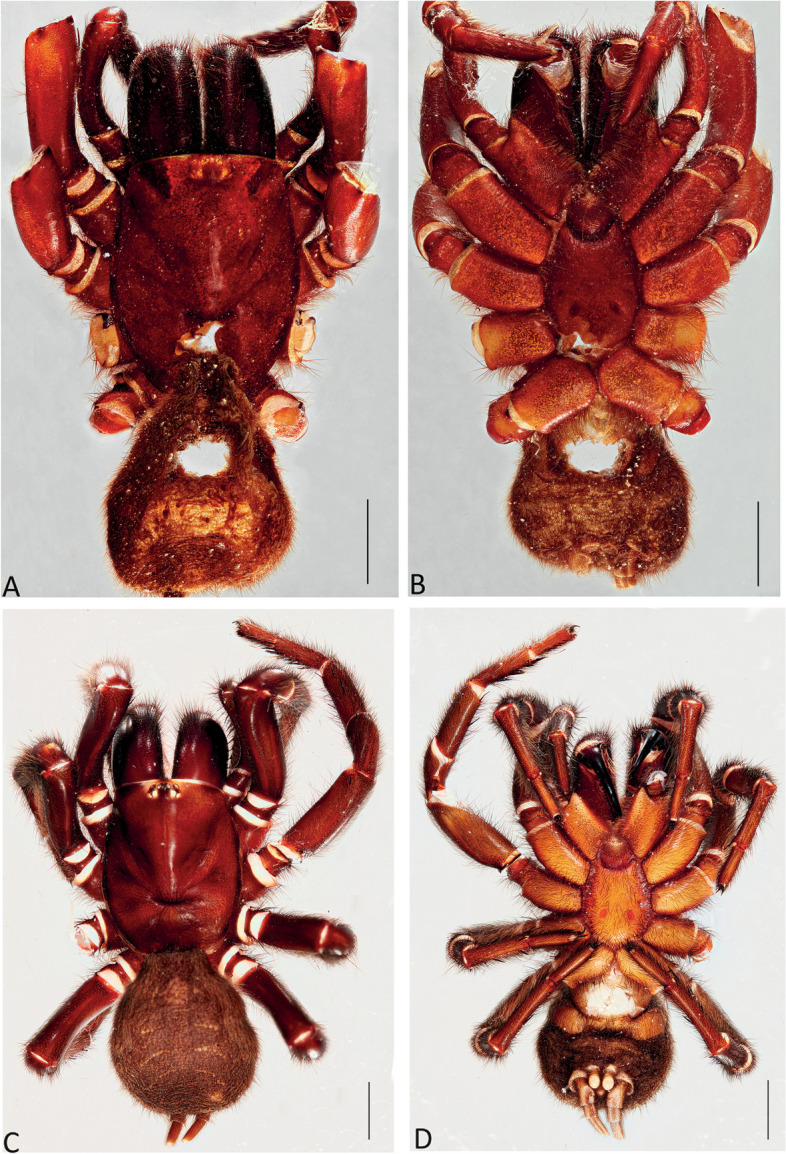
The Sydney funnel-web spider Atrax robustus O. Pickard-Cambridge, 1877 is an iconic Australian species and considered among the most dangerously venomous spiders for humans. Originally described in 1877 from a single specimen collected in "New Holland", this spider has a complex taxonomic history. The most recent morphological revision of funnel-web spiders (Atracidae) lists this species as both widespread and common in the Sydney Basin bioregion and beyond, roughly 250 km from the Newcastle area south to the Illawarra, and extending inland across the Blue Mountains. Morphological variability and venom diversity in this species appear to be unusually high, raising questions about species concepts and diversity in these spiders. In this study, we use a combination of molecular phylogenetics, divergence time analyses and morphology to establish the Sydney funnel-web spider as a complex of three species. The "real" Sydney funnel-web spider Atrax robustus is relatively widespread in the Sydney metropolitan region. A second species, Atrax montanus (Rainbow, 1914), which is revalidated here, overlaps but mainly occurs further south and west, and a third larger species, Atrax christenseni sp. nov., is found in a small area surrounding Newcastle to the north. The revised taxonomy for funnel-web spiders may have practical implications for antivenom production and biochemical studies on spider venoms. Although no human fatalities have occurred since the development of antivenom in the 1980s, antivenom for Sydney funnel-web spiders might be optimized by considering biological differentiation at the species level.

摘要

悉尼漏斗网蜘蛛(Atrax robustus O. Pickard-Cambridge,1877)是澳大利亚的标志性物种,被认为是对人类最具危险性的有毒蜘蛛之一。该蜘蛛最初于1877年根据在“新荷兰”采集的单个标本进行描述,其分类历史复杂。漏斗网蜘蛛(Atracidae)的最新形态学修订将该物种列为在悉尼盆地生物区域及周边广泛分布且常见,范围大致从纽卡斯尔地区以南250公里处的伊拉瓦拉,一直延伸到内陆的蓝山地区。该物种的形态变异性和毒液多样性似乎异常高,这引发了关于这些蜘蛛的物种概念和多样性的问题。在本研究中,我们结合分子系统发育学、分歧时间分析和形态学,确定悉尼漏斗网蜘蛛是一个由三个物种组成的复合体。“真正的”悉尼漏斗网蜘蛛Atrax robustus在悉尼大都市区相对广泛分布。第二个物种Atrax montanus(Rainbow,1914)在此重新确认,其分布与前者重叠,但主要出现在更南部和西部,第三个更大的物种Atrax christenseni sp. nov. 则在纽卡斯尔以北的一个小区域被发现。漏斗网蜘蛛的修订分类学可能对抗蛇毒血清生产和蜘蛛毒液的生化研究具有实际意义。尽管自20世纪80年代抗蛇毒血清研发以来未发生过人类死亡事件,但考虑到物种水平的生物学差异,悉尼漏斗网蜘蛛的抗蛇毒血清可能会得到优化。

https://cdn.ncbi.nlm.nih.gov/pmc/blobs/2ef9/11727706/38258af0fa6f/12862_2024_2332_Fig18_HTML.jpg
https://cdn.ncbi.nlm.nih.gov/pmc/blobs/2ef9/11727706/b752cbbaaa0e/12862_2024_2332_Fig1_HTML.jpg
https://cdn.ncbi.nlm.nih.gov/pmc/blobs/2ef9/11727706/4a11360fd448/12862_2024_2332_Fig2_HTML.jpg
https://cdn.ncbi.nlm.nih.gov/pmc/blobs/2ef9/11727706/07878699ea86/12862_2024_2332_Fig3_HTML.jpg
https://cdn.ncbi.nlm.nih.gov/pmc/blobs/2ef9/11727706/33c13c27a659/12862_2024_2332_Fig4_HTML.jpg
https://cdn.ncbi.nlm.nih.gov/pmc/blobs/2ef9/11727706/bcddd19e2028/12862_2024_2332_Fig5_HTML.jpg
https://cdn.ncbi.nlm.nih.gov/pmc/blobs/2ef9/11727706/44119ee00993/12862_2024_2332_Fig6_HTML.jpg
https://cdn.ncbi.nlm.nih.gov/pmc/blobs/2ef9/11727706/d496434afb44/12862_2024_2332_Fig7_HTML.jpg
https://cdn.ncbi.nlm.nih.gov/pmc/blobs/2ef9/11727706/98735e6bf9c3/12862_2024_2332_Fig8_HTML.jpg
https://cdn.ncbi.nlm.nih.gov/pmc/blobs/2ef9/11727706/1a4de692f1f5/12862_2024_2332_Fig9_HTML.jpg
https://cdn.ncbi.nlm.nih.gov/pmc/blobs/2ef9/11727706/f27855fbbd56/12862_2024_2332_Fig10_HTML.jpg
https://cdn.ncbi.nlm.nih.gov/pmc/blobs/2ef9/11727706/bd244a300ef3/12862_2024_2332_Fig11_HTML.jpg
https://cdn.ncbi.nlm.nih.gov/pmc/blobs/2ef9/11727706/fc0f3a17afa0/12862_2024_2332_Fig12_HTML.jpg
https://cdn.ncbi.nlm.nih.gov/pmc/blobs/2ef9/11727706/e916546c68b4/12862_2024_2332_Fig13_HTML.jpg
https://cdn.ncbi.nlm.nih.gov/pmc/blobs/2ef9/11727706/8bca28cd477b/12862_2024_2332_Fig14_HTML.jpg
https://cdn.ncbi.nlm.nih.gov/pmc/blobs/2ef9/11727706/6fbad2eceb99/12862_2024_2332_Fig15_HTML.jpg
https://cdn.ncbi.nlm.nih.gov/pmc/blobs/2ef9/11727706/aa4729a311bc/12862_2024_2332_Fig16_HTML.jpg
https://cdn.ncbi.nlm.nih.gov/pmc/blobs/2ef9/11727706/809e95393e2f/12862_2024_2332_Fig17_HTML.jpg
https://cdn.ncbi.nlm.nih.gov/pmc/blobs/2ef9/11727706/38258af0fa6f/12862_2024_2332_Fig18_HTML.jpg
https://cdn.ncbi.nlm.nih.gov/pmc/blobs/2ef9/11727706/b752cbbaaa0e/12862_2024_2332_Fig1_HTML.jpg
https://cdn.ncbi.nlm.nih.gov/pmc/blobs/2ef9/11727706/4a11360fd448/12862_2024_2332_Fig2_HTML.jpg
https://cdn.ncbi.nlm.nih.gov/pmc/blobs/2ef9/11727706/07878699ea86/12862_2024_2332_Fig3_HTML.jpg
https://cdn.ncbi.nlm.nih.gov/pmc/blobs/2ef9/11727706/33c13c27a659/12862_2024_2332_Fig4_HTML.jpg
https://cdn.ncbi.nlm.nih.gov/pmc/blobs/2ef9/11727706/bcddd19e2028/12862_2024_2332_Fig5_HTML.jpg
https://cdn.ncbi.nlm.nih.gov/pmc/blobs/2ef9/11727706/44119ee00993/12862_2024_2332_Fig6_HTML.jpg
https://cdn.ncbi.nlm.nih.gov/pmc/blobs/2ef9/11727706/d496434afb44/12862_2024_2332_Fig7_HTML.jpg
https://cdn.ncbi.nlm.nih.gov/pmc/blobs/2ef9/11727706/98735e6bf9c3/12862_2024_2332_Fig8_HTML.jpg
https://cdn.ncbi.nlm.nih.gov/pmc/blobs/2ef9/11727706/1a4de692f1f5/12862_2024_2332_Fig9_HTML.jpg
https://cdn.ncbi.nlm.nih.gov/pmc/blobs/2ef9/11727706/f27855fbbd56/12862_2024_2332_Fig10_HTML.jpg
https://cdn.ncbi.nlm.nih.gov/pmc/blobs/2ef9/11727706/bd244a300ef3/12862_2024_2332_Fig11_HTML.jpg
https://cdn.ncbi.nlm.nih.gov/pmc/blobs/2ef9/11727706/fc0f3a17afa0/12862_2024_2332_Fig12_HTML.jpg
https://cdn.ncbi.nlm.nih.gov/pmc/blobs/2ef9/11727706/e916546c68b4/12862_2024_2332_Fig13_HTML.jpg
https://cdn.ncbi.nlm.nih.gov/pmc/blobs/2ef9/11727706/8bca28cd477b/12862_2024_2332_Fig14_HTML.jpg
https://cdn.ncbi.nlm.nih.gov/pmc/blobs/2ef9/11727706/6fbad2eceb99/12862_2024_2332_Fig15_HTML.jpg
https://cdn.ncbi.nlm.nih.gov/pmc/blobs/2ef9/11727706/aa4729a311bc/12862_2024_2332_Fig16_HTML.jpg
https://cdn.ncbi.nlm.nih.gov/pmc/blobs/2ef9/11727706/809e95393e2f/12862_2024_2332_Fig17_HTML.jpg
https://cdn.ncbi.nlm.nih.gov/pmc/blobs/2ef9/11727706/38258af0fa6f/12862_2024_2332_Fig18_HTML.jpg

相似文献

1
The world's most venomous spider is a species complex: systematics of the Sydney funnel-web spider (Atracidae: Atrax robustus).世界上最具毒性的蜘蛛是一个物种复合体:悉尼漏斗网蜘蛛(穴居狼蛛科:粗壮漏斗蛛)的系统分类学。
BMC Ecol Evol. 2025 Jan 13;25(1):7. doi: 10.1186/s12862-024-02332-0.
2
Phylogenomic reclassification of the world's most venomous spiders (Mygalomorphae, Atracinae), with implications for venom evolution.世界上最毒蜘蛛(长脚蛛目,捕鸟蛛科)的系统基因组再分类,对毒液进化的启示。
Sci Rep. 2018 Jan 26;8(1):1636. doi: 10.1038/s41598-018-19946-2.
3
Cross-reactivity of Sydney funnel-web spider antivenom: neutralization of the in vitro toxicity of other Australian funnel-web (Atrax and Hadronyche) spider venoms.悉尼漏斗网蜘蛛抗蛇毒血清的交叉反应性:对其他澳大利亚漏斗网(阿氏蛛属和哈德蛛属)蜘蛛毒液体外毒性的中和作用。
Toxicon. 2002 Mar;40(3):259-66. doi: 10.1016/s0041-0101(01)00210-0.
4
Clinical features and management of Hadronyche envenomation in man.人类被哈德罗尼切蜘蛛蜇伤的临床特征与处理
Toxicon. 2000 Mar;38(3):409-27. doi: 10.1016/s0041-0101(99)00171-3.
5
Australian funnel-web spiders evolved human-lethal δ-hexatoxins for defense against vertebrate predators.澳大利亚漏斗网蜘蛛进化出了对人类致命的 δ-六肽毒素,以防御脊椎动物捕食者。
Proc Natl Acad Sci U S A. 2020 Oct 6;117(40):24920-24928. doi: 10.1073/pnas.2004516117. Epub 2020 Sep 21.
6
Unravelling the complex venom landscapes of lethal Australian funnel-web spiders (Hexathelidae: Atracinae) using LC-MALDI-TOF mass spectrometry.利用 LC-MALDI-TOF 质谱法揭示致命的澳大利亚漏斗网蜘蛛(Hexathelidae:Atracinae)复杂的毒液特征。
J Proteomics. 2013 Mar 27;80:292-310. doi: 10.1016/j.jprot.2013.01.002. Epub 2013 Jan 23.
7
Antivenom to the venom of the male Sydney funnel-web spider Atrax robustus: preliminary report.针对雄性悉尼漏斗网蜘蛛(Atrax robustus)毒液的抗蛇毒血清:初步报告。
Med J Aust. 1980 Oct 18;2(8):437-41. doi: 10.5694/j.1326-5377.1980.tb131913.x.
8
Funnel-web spider (Atrax robustus) antivenom in the treatment of human envenomation.漏斗网蜘蛛(澳大利亚毒蛛)抗毒血清治疗人类中毒。
Med J Aust. 1984;141(12-13):796-9. doi: 10.5694/j.1326-5377.1984.tb132953.x.
9
The Sydney funnel-web spider (Atrax robustus): II. Venom yield and other characteristics of spider in captivity.悉尼漏斗网蜘蛛(粗壮刺客蛛):II. 圈养蜘蛛的毒液产量及其他特征
Med J Aust. 1959 Nov 7;46(2):678-82.
10
The Deadly Toxin Arsenal of the Tree-Dwelling Australian Funnel-Web Spiders.树栖澳大利亚漏斗网蜘蛛的致命毒素武器库。
Int J Mol Sci. 2022 Oct 28;23(21):13077. doi: 10.3390/ijms232113077.

本文引用的文献

1
Species delimitation, biogeography, and natural history of dwarf funnel web spiders (Mygalomorphae, Hexurellidae, ) from the United States / Mexico borderlands.美国/墨西哥边境地区侏儒漏斗网蜘蛛(原蛛亚目,六疣蛛科)的物种界定、生物地理学及自然史
Zookeys. 2023 Jun 14;1167:109-157. doi: 10.3897/zookeys.1167.103463. eCollection 2023.
2
Behaviour of the Sydney funnel-web spider over different contexts, time, and stimuli.悉尼漏斗网蜘蛛在不同环境、时间和刺激下的行为表现。
Toxicon X. 2022 Jan 24;13:100093. doi: 10.1016/j.toxcx.2022.100093. eCollection 2022 Mar.
3
A Lagerstätte from Australia provides insight into the nature of Miocene mesic ecosystems.
来自澳大利亚的一个化石库为了解中新世中生生态系统的本质提供了线索。
Sci Adv. 2022 Jan 7;8(1):eabm1406. doi: 10.1126/sciadv.abm1406.
4
Winter is coming: Miocene and Quaternary climatic shifts shaped the diversification of Western-Mediterranean Harpactocrates (Araneae, Dysderidae) spiders.寒冬将至:中新世和第四纪的气候变化塑造了西地中海哈氏蛛属(蜘蛛目,隙蛛科)蜘蛛的多样化。
Cladistics. 2014 Aug;30(4):428-446. doi: 10.1111/cla.12054. Epub 2013 Sep 23.
5
The spider tree of life: phylogeny of Araneae based on target-gene analyses from an extensive taxon sampling.生命之网蜘蛛:基于广泛分类群采样的靶基因分析的蜘蛛目系统发育
Cladistics. 2017 Dec;33(6):574-616. doi: 10.1111/cla.12182. Epub 2016 Dec 12.
6
MEGA11: Molecular Evolutionary Genetics Analysis Version 11.MEGA11:分子进化遗传学分析版本 11。
Mol Biol Evol. 2021 Jun 25;38(7):3022-3027. doi: 10.1093/molbev/msab120.
7
Diversification of the mygalomorph spider genus Aname (Araneae: Anamidae) across the Australian arid zone: Tracing the evolution and biogeography of a continent-wide radiation.澳荒漠区澳穴蛛属(蜘蛛目:澳穴蛛科)的多样化:大陆范围辐射的进化和生物地理学追踪。
Mol Phylogenet Evol. 2021 Jul;160:107127. doi: 10.1016/j.ympev.2021.107127. Epub 2021 Mar 2.
8
Australian funnel-web spiders evolved human-lethal δ-hexatoxins for defense against vertebrate predators.澳大利亚漏斗网蜘蛛进化出了对人类致命的 δ-六肽毒素,以防御脊椎动物捕食者。
Proc Natl Acad Sci U S A. 2020 Oct 6;117(40):24920-24928. doi: 10.1073/pnas.2004516117. Epub 2020 Sep 21.
9
Phylogenetic Systematics and Evolution of the Spider Infraorder Mygalomorphae Using Genomic Scale Data.利用基因组规模数据研究蜘蛛亚目 Mygalomorphae 的系统发育系统学和进化。
Syst Biol. 2020 Jul 1;69(4):671-707. doi: 10.1093/sysbio/syz064.
10
Phylogenomic analysis and revised classification of atypoid mygalomorph spiders (Araneae, Mygalomorphae), with notes on arachnid ultraconserved element loci.非典型原蛛亚目蜘蛛(蜘蛛目,原蛛亚目)的系统基因组分析与修订分类,并附蛛形纲超保守元件位点注释
PeerJ. 2019 May 3;7:e6864. doi: 10.7717/peerj.6864. eCollection 2019.