Lam Kevin K W, Tsang Percy C K, Chan Connie C Y, Ng Evans P K, Cheung Tak-Ming, Li Raymond H W, Ng Ernest H Y, Yeung William S B
Department of Obstetrics and Gynaecology, School of Clinical Medicine, Li Ka Shing Faculty of Medicine, The University of Hong Kong, Pokfulam Road, Hong Kong SAR, Hong Kong.
Department of Obstetrics and Gynaecology, Queen Mary Hospital, Pokfulam Road, Hong Kong SAR, Hong Kong.
Basic Clin Androl. 2025 Jan 13;35(1):1. doi: 10.1186/s12610-024-00248-9.
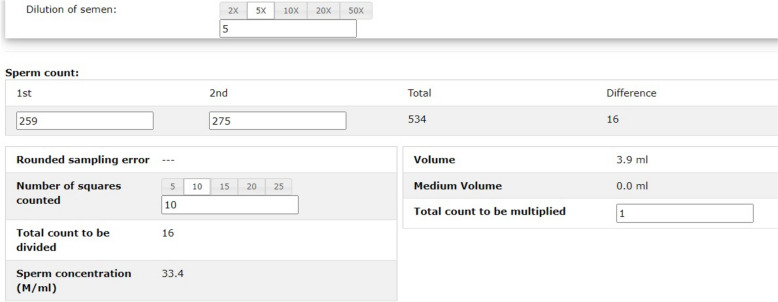
Manual counting for semen analysis is recommended by the World Health Organization. Technicians performing this usually record their results on a paper worksheet and then enter the data into an electronic laboratory information system. One disadvantage of this approach is the chance of post-analytical transcription errors, which can be reduced by checking the computer entries before reporting by another technician. Such practice inevitably increases the running cost and delays the reporting time. The present study was to establish a paperless electronic data entry system for semen analysis and compare its precision with the conventional paper method. During semen analysis, readings on the cell counter were video recorded. The precision of the paper record entries was determined by comparing them with the corresponding video records. Patient characteristics and semen analysis results were input directly into an in-house developed data entry system via a tablet computer immediately after analysis. The same set of data was also handwritten on a paper form and was subsequently input into a standard computerized database according to routine practice. The agreement of the data entries between the two systems was then compared.
A total of 787 semen analyses were included in the study, involving 201 samples in Phase I and 586 samples in Phase II of the study. Phase I was the initial learning period. The overall rate of transcription error of the paper form was 0.07%, whereas that of the paperless system was 0.17%. In phase II, the paperless system was modified according to users' comments. The transcription error rate of the paper form was 0.05%, while that of the paperless system was substantially reduced to 0.01% (p = 0.008).
The paperless system is a reliable tool for recording data from semen analysis compared with the conventional paper form. However, training is needed to reduce the error rate of the paperless system.
世界卫生组织推荐采用人工计数法进行精液分析。执行此项操作的技术人员通常会将结果记录在纸质工作表上,然后将数据录入电子实验室信息系统。这种方法的一个缺点是存在分析后转录错误的可能性,而在报告前由另一名技术人员检查计算机录入内容可减少此类错误。这种做法不可避免地会增加运营成本并延迟报告时间。本研究旨在建立一种用于精液分析的无纸化电子数据录入系统,并将其精度与传统纸质方法进行比较。在精液分析过程中,对细胞计数器上的读数进行视频记录。通过将纸质记录条目与相应的视频记录进行比较来确定纸质记录条目的精度。分析完成后,患者特征和精液分析结果立即通过平板电脑直接输入到内部开发的数据录入系统中。同一组数据也手写在纸质表格上,随后按照常规做法输入到标准计算机化数据库中。然后比较两个系统之间数据录入的一致性。
本研究共纳入787例精液分析,其中研究第一阶段有201个样本,第二阶段有586个样本。第一阶段是初始学习期。纸质表格的总体转录错误率为0.07%,而无纸化系统的转录错误率为0.17%。在第二阶段,根据用户意见对无纸化系统进行了修改。纸质表格的转录错误率为0.05%,而无纸化系统的转录错误率大幅降至0.01%(p = 0.008)。
与传统纸质表格相比,无纸化系统是记录精液分析数据的可靠工具。然而,需要进行培训以降低无纸化系统的错误率。