Hao Mengwei, Wang Xuxia, Wei Tao, Sheng Chao
Department of Neurology, Xuzhou Central Hospital, 221000 Xuzhou, Jiangsu, China.
Department of Rehabilitation Medicine, Xuzhou Central Hospital, 221000 Xuzhou, Jiangsu, China.
Actas Esp Psiquiatr. 2025 Jan;53(1):110-118. doi: 10.62641/aep.v53i1.1676.
Acute ischemic stroke (AIS) is a prevalent and challenging neurological condition associated with high mortality and morbidity rates. This study aimed to evaluate the therapeutic efficacy of repetitive transcranial magnetic stimulation (rTMS) combined with ginkgo diterpene lactone meglumine injection (GDLMI) on cognitive and neurological function recovery in patients with AIS.
A total of 120 patients with AIS, admitted between January 2021 and January 2022, received rTMS combined with GDLMI after admission. Their cognitive and neurological functions were assessed using the Chinese version of the Montreal Cognitive Assessment (MoCA) and the National Institute of Health Stroke Scale (NIHSS) respectively before and after treatment. Additionally, serum levels of lipoprotein-associated phospholipase A2 (Lp-PLA2) and ischemia-modified albumin (IMA) were quantified. Statistical analyses were performed to elucidate potential correlations between Lp-PLA2 and IMA levels and clinical outcomes.
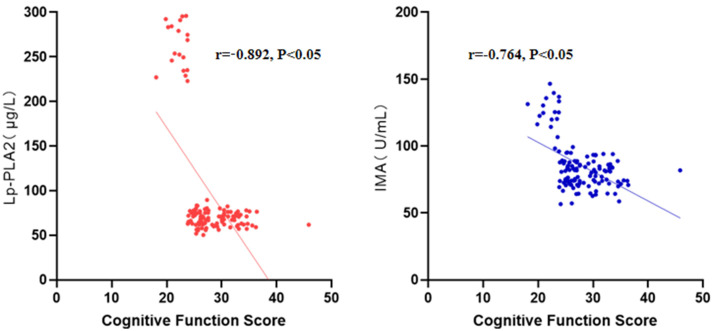
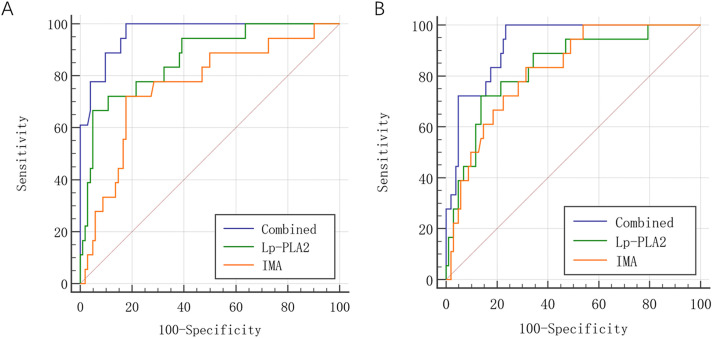
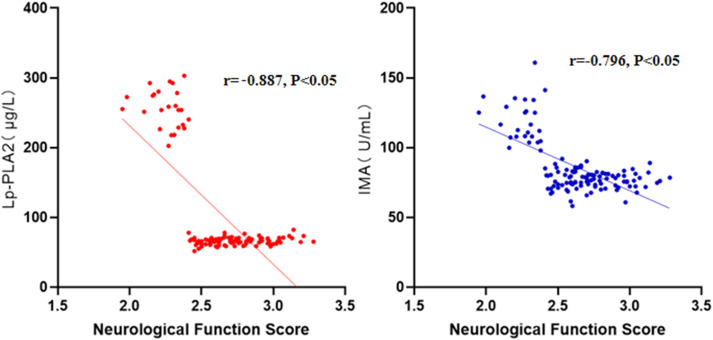
After treatment, patients with AIS exhibited significantly improved cognitive and neurological functions, increased MoCA score and decreased NIHSS score compared to those before treatment (p < 0.05). A linear correlation was observed between Lp-PLA2 and IMA levels and the recovery of cognitive function in AIS patients (r = -0.892/-0.764, p < 0.05). Before and after factor adjustment, Lp-PLA2 and IMA were identified as independent influencing factors for the efficiency in cognitive function recovery (p < 0.05). Similarly, Lp-PLA2 and IMA levels were linearly correlated with the recovery of neurological function in AIS patients (r = -0.887/-0.796, p < 0.05). Lp-PLA2 combined with IMA performed better than Lp-PLA2 or IMA alone in predicting the efficiency of rTMS plus GDLMI in promoting the cognitive and neurological function recovery (p < 0.05).
rTMS combined with GDLMI can contribute to the cognitive and neurological function recovery in patients with AIS. Serum levels of Lp-PLA2 and IMA could serve as independent influencing factors for the efficiency in promoting cognitive and neurological function recovery.
急性缺血性卒中(AIS)是一种常见且具有挑战性的神经系统疾病,死亡率和发病率都很高。本研究旨在评估重复经颅磁刺激(rTMS)联合银杏二萜内酯葡胺注射液(GDLMI)对AIS患者认知和神经功能恢复的治疗效果。
选取2021年1月至2022年1月期间收治的120例AIS患者,入院后接受rTMS联合GDLMI治疗。分别在治疗前后使用中文版蒙特利尔认知评估量表(MoCA)和美国国立卫生研究院卒中量表(NIHSS)评估他们的认知和神经功能。此外,还对血清脂蛋白相关磷脂酶A2(Lp-PLA2)和缺血修饰白蛋白(IMA)水平进行了定量分析。进行统计分析以阐明Lp-PLA2和IMA水平与临床结局之间的潜在相关性。
治疗后,AIS患者的认知和神经功能显著改善,与治疗前相比,MoCA评分升高,NIHSS评分降低(p < 0.05)。观察到AIS患者的Lp-PLA2和IMA水平与认知功能恢复之间存在线性相关性(r = -0.892/-0.764,p < 0.05)。在因素调整前后,Lp-PLA2和IMA被确定为认知功能恢复效率的独立影响因素(p < 0.05)。同样,Lp-PLA2和IMA水平与AIS患者的神经功能恢复呈线性相关(r = -0.887/-0.796,p < 0.05)。在预测rTMS加GDLMI促进认知和神经功能恢复的效率方面,Lp-PLA2与IMA联合使用比单独使用Lp-PLA2或IMA表现更好(p < 0.05)。
rTMS联合GDLMI有助于AIS患者的认知和神经功能恢复。血清Lp-PLA2和IMA水平可作为促进认知和神经功能恢复效率的独立影响因素。