Department of Emergency Medicine, Affiliated Kunshan Hospital of Jiangsu University, Kunshan, P.R. China.
Department of Neurosurgery, Suzhou Kowloon Hospital, Shanghai Jiaotong University School of Medicine, Suzhou, P.R. China.
J Clin Lab Anal. 2021 May;35(5):e23756. doi: 10.1002/jcla.23756. Epub 2021 Mar 18.
There is still a lack of tools to assess the prognosis of ischemic stroke patients induced by hypertension. In this study, we built a novel prognostic assessment model for ischemic stroke in the Chinese hypertensive population.
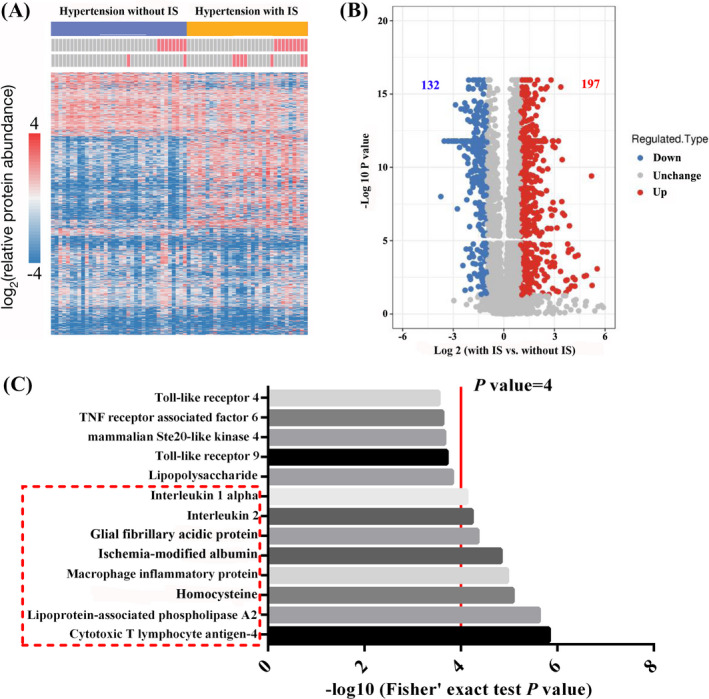
Mass spectrometry technique was used to analyze the changes in serum protein profiles of hypertensive patients with ischemic stroke. A total of 314 hypertensive patients were divided into the testing group (206 patients) and the validation group (108 patients).
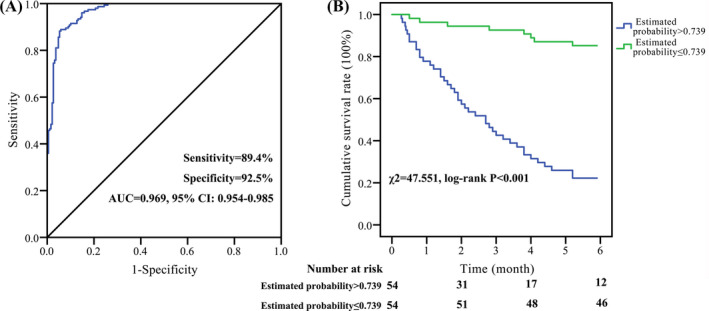
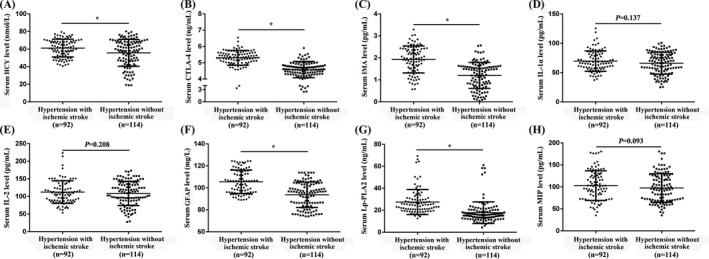
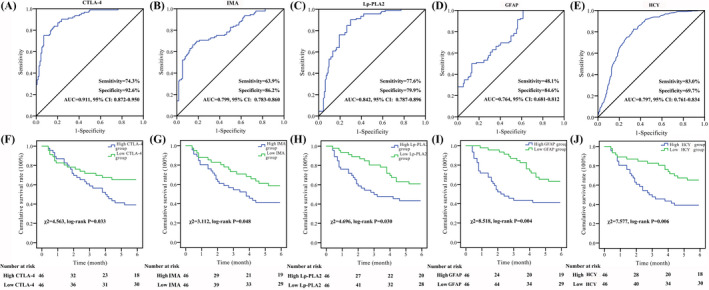
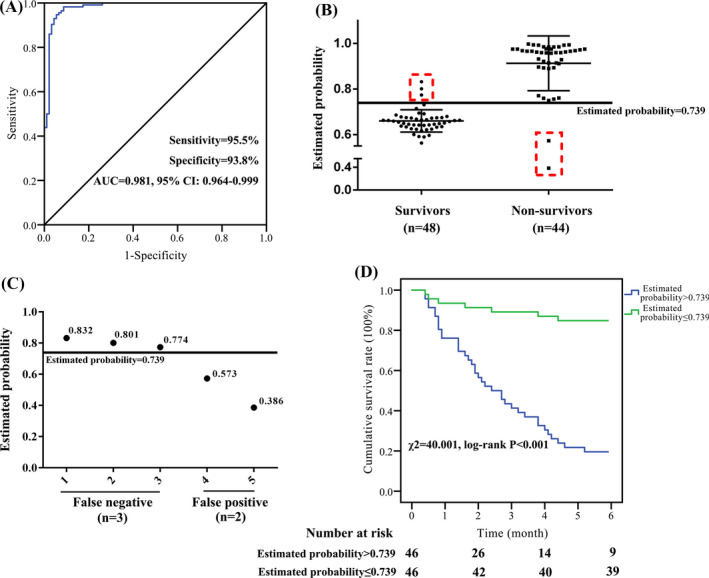
Compared with hypertensive patients without ischemic stroke, serum cytotoxic T lymphocyte-associated antigen-4 (CTLA-4), ischemia-modified albumin (IMA), lipoprotein-associated phospholipase A2 (Lp-PLA2), glial fibrillary acidic protein (GFAP), and homocysteine (HCY) levels were significantly increased among hypertensive patients with ischemic stroke (p < 0.05). Then, we built a novel prognostic assessment model for hypertensive patients with ischemic stroke [Logit(P) = 29.172-1.088*CTLA-4-0.952*IMA-0.537*Lp-PLA2 -0.066*GFAP -0.149*HCY]. It showed higher efficiency (AUC = 0.981, sensitivity = 95.5%, specificity = 93.8%) than any single marker. The estimated probability was 0.739, which means if higher than 0.739, it was classified into poor prognosis. Compared with the estimated probability ≤0.739 group, the survival rate of hypertensive patients with ischemic stroke in the estimated probability >0.739 group was significantly decreased (χ = 40.001, p < 0.001). In the validation group, our novel prognostic assessment model still showed good efficiency (AUC = 0.969, sensitivity = 89.4%, specificity = 92.5%; χ = 47.551, p < 0.001).
Current novel prognostic assessment model we have built is of great value in the prognostic evaluation for ischemic stroke in the Chinese hypertensive population.
目前仍缺乏评估高血压引起的缺血性脑卒中患者预后的工具。本研究旨在建立适合中国高血压人群的缺血性脑卒中预后评估模型。
采用质谱技术分析高血压合并缺血性脑卒中患者血清蛋白谱的变化,共纳入 314 例高血压患者,分为检测组(206 例)和验证组(108 例)。
与无缺血性脑卒中的高血压患者相比,高血压合并缺血性脑卒中患者的血清细胞毒性 T 淋巴细胞相关抗原 4(CTLA-4)、缺血修饰白蛋白(IMA)、脂蛋白相关磷脂酶 A2(Lp-PLA2)、胶质纤维酸性蛋白(GFAP)和同型半胱氨酸(HCY)水平显著升高(P<0.05)。在此基础上建立了适合中国高血压人群的缺血性脑卒中预后评估模型[Logit(P)=29.172-1.088*CTLA-4-0.952*IMA-0.537*Lp-PLA2-0.066*GFAP-0.149*HCY],该模型的效能(AUC=0.981,灵敏度=95.5%,特异性=93.8%)明显高于各单项指标。当预测概率为 0.739 时,该模型对预后不良的预测效能最高,敏感度为 95.5%,特异度为 93.8%。预测概率>0.739 时,高血压合并缺血性脑卒中患者的 1 年生存率明显低于预测概率≤0.739 组(χ ²=40.001,P<0.001)。在验证组中,该模型仍具有良好的预测效能(AUC=0.969,灵敏度=89.4%,特异性=92.5%;χ ²=47.551,P<0.001)。
本研究建立的新型预后评估模型对中国高血压人群的缺血性脑卒中预后评估具有重要价值。