Ouyang Yifei, Wang Huijun, He Yuna, Su Chang, Zhang Jiguo, Du Wenwen, Jia Xiaofang, Huang Feifei, Li Li, Bai Jiang, Zhang Xiaofan, Guan Fangxu, Zhang Bing, Ding Gangqiang, Wang Zhihong
Key Laboratory of Public Nutrition and Health, National Health Commission of the People's Republic of China; National Institute for Nutrition and Health, Chinese Center for Disease Control and Prevention, Beijing, China.
China CDC Wkly. 2025 Jan 3;7(1):6-9. doi: 10.46234/ccdcw2025.002.
WHAT IS ALREADY KNOWN ABOUT THIS TOPIC?: The prevalence of insufficient physical activity (PA) among Chinese adults has shown an upward trend, reaching 22.3% in 2018. Leisure time PA (LTPA) constitutes a minimal proportion of total physical activity patterns.
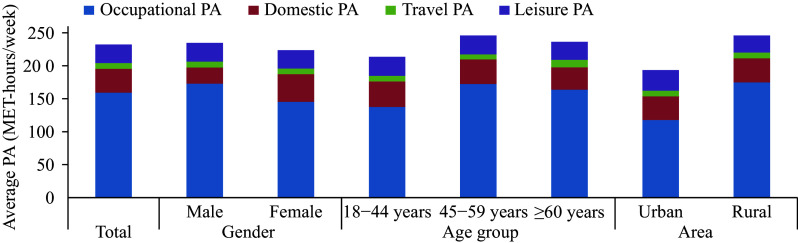
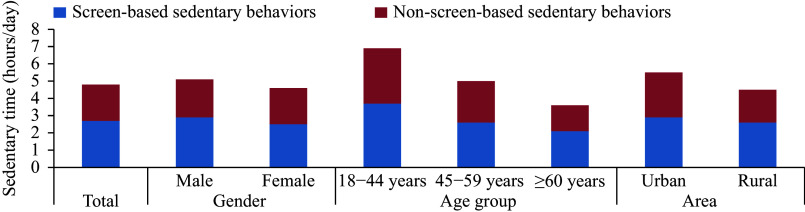
WHAT IS ADDED BY THIS REPORT?: The adherence rate to Physical activity guidelines (PAGs) was 85.7%. While occupational PA remained the predominant form of physical activity, its proportion has decreased. LTPA has emerged from its historically lowest position among activity types. Screen-based activities now constitute the primary form of sedentary behavior.
WHAT ARE THE IMPLICATIONS FOR PUBLIC HEALTH PRACTICE?: Strategic interventions are needed to promote LTPA by addressing urban-rural disparities in sports facility access and increasing public venue availability. Additionally, targeted initiatives are required to reduce sedentary time, particularly among young people and urban residents, while maintaining engagement in LTPA.
关于该主题已知的信息有哪些?:中国成年人身体活动不足的患病率呈上升趋势,2018年达到22.3%。休闲时间身体活动在总体身体活动模式中所占比例极小。
本报告新增了哪些内容?:身体活动指南的依从率为85.7%。虽然职业性身体活动仍然是身体活动的主要形式,但其比例有所下降。休闲时间身体活动在各类活动中已从历史最低水平有所回升。以屏幕为基础的活动现在构成了久坐行为的主要形式。
对公共卫生实践有何启示?:需要采取战略干预措施,通过解决城乡体育设施获取方面的差距并增加公共场所的可用性来促进休闲时间身体活动。此外,还需要有针对性的举措来减少久坐时间,特别是在年轻人和城市居民中,同时保持对休闲时间身体活动的参与度。