Gandy Chandler, Bazzazzadehgan Shadi, Bruera Sebastian, Huang Yinan
Department of Pharmacy Administration, University of Mississippi School of Pharmacy, University, MS, 38677 USA.
Section of Immunology, Allergy & Rheumatology, Baylor College of Medicine, Houston, TX, USA.
Drug Healthc Patient Saf. 2025 Jan 7;17:25-49. doi: 10.2147/DHPS.S492887. eCollection 2025.
This review summarized the real-world effectiveness outcomes of Janus kinase inhibitors (JAKi) for rheumatoid arthritis (RA) based on observational studies.
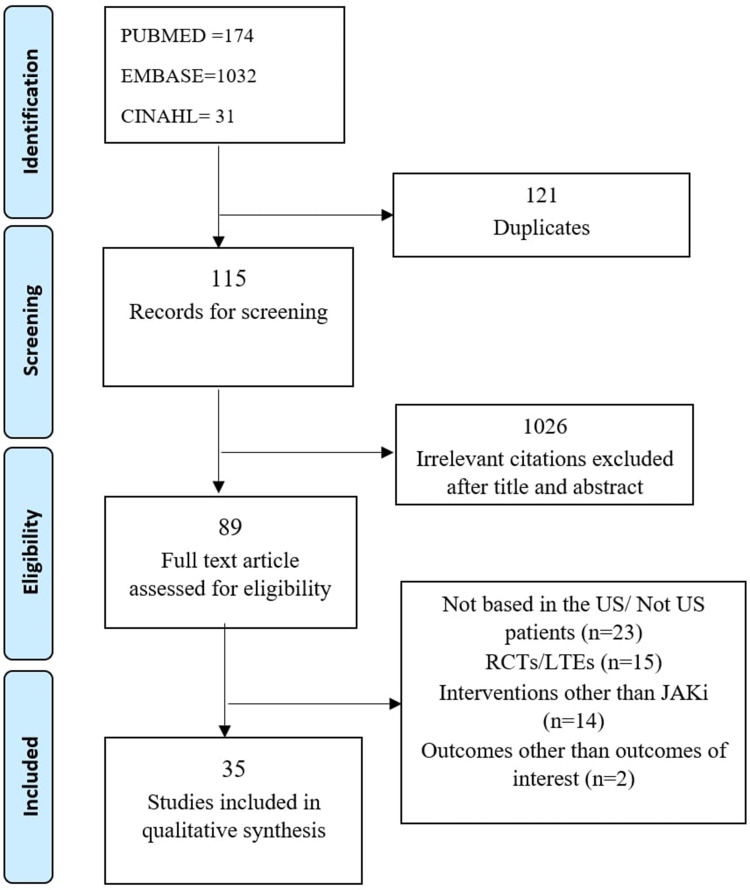
A systematic review followed PRISMA guidelines, with searches conducted in PubMed, Embase, and CINAHL from each database's inception to June 2, 2023. Studies were included if they evaluated real-world effectiveness outcomes of JAKi for US RA patients. Search terms included "RA", "JAKi", and "real-world". All citations were imported into COVIDENCE platform. Two reviewers independently performed title/abstract screening and full-text eligibility. For each article, study characteristics and effectiveness measures focusing on treatment pattern, clinical response, and patient-reported outcomes (PROs) of JAKi were extracted. Newcastle-Ottawa Scale (NOS) was utilized to assess the quality of the included articles.
In total, 35 studies representing 252-30,556 patients were included. A majority used the administrative claims datasets (n=23, 65.71%), followed by 9 studies using electronic medical record (EMR) data and 3 studies using patient registry databases. Across claims-based studies, adherence, persistence, and effectiveness of JAKi were common outcomes. Adherence rates varied, with a proportion of days covered (PDC) ranging from 0.53 to 0.83 across 11 studies. Persistence of JAKi in RA patients was reported in 14 studies, where the median persistence time in treatment was reported to be between 121-516 days. Six studies applied effectiveness algorithms, with 14.8-26% of patients meeting effective treatment criteria. In addition, the most common measure of clinical response throughout the studies was Clinical Disease Activity Index (CDAI), with 10 articles reporting mean CDAI changes between -4.7 and 5.1. Across 12 studies that measured the PROs, the most prevalent PRO was pain, with the mean change in pain ranging from -9.3 to 8.9 across these studies.
Real-world studies on JAKi for RA reflect a range of effectiveness measures, illustrating the expanding role of JAKi in clinical practice.
本综述基于观察性研究总结了Janus激酶抑制剂(JAKi)治疗类风湿关节炎(RA)的真实世界有效性结果。
按照PRISMA指南进行系统综述,在PubMed、Embase和CINAHL数据库中从各数据库建库至2023年6月2日进行检索。纳入评估JAKi对美国RA患者真实世界有效性结果的研究。检索词包括“RA”“JAKi”和“真实世界”。所有文献导入COVIDENCE平台。两名评审员独立进行标题/摘要筛选和全文合格性评估。针对每篇文章,提取研究特征以及聚焦于JAKi治疗模式、临床反应和患者报告结局(PROs)的有效性指标。采用纽卡斯尔-渥太华量表(NOS)评估纳入文章的质量。
共纳入35项研究,涉及252 - 30556例患者。大多数研究使用行政索赔数据集(n = 23,65.71%),其次是9项使用电子病历(EMR)数据的研究和3项使用患者登记数据库的研究。在基于索赔的研究中,JAKi的依从性、持续性和有效性是常见结局。依从率各不相同,11项研究中覆盖天数比例(PDC)范围为0.53至0.83。14项研究报告了RA患者中JAKi的持续性,其中治疗的中位持续时间报告为121 - 516天。6项研究应用了有效性算法,14.8% - 26%的患者符合有效治疗标准。此外,整个研究中最常见的临床反应指标是临床疾病活动指数(CDAI),10篇文章报告CDAI平均变化在 - 4.7至5.1之间。在12项测量PROs的研究中,最普遍的PRO是疼痛,这些研究中疼痛的平均变化范围为 - 9.3至8.9。
关于JAKi治疗RA的真实世界研究反映了一系列有效性指标,说明了JAKi在临床实践中日益扩大的作用。