Wang Yanan, Ma Xutao, Wang Xinyuan, Liu Liru, Zhang Xue, Wang Qiuyue, Zhu Yingfei, Xu Huanhua, Yu Liangmin, He Zhiyu
Frontiers Science Center for Deep Ocean Multispheres and Earth Systems, Key Laboratory of Marine Chemistry Theory and Technology, Ministry of Education/Sanya Oceanographic Institution, Ocean University of China, Qingdao/Sanya, 266003/572024, China.
Sanya Oceanographic Laboratory, Sanya, 572024, China.
Adv Sci (Weinh). 2025 Mar;12(9):e2410889. doi: 10.1002/advs.202410889. Epub 2025 Jan 13.
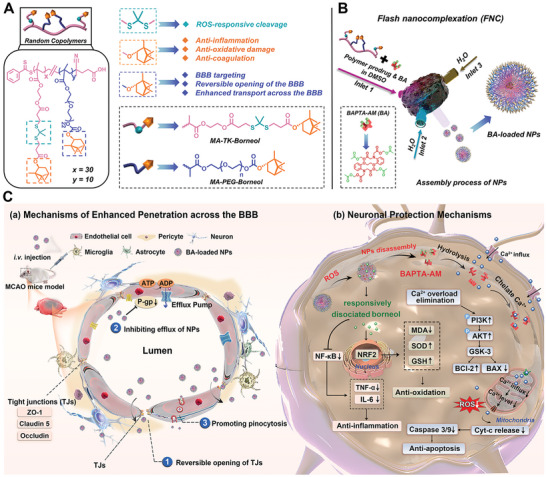
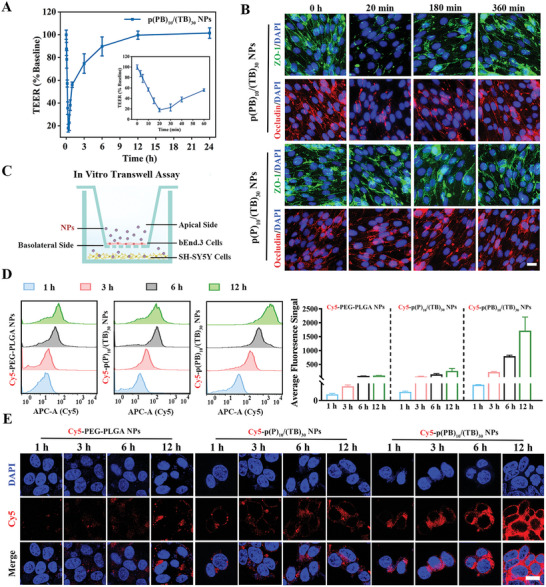
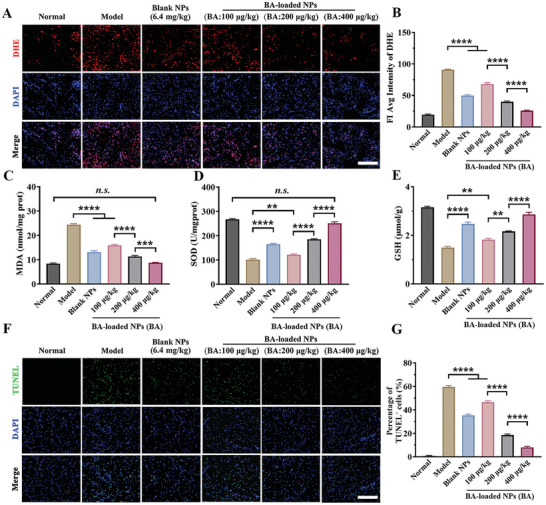
The scarcity of effective neuroprotective agents and the presence of blood-brain barrier (BBB)-mediated extremely inefficient intracerebral drug delivery are predominant obstacles to the treatment of cerebral ischemic stroke (CIS). Herein, ROS-responsive borneol-based amphiphilic polymeric NPs are constructed by using traditional Chinese medicine borneol as functional blocks that served as surface brain-targeting ligand, inner hydrophobic core for efficient drug loading of membrane-permeable calcium chelator BAPTA-AM, and neuroprotective structural component. In MCAO mice, the nanoformulation (polymer: 3.2 mg·kg, BAPTA-AM: 400 µg·kg) reversibly opened the BBB and achieved high brain biodistribution up to 12.7%ID/g of the total administered dose after 3 h post single injection, effectively restoring intracellular Ca and redox homeostasis, improving cerebral histopathology, and inhibiting mitochondrial PI3K/Akt/Bcl-2/Bax/Cyto-C/Caspase-3,9 apoptosis pathway for rescuing dying neurons (reduced apoptosis cell from 59.5% to 7.9%). It also remodeled the inflammatory microenvironment in cerebral ischemic penumbra by inhibiting astrocyte over-activation, reprogramming microglia polarization toward an anti-inflammatory phenotype, and blocking NF-κB/TNF-α/IL-6 signaling pathways. These interventions eventually reduced the cerebral infarction area by 96.3%, significantly improved neurological function, and restored blood flow reperfusion from 66.2% to ≈100%, all while facilitating BBB repair and avoiding brain edema. This provides a potentially effective multiple-stage sequential treatment strategy for clinical CIS.
有效的神经保护剂的稀缺以及血脑屏障(BBB)介导的脑内药物递送效率极低是治疗脑缺血性中风(CIS)的主要障碍。在此,以活性氧(ROS)响应的冰片基两亲聚合物纳米粒通过使用传统中药冰片作为功能块构建而成,冰片作为表面脑靶向配体、用于高效负载膜通透性钙螯合剂BAPTA-AM的内部疏水核心以及神经保护结构成分。在大脑中动脉闭塞(MCAO)小鼠中,该纳米制剂(聚合物:3.2mg·kg,BAPTA-AM:400μg·kg)可逆地打开血脑屏障,单次注射后3小时达到高达总给药剂量12.7%ID/g的高脑生物分布,有效恢复细胞内钙和氧化还原稳态,改善脑组织病理学,并抑制线粒体PI3K/Akt/Bcl-2/Bax/Cyto-C/Caspase-3、9凋亡途径以拯救濒死神经元(凋亡细胞从59.5%减少到7.9%)。它还通过抑制星形胶质细胞过度激活、将小胶质细胞极化重编程为抗炎表型以及阻断NF-κB/TNF-α/IL-6信号通路来重塑脑缺血半暗带中的炎症微环境。这些干预最终使脑梗死面积减少了96.3%,显著改善了神经功能,并将血流再灌注从66.2%恢复到≈100%,同时促进血脑屏障修复并避免脑水肿。这为临床CIS提供了一种潜在有效的多阶段序贯治疗策略。