Gupta Sanjay Kumar, Gupta Akruti, Choudhary Jaipal Singh, Foysal Md Javed, Gupta Rajan, Sarkar Biplab, Krishnani K K
ICAR-Indian Institute of Agricultural Biotechnology, Namkum, Ranchi, 834010, India.
School of Molecular Diagnostics, Prophylactics and Nanobiotechnology (SMDPN), ICAR-Indian Institute of Agricultural Biotechnology, Garhkhatanga, Ranchi, 834003, India.
Sci Rep. 2025 Jan 13;15(1):1866. doi: 10.1038/s41598-024-83102-2.
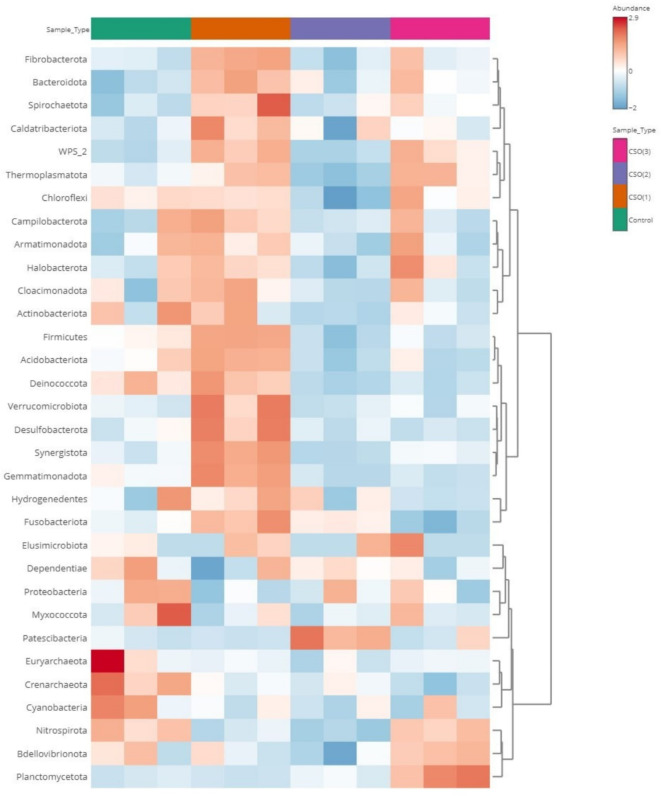
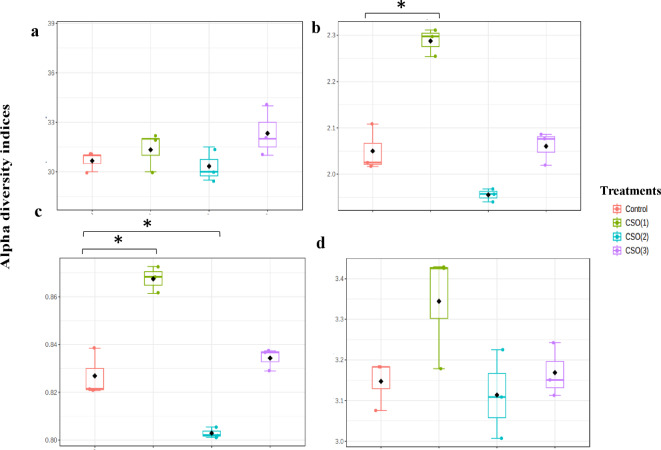
The present study investigates the supplemental effects of chia seed oil (CSO) on the growth performance and modulation of intestinal microbiota in Labeo rohita fingerlings. Four diets were formulated with graded levels of CSO: 1.0%, 2.0%, and 3.0% represented as CSO (1), CSO (2), and, CSO (3) groups alongside a control group without CSO. L. rohita fingerlings (n = 180) (mean weight = 19.74 ± 0.33 g) were randomly distributed in triplicates for 60 days to these treatment groups. The results depicted significant improvements (p < 0.05) in weight gain (WG) %, specific growth rate (SGR), feed conversion ratio (FCR), and feed conversion efficiency (FCE) in the group supplemented with the lowest level of CSO. Gut microbial analysis evidenced the ability of CSO at 1.0% to augment the relative abundance of bacterial phyla such as Verrucomicrobiota, Actinobacteria, Bacteroidota, Fusobacteria and Firmicutes, as well as genera Luteolibacter and Cetobacterium, indicating higher alpha diversity compared to the control. Principle coordinate analysis (PCoA) demonstrated a distinct composition of microbial communities in CSO-supplemented groups relative to the control (p < 0.001). Correlation analysis further revealed a significant (p < 0.05) association of specific microbial taxa with growth performance parameters. The predictions of metabolic pathways suggested the involvement of carbohydrate and amino acid metabolic pathways in the CSO (1) group, indicating improved nutrient transport and metabolism. Overall, the findings highlight the beneficial effects of 1.0% CSO supplementation on growth performance and modulation of gut microbiota in L. rohita fingerlings.
本研究调查了奇亚籽油(CSO)对露斯塔野鲮幼鱼生长性能和肠道微生物群调节的补充作用。用不同水平的CSO配制了四种饲料:1.0%、2.0%和3.0%,分别表示为CSO(1)组、CSO(2)组和CSO(3)组,同时设置一个不含CSO的对照组。将180尾露斯塔野鲮幼鱼(平均体重=19.74±0.33克)随机分成三组,每组进行60天的试验。结果表明,在添加最低水平CSO的组中,增重率(WG)%、特定生长率(SGR)、饲料转化率(FCR)和饲料转化效率(FCE)有显著提高(p<0.05)。肠道微生物分析证明,1.0%的CSO能够增加疣微菌门、放线菌门、拟杆菌门、梭杆菌门和厚壁菌门等细菌门以及黄杆菌属和鲸杆菌属的相对丰度,表明与对照组相比具有更高的α多样性。主坐标分析(PCoA)表明,与对照组相比,添加CSO的组中微生物群落组成明显不同(p<0.001)。相关性分析进一步揭示了特定微生物分类群与生长性能参数之间存在显著(p<0.05)关联。代谢途径预测表明,CSO(1)组涉及碳水化合物和氨基酸代谢途径,表明营养物质运输和代谢得到改善。总体而言,研究结果突出了添加1.0%CSO对露斯塔野鲮幼鱼生长性能和肠道微生物群调节的有益作用。