Park Hee Sun, Lee Jungkuk, Kim Hasung, Woo Seong-Dae
Department of Pulmonary, Allergy, and Critical Care Medicine, Chungnam National University School of Medicine, Daejeon, South Korea.
Data Science Team, Hanmi Pharm. Co., Ltd, Seoul, South Korea.
Respir Res. 2025 Jan 13;26(1):12. doi: 10.1186/s12931-024-03084-7.
Choosing effective devices (inhaled corticosteroid [ICS]-long-acting β2 agonist [LABA] combination inhalers) as maintenance treatment is critical for managing patients with asthma. We aimed to compare ICS/LABA combination efficacy, safety, and adherence across inhaler types and components in patients newly diagnosed with asthma.
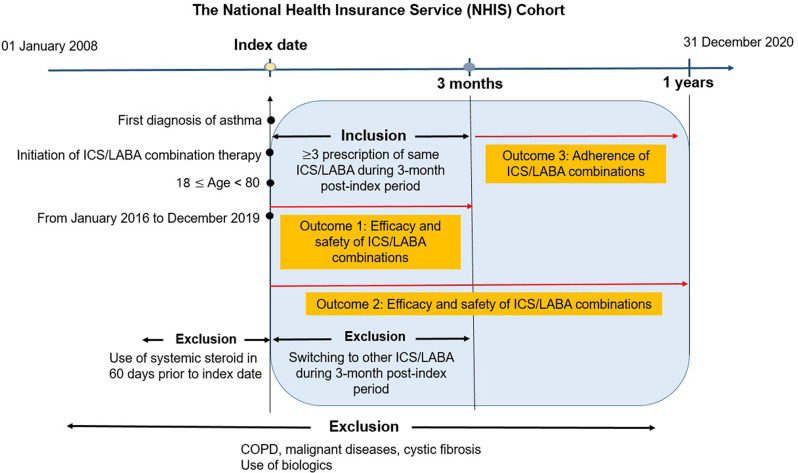
Utilizing South Korea's National Health Insurance Service data, we conducted a population-based cohort study involving patients aged 18-80 years, newly diagnosed with asthma who received ICS/LABA combination therapy between January 2016 and December 2020. Outcomes assessed included treatment adherence, asthma exacerbations, hospitalizations, emergency-department visits, mortality, and safety outcomes within 3-month and 1-year post-index periods.
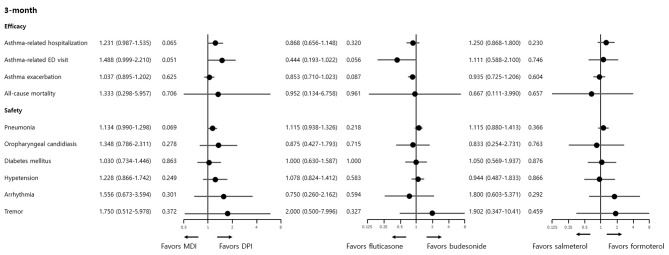
Overall, 13,850 eligible patients were included, with subgroups categorized and compared according to inhaler type and component (metered dose inhalers [MDIs] vs. dry powder inhalers [DPIs], budesonide vs. fluticasone, and formoterol vs. salmeterol). Efficacy and safety profiles did not significantly differ across device types or ICS/LABA combination components during the 3-month and 1-year follow-up periods. However, the DPI group exhibited a significantly higher mean proportion of days covered (0.67 ± 0.23 vs. 0.62 ± 0.23; P < 0.001) and a lower risk of discontinuation (adjusted hazard ratio, 0.867; 95% confidence interval, 0.804-0.927; P < 0.001) than did the MDI group, with no significant differences observed between the other subgroups.
The choice of inhaler device (MDI vs. DPI) and specific ICS/LABA combination components does not significantly impact efficacy and safety profiles in patients newly diagnosed with asthma. However, DPI use may be associated with improved adherence. These results provide valuable insights for clinicians in selecting appropriate and individually tailored inhaler therapies in real-world settings.
选择有效的装置(吸入性糖皮质激素[ICS]-长效β2受体激动剂[LABA]联合吸入器)作为维持治疗对于哮喘患者的管理至关重要。我们旨在比较新诊断哮喘患者中不同吸入器类型和成分的ICS/LABA联合治疗的疗效、安全性和依从性。
利用韩国国民健康保险服务数据,我们进行了一项基于人群的队列研究,纳入年龄在18至80岁之间、2016年1月至2020年12月期间新诊断为哮喘并接受ICS/LABA联合治疗的患者。评估的结局包括治疗依从性、哮喘急性加重、住院、急诊就诊、死亡率以及索引期后3个月和1年内的安全性结局。
总体而言,纳入了13850例符合条件的患者,并根据吸入器类型和成分(定量吸入器[MDI]与干粉吸入器[DPI]、布地奈德与氟替卡松、福莫特罗与沙美特罗)进行亚组分类和比较。在3个月和1年的随访期内,不同装置类型或ICS/LABA联合成分的疗效和安全性概况无显著差异。然而,DPI组的平均覆盖天数比例显著更高(0.67±0.23对0.62±0.23;P<0.001),停药风险更低(调整后的风险比,0.867;95%置信区间,0.804-0.927;P<0.001),其他亚组之间未观察到显著差异。
吸入器装置(MDI与DPI)和特定的ICS/LABA联合成分的选择对新诊断哮喘患者的疗效和安全性概况没有显著影响。然而,使用DPI可能与依从性改善有关。这些结果为临床医生在现实环境中选择合适的个体化吸入器治疗提供了有价值的见解。