Ramyarangsi Papatsorn, Bennett Simon J, Siripornpanich Vorasith, Nanbancha Ampika, Pokaisasawan Akachai, Noppongsakit Prapan, Ajjimaporn Amornpan
College of Sports Science and Technology, Mahidol University, Salaya, Nakhonpathom, THAILAND.
Research Institute for Sport and Exercise Sciences, Faculty of Science, Liverpool John Moores University, Liverpool, UNITED KINGDOM.
Int J Exerc Sci. 2024 Dec 1;17(5):1595-1604. doi: 10.70252/INCC1951. eCollection 2024.
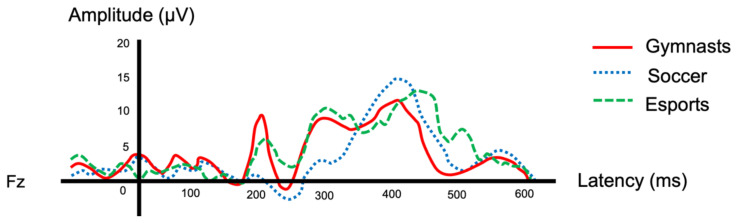
Visual processing is crucial for sports performance, influencing athletes' ability to interpret and respond to visual stimuli. This study investigated distinct visual processing patterns among Thai elite athletes in gymnastics, soccer, and esports, utilizing visual P300 event-related potentials (P300 ERPs). Forty-two female athletes (14 gymnasts, 14 soccer players, and 14 esports athletes) participated. Visual P300 ERP responses were stimulated using the visual oddball paradigm. One-way ANOVA was employed to assess significant differences among the groups in P300 ERPs data, including amplitude and latency of waveforms, response time, and accuracy rate. Significant differences were found across the groups in various parameters. Esports athletes exhibited longer P300 ERP latencies at the frontal electrode sites compared to gymnasts ( = 0.01), suggesting slower visual processing in the frontal brain regions. Gymnasts demonstrated the fastest response times, significantly quicker than esports and soccer players ( 0.01). In contrast, soccer players exhibited the highest accuracy rate ( 0.03). These findings underscore athletes' diverse visual processing strategies in different sports contexts, reflecting sport-specific adaptations. Understanding these distinct visual processing patterns can guide targeted interventions aimed at improving cognitive abilities and decision-making processes among elite athletes, ultimately contributing to better overall performance.
视觉处理对运动表现至关重要,影响运动员解释和应对视觉刺激的能力。本研究利用视觉P300事件相关电位(P300 ERPs),调查了泰国体操、足球和电子竞技项目的精英运动员之间不同的视觉处理模式。42名女性运动员(14名体操运动员、14名足球运动员和14名电子竞技运动员)参与了研究。使用视觉oddball范式刺激视觉P300 ERP反应。采用单因素方差分析评估P300 ERPs数据中各组之间的显著差异,包括波形的幅度和潜伏期、反应时间和准确率。在各个参数上,各组之间均发现了显著差异。与体操运动员相比,电子竞技运动员在额电极部位的P300 ERP潜伏期更长( = 0.01),这表明额叶脑区的视觉处理较慢。体操运动员的反应时间最快,显著快于电子竞技运动员和足球运动员( 0.01)。相比之下,足球运动员的准确率最高( 0.03)。这些发现强调了运动员在不同运动情境中多样的视觉处理策略,反映了特定运动的适应性。了解这些不同的视觉处理模式可以指导有针对性的干预措施,旨在提高精英运动员的认知能力和决策过程,最终有助于提高整体表现。