López Estrada Daniel, Chang Wen-Te, Heinrich Michael
Department of Chinese Pharmaceutical Sciences and Chinese Medicine Resources, College of Chinese Medicine, China Medical University, Taichung, 40402, Taiwan.
Pharmacognosy & Phytotherapy, UCL School of Pharmacy London WC1N 1AX, England, UK.
J Tradit Complement Med. 2024 Aug 5;15(1):6-14. doi: 10.1016/j.jtcme.2024.08.001. eCollection 2025 Jan.
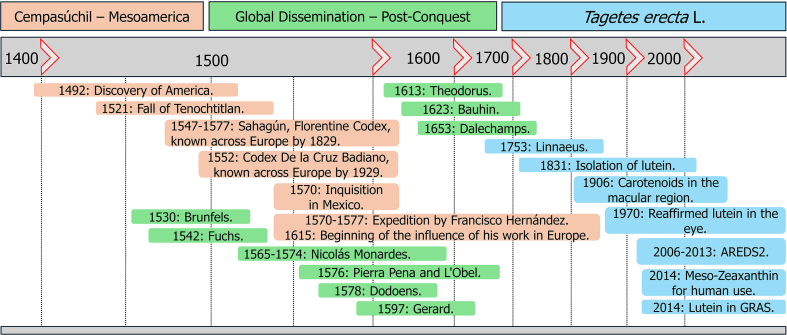
The medicinal value of herbal products is often rooted in their "traditional" use, recontextualized by modern biomedical research granting them certain medical uses. L. (Asteraceae), native to Mexico, exemplifies such historical developments of a species that played a key role in developing a major pharmacologically active compound - lutein. T. (Cempasúchil in Nahuatl) has held ritual and medicinal importance in Mesoamerica and was associated with the rain god Tláloc. The species' historical use spans ancient texts with varied medicinal applications, including treating cold-related ailments and promoting menstruation and urination. However, the Spanish conquest redefined it culturally, medicinally, and religiously, mainly as an ornamental flower. The discovery of lutein in . marked a significant shift, emphasizing its role in macular health and preventing aging-related macular degeneration. Clinically, lutein trials reveal cognitive, visual, cardiovascular, and systemic health enhancements, substantiating its potential therapeutic benefits. Pharmacologically, it demonstrates significant anti-inflammatory, antiparasitic, and anticancer properties. Today, . is recognized globally for its rich carotenoid content. This multifunctional metabolite is also used in poultry feed and health supplements. In contemporary culture, cempasúchil, also known as the "flower of the dead," has been adapted for ornamental, medicinal, ceremonial, and industrial uses. However, its traditional medicinal uses in pre-Conquest Mexico remain largely unexplored, with its current applications influenced by global research. T. erec's evolution beyond traditional medical and ritual uses in Mesoamerica demonstrates the dynamic development of a medicinal plant's role in medicine, as well as a range of other spheres of daily life.
草药产品的药用价值往往源于其“传统”用途,并通过现代生物医学研究重新诠释,赋予它们特定的医学用途。原产于墨西哥的万寿菊属(菊科)体现了一个物种的这种历史发展,该物种在开发一种主要的药理活性化合物——叶黄素方面发挥了关键作用。万寿菊(纳瓦特语称Cempasúchil)在中美洲具有仪式和药用价值,与雨神特拉洛克有关。该物种的历史用途跨越了各种古代文献,具有多种药用应用,包括治疗感冒相关疾病以及促进月经和排尿。然而,西班牙征服在文化、医学和宗教方面对其进行了重新定义,主要将其作为一种观赏花卉。在万寿菊中发现叶黄素标志着一个重大转变,强调了它在黄斑健康和预防与衰老相关的黄斑变性方面的作用。临床上,叶黄素试验显示出对认知、视觉、心血管和全身健康的改善,证实了其潜在的治疗益处。在药理学上,它表现出显著的抗炎、抗寄生虫和抗癌特性。如今,万寿菊因其丰富的类胡萝卜素含量而在全球范围内得到认可。这种多功能代谢物还用于家禽饲料和健康补充剂。在当代文化中,万寿菊,也被称为“死亡之花”,已被用于观赏、药用、仪式和工业用途。然而,它在征服前的墨西哥的传统药用用途在很大程度上仍未得到探索,其目前的应用受到全球研究的影响。万寿菊在中美洲超越传统医学和仪式用途的演变展示了一种药用植物在医学以及日常生活的一系列其他领域中作用的动态发展。