Nakanishi Syoya, Tsutsumi Masahiro, Kitagawa Takashi, Miyashita Toshinori, Wada Makoto, Kudo Shintarou
Graduate School of Health Sciences, Morinomiya University of Medical Sciences, Osaka, Japan.
Wada Orthopaedic Clinic, Osaka, Japan.
Osteoarthr Cartil Open. 2024 Dec 11;7(1):100559. doi: 10.1016/j.ocarto.2024.100559. eCollection 2025 Mar.
To investigate whether there is a difference in hardness and hemoglobin concentration changes in the infrapatellar fat pad (IFP) during isometric quadriceps exercise (IQE) in patients with knee osteoarthritis (KOA) between those with and without knee extension limitation.
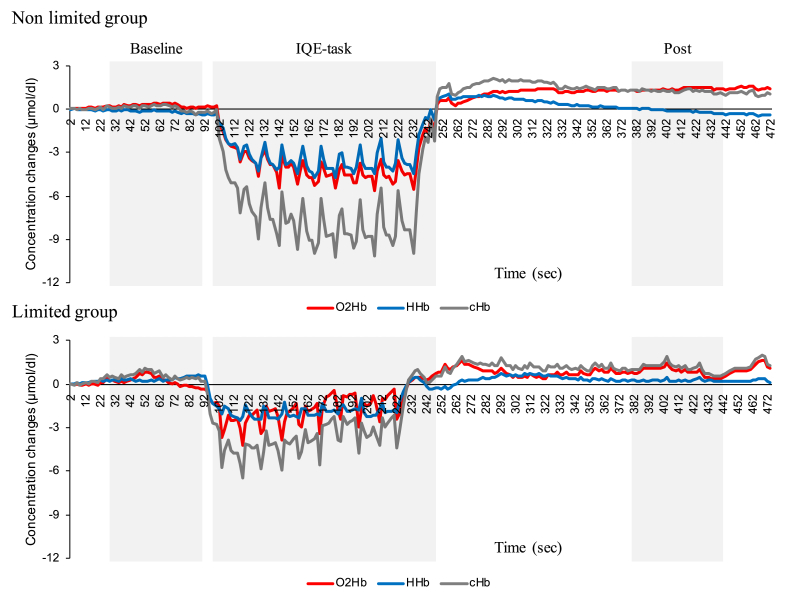
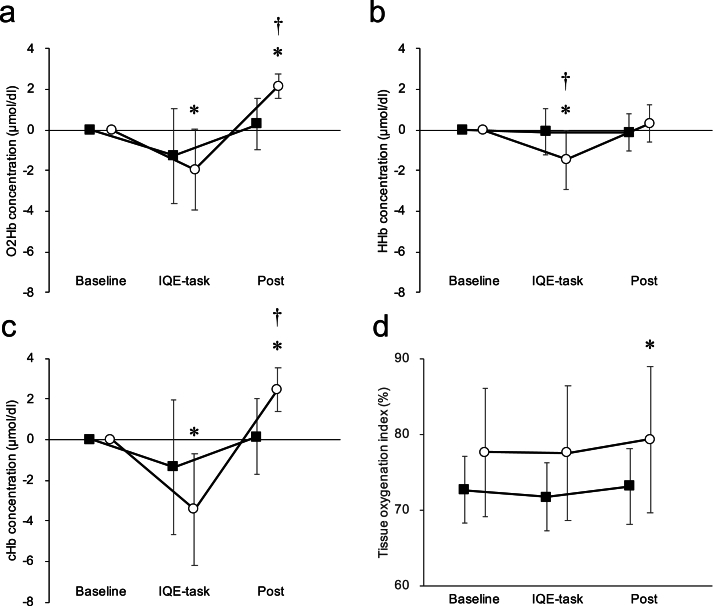
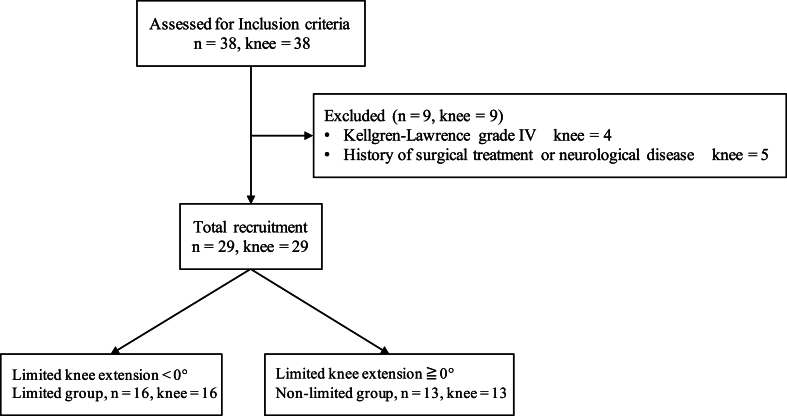
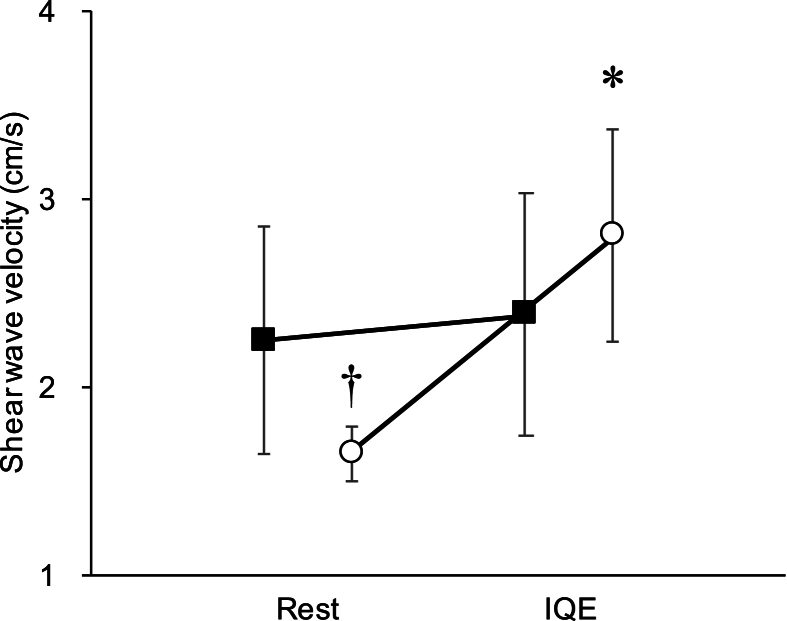
In this cross-sectional study, data were collected at an orthopedic clinic from March 2022 to April 2023. Among patients diagnosed with KOA, those with knee joint extension range of motion <0° and >0° were defined as the limited group (n = 16) and non-limited group (n = 13), respectively. Ultrasonography was performed at rest and during IQE to measure IFP hardness based on shear wave velocity. Near-infrared spectroscopy was performed to measure oxygenated hemoglobin (O2Hb), deoxygenated hemoglobin (HHb), and total hemoglobin (cHb) in the IFP before (baseline), during (IQE task), and post IQE. IFP hardness and O2Hb, HHb, and cHb concentration were analyzed using a linear mixed model for the groups and measurement points.
IFP hardness changes during IQE were significantly less in the limited group than in the non-limited group (limited: mean difference [MD] = -0.136, 95 % confidence interval [CI] [-0.475, 0.203]; non-limited: MD = -1.154, 95 % CI [-1.530, -0.778]). O2Hb concentration did not significantly change at post compared with baseline in the limited group but did in the non-limited group (limited: MD = -0.024, 95 % CI [-0.961, 0.913]; non-limited: MD = -4.118, 95 % CI [-5.156, -3.079]).
The limited group revealed no IFP hardness and hemoglobin concentration change following IQE, whereas the opposite was observed for the non-limited group, indicating oxygenation.
探讨膝关节骨关节炎(KOA)患者在等长股四头肌锻炼(IQE)过程中,髌下脂肪垫(IFP)硬度及血红蛋白浓度变化在膝关节伸展受限与未受限患者之间是否存在差异。
在这项横断面研究中,于2022年3月至2023年4月期间在一家骨科诊所收集数据。在被诊断为KOA的患者中,膝关节伸展活动范围<0°和>0°的患者分别被定义为受限组(n = 16)和非受限组(n = 13)。在静息状态和IQE过程中进行超声检查,以基于剪切波速度测量IFP硬度。进行近红外光谱检查,以测量IFP在(基线)之前、(IQE任务)期间和IQE之后的氧合血红蛋白(O2Hb)、脱氧血红蛋白(HHb)和总血红蛋白(cHb)。使用线性混合模型对组和测量点分析IFP硬度以及O2Hb、HHb和cHb浓度。
IQE期间,受限组IFP硬度变化显著小于非受限组(受限组:平均差异[MD]= -0.136,95%置信区间[CI][-0.475,0.203];非受限组:MD = -1.154,95%CI[-1.530,-0.778])。受限组与基线相比,O2Hb浓度在IQE后无显著变化,而非受限组有显著变化(受限组:MD = -0.024,95%CI[-0.961,0.913];非受限组:MD = -4.118,95%CI[-5.156,-3.079])。
受限组在IQE后未显示IFP硬度和血红蛋白浓度变化,而非受限组则相反,表明存在氧合作用。