Alasmar Mohamed, Matias Nadia, Alhamed Norah Ali M, Alwani Omneya, Rudge Brogan, Moti Terngu David, Abdelwahab Muhammad Ossama Yassin, Stockton Jennifer, Raslan Charef, Cairney-Hill Jess, Altarawni Mohammad, Alkhaffaf Bilal
Department of Oesophago-Gastric & Bariatric Surgery, Salford Care Organisation, Northern Care Alliance NHS Foundation Trust, Salford Royal Hospital, Manchester, UK.
Division of Cancer Sciences, School of Medical Sciences, Faculty of Biology, Medicine and Health, University of Manchester, Manchester, UK.
World J Surg Oncol. 2025 Jan 14;22(1):342. doi: 10.1186/s12957-024-03621-0.
The delivery of cancer services changed significantly during the COVID-19 pandemic. This study aimed to describe changes in presentations, assess the change in recommendations by the MDT during the pandemic, and describe the subsequent long-term impact of these changes on survival rates in patients with EG cancer.
A retrospective cohort study was designed comparing three patient groups of those referred to EG MDT in the same 6-month period pre-pandemic (PP;2019) during the initial phase of the pandemic (P1;2020) and the year after the initial phase (P2;2021). The primary aim of this study was to describe and compare deviations from the standard of care across these three timeframes. Secondary outcomes included differences in the number of new cases with early and advanced oesophageal and gastric lesions, a comparison of survival rates among the groups, and an analysis of postoperative histopathology to identify any shifts in the tumour stage across the studied periods.
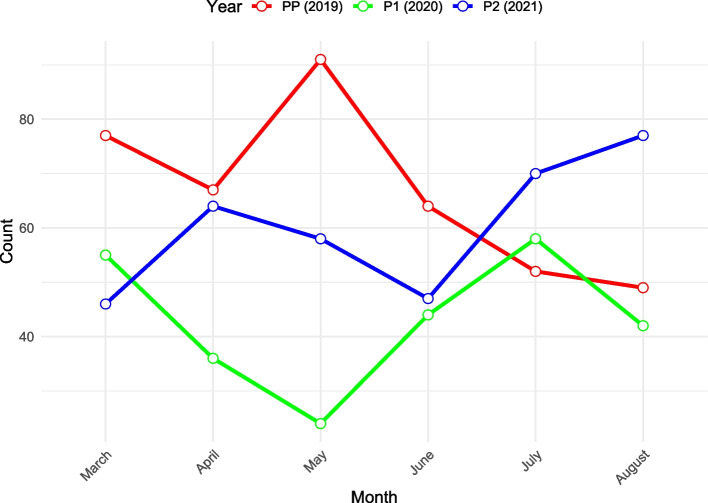
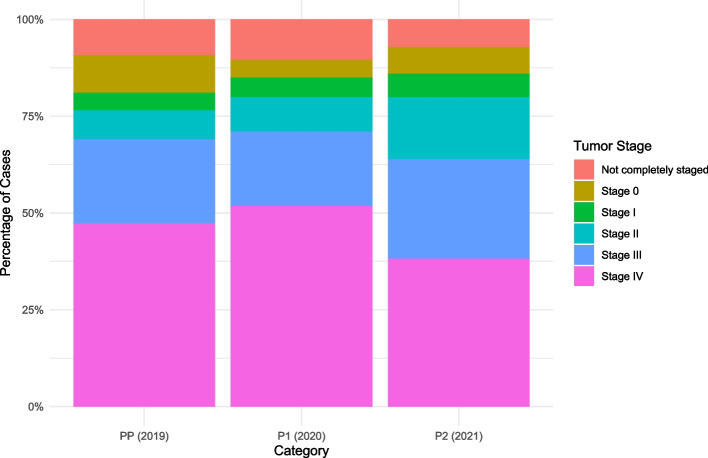
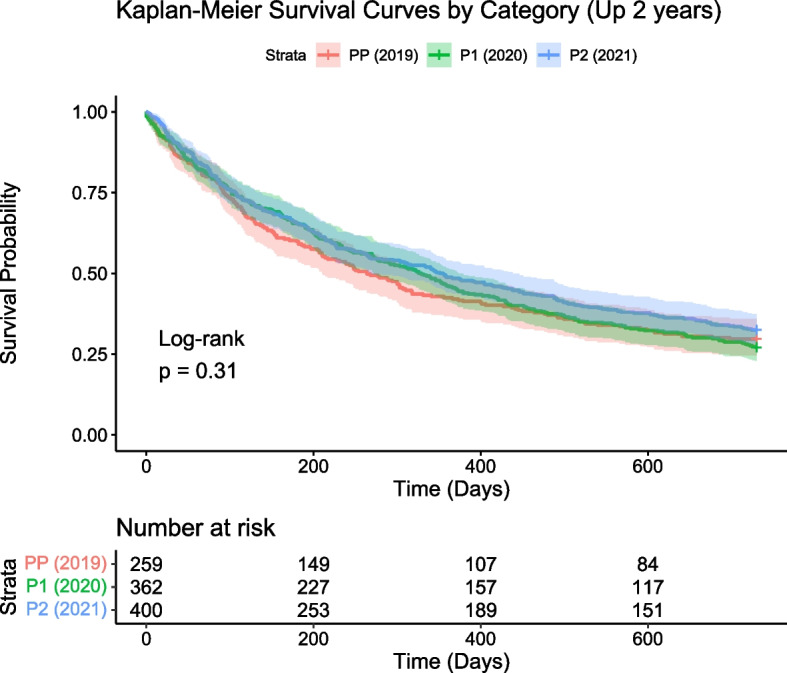
A consistent demographic profile across these periods was maintained, but with a significant decrease in patient referrals during P1 (35.25% reduction from PP to P1 and 9.5% reduction from PP to P2), quicker 'time to treatment' during P1 (130.8 days in P1 vs 162 in PP and 178.9 in P2), and notable changes in treatment modalities. Additionally, we found an increased deviation from initial curative to palliative intent in the P2 group (6.4% changed in P2 vs 2.2% in PP and 3.5% in P2) primarily driven by disease progression. A further significant observation was the emergence of more aggressive tumour characteristics, particularly in the P2 group, albeit without a statistically significant difference in two-year overall survival rates among the groups (p-value 0.31).
The COVID-19 pandemic significantly impacted oesophagogastric cancer care, with a reduction in patient referral rates during the initial pandemic phase and a subsequent increase in more advanced stage disease. Our findings from a major UK EG centre highlight accelerated treatment decision-making during the initial pandemic phase was possible and that standard of care was maintained. These insights provide valuable lessons for healthcare systems in managing cancer care during global health emergencies.
在新冠疫情期间,癌症服务的提供发生了显著变化。本研究旨在描述就诊情况的变化,评估多学科团队(MDT)在疫情期间建议的变化,并描述这些变化对食管癌(EG)患者生存率的后续长期影响。
设计了一项回顾性队列研究,比较了疫情前(PP;2019年)同一6个月期间、疫情初始阶段(P1;2020年)和初始阶段后一年(P2;2021年)转诊至EG MDT的三组患者。本研究的主要目的是描述和比较这三个时间框架内与护理标准的偏差。次要结果包括早期和晚期食管及胃病变新病例数量的差异、各组生存率的比较,以及对术后组织病理学的分析,以确定研究期间肿瘤分期的任何变化。
这些时期的人口统计学特征保持一致,但P1期间患者转诊显著减少(从PP到P1减少35.25%,从PP到P2减少9.5%),P1期间“治疗时间”更快(P1为130.8天,PP为162天,P2为178.9天),治疗方式也有显著变化。此外,我们发现P2组从初始治愈意图到姑息意图的偏差增加(P2组为6.4%,PP组为2.2%,P2组为3.5%),主要由疾病进展驱动。另一个重要观察结果是出现了更具侵袭性的肿瘤特征,特别是在P2组,尽管各组两年总生存率没有统计学显著差异(p值为0.31)。
新冠疫情对食管癌护理产生了重大影响,疫情初始阶段患者转诊率降低,随后晚期疾病增加。我们来自英国一个主要EG中心的研究结果表明,在疫情初始阶段加快治疗决策是可能的,并且护理标准得以维持。这些见解为全球卫生紧急情况期间医疗系统管理癌症护理提供了宝贵经验。