Wijnbergen Daphne, Johari Mridul, Ozisik Ozan, 't Hoen Peter A C, Ehrhart Friederike, Baudot Anaïs, Evelo Chris T, Udd Bjarne, Roos Marco, Mina Eleni
Department of Human Genetics, Leiden University Medical Center, Leiden, The Netherlands.
Harry Perkins Institute of Medical Research, Centre for Medical Research, University of Western Australia, Nedlands, WA, Australia.
Orphanet J Rare Dis. 2025 Jan 15;20(1):27. doi: 10.1186/s13023-024-03526-x.
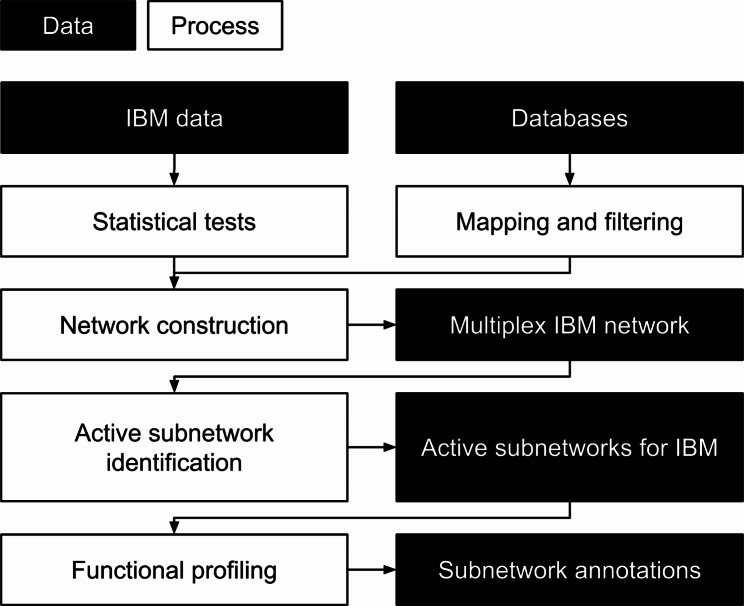
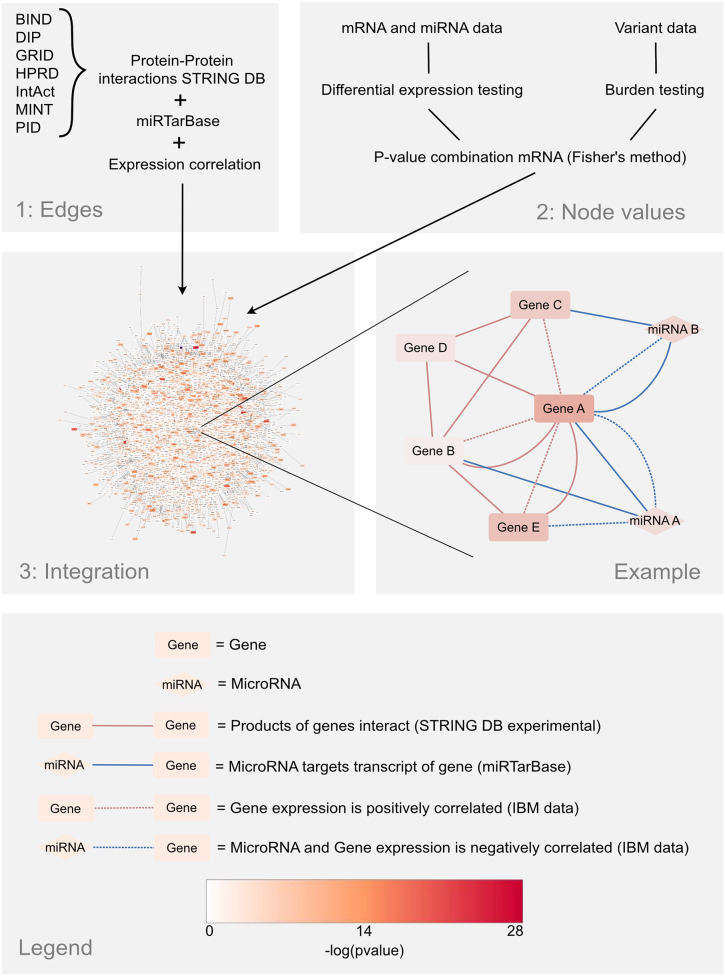
Inclusion Body Myositis is an acquired muscle disease. Its pathogenesis is unclear due to the co-existence of inflammation, muscle degeneration and mitochondrial dysfunction. We aimed to provide a more advanced understanding of the disease by combining multi-omics analysis with prior knowledge. We applied molecular subnetwork identification to find highly interconnected subnetworks with a high degree of change in Inclusion Body Myositis. These could be used as hypotheses for potential pathomechanisms and biomarkers that are implicated in this disease.
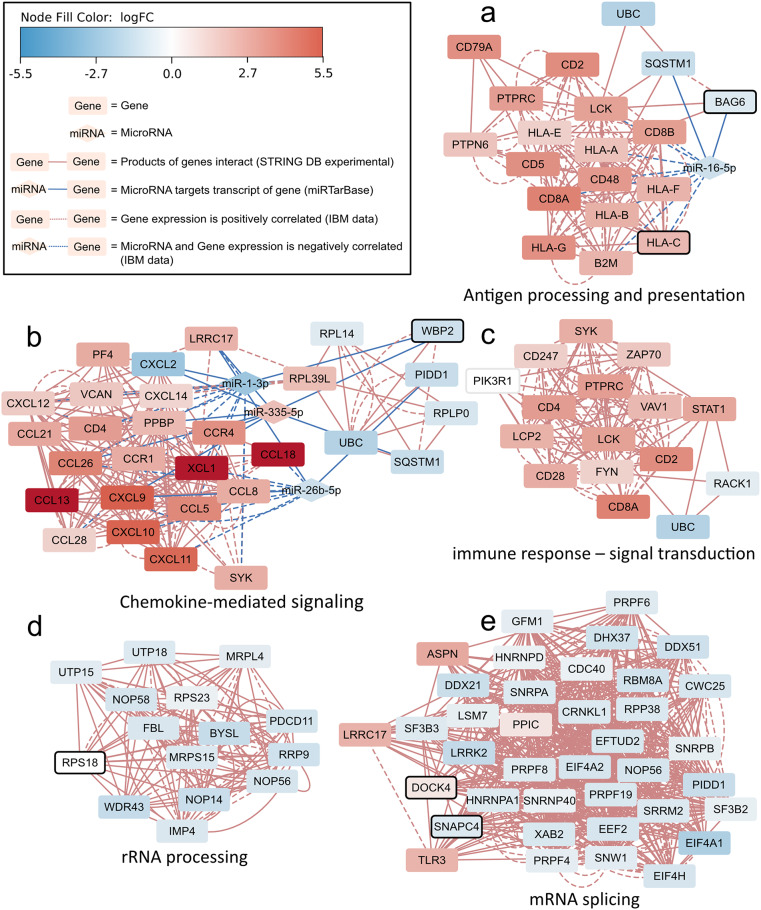
Our multi-omics analysis resulted in five subnetworks that exhibit changes in multiple omics layers. These subnetworks are related to antigen processing and presentation, chemokine-mediated signaling, immune response-signal transduction, rRNA processing, and mRNA splicing. An interesting finding is that the antigen processing and presentation subnetwork links the underexpressed miR-16-5p to overexpressed HLA genes by negative expression correlation. In addition, the rRNA processing subnetwork contains the RPS18 gene, which is not differentially expressed, but has significant variant association. The RPS18 gene could potentially play a role in the underexpression of the genes involved in 18 S ribosomal RNA processing, which it is highly connected to.
Our analysis highlights the importance of interrogating multiple omics to enhance knowledge discovery in rare diseases. We report five subnetworks that can provide additional insights into the molecular pathogenesis of Inclusion Body Myositis. Our analytical workflow can be reused as a method to study disease mechanisms involved in other diseases when multiple omics datasets are available.
包涵体肌炎是一种获得性肌肉疾病。由于炎症、肌肉变性和线粒体功能障碍并存,其发病机制尚不清楚。我们旨在通过将多组学分析与先验知识相结合,更深入地了解这种疾病。我们应用分子子网识别来寻找包涵体肌炎中高度相互连接且变化程度高的子网。这些子网可作为该疾病潜在发病机制和生物标志物的假设。
我们的多组学分析产生了五个在多个组学层面表现出变化的子网。这些子网与抗原加工和呈递、趋化因子介导的信号传导、免疫反应信号转导、rRNA加工和mRNA剪接有关。一个有趣的发现是,抗原加工和呈递子网通过负表达相关性将低表达的miR-16-5p与高表达的HLA基因联系起来。此外,rRNA加工子网包含RPS18基因,该基因没有差异表达,但具有显著的变异关联。RPS18基因可能在与其高度相关的18S核糖体RNA加工相关基因的低表达中发挥作用。
我们的分析强调了研究多个组学以加强罕见病知识发现的重要性。我们报告了五个子网,它们可以为包涵体肌炎的分子发病机制提供更多见解。当有多组学数据集可用时,我们的分析流程可以作为一种研究其他疾病所涉及疾病机制的方法被重新使用。