Chen Ya-Ping, Neff Patrick, Leske Sabine, Wong Daniel D E, Peter Nicole, Obleser Jonas, Kleinjung Tobias, Dimitrijevic Andrew, Dalal Sarang S, Weisz Nathan
Centre for Cognitive Neuroscience, University of Salzburg, 5020 Salzburg, Austria.
Department of Psychology, University of Salzburg, 5020 Salzburg, Austria.
Brain Commun. 2025 Jan 3;7(1):fcaf001. doi: 10.1093/braincomms/fcaf001. eCollection 2025.
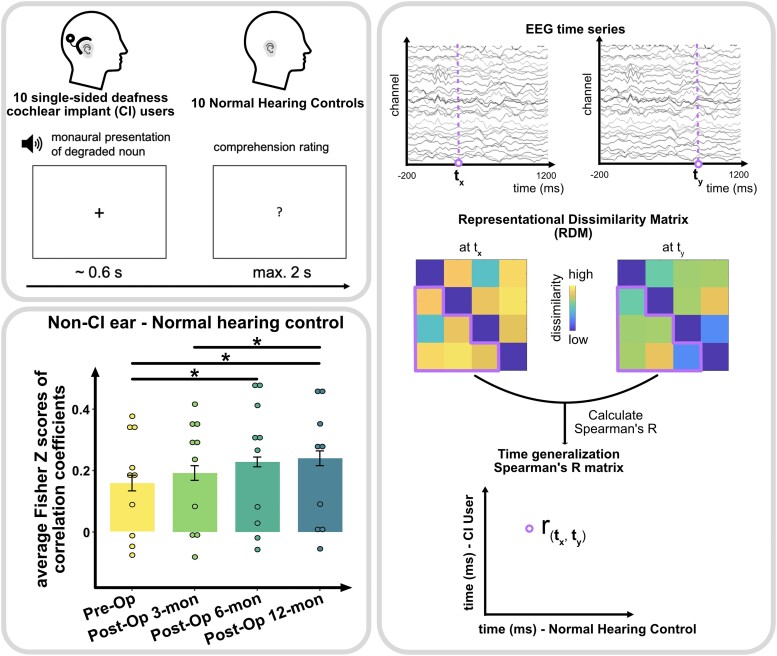
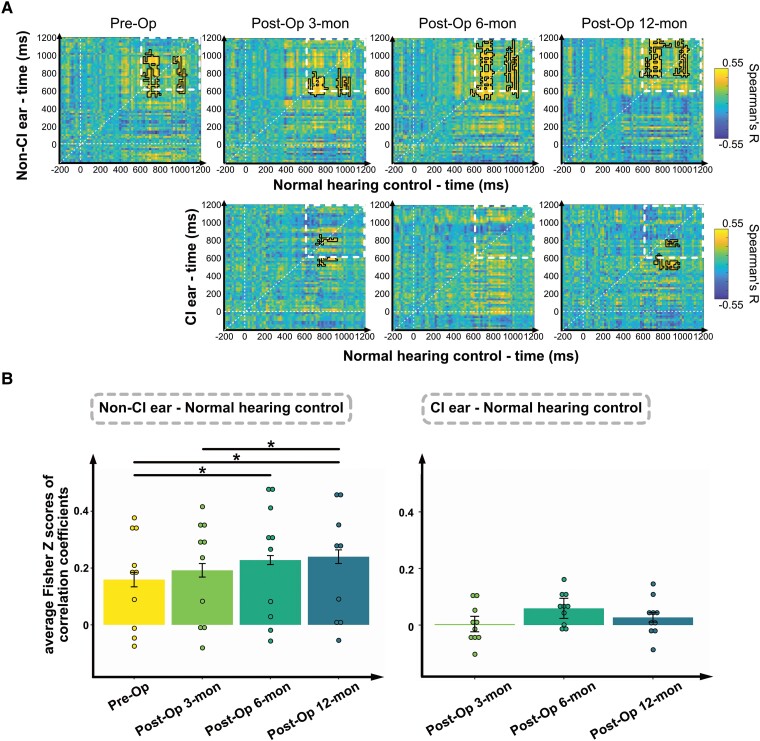
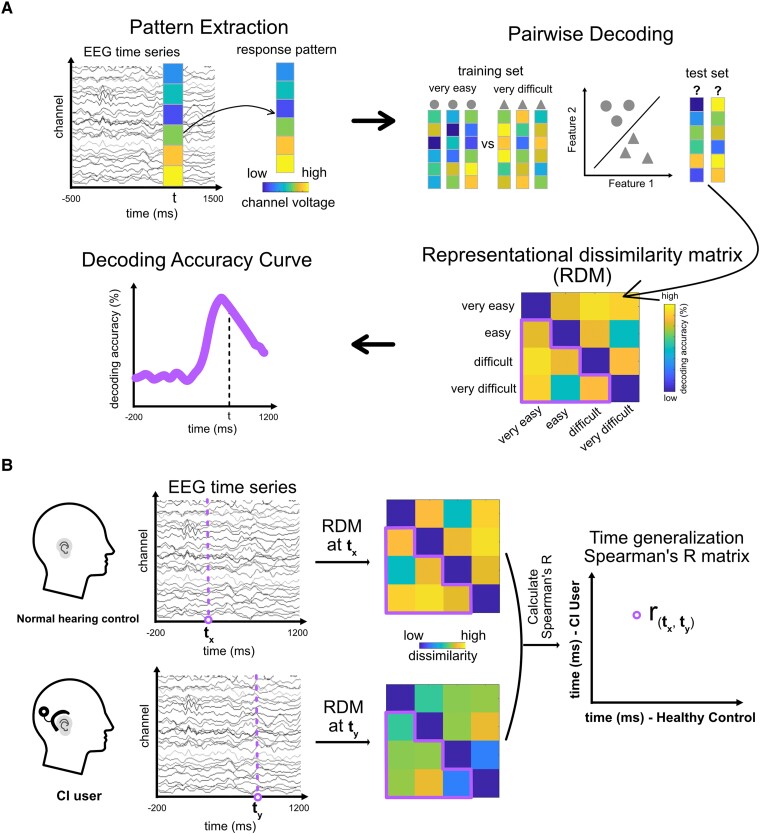
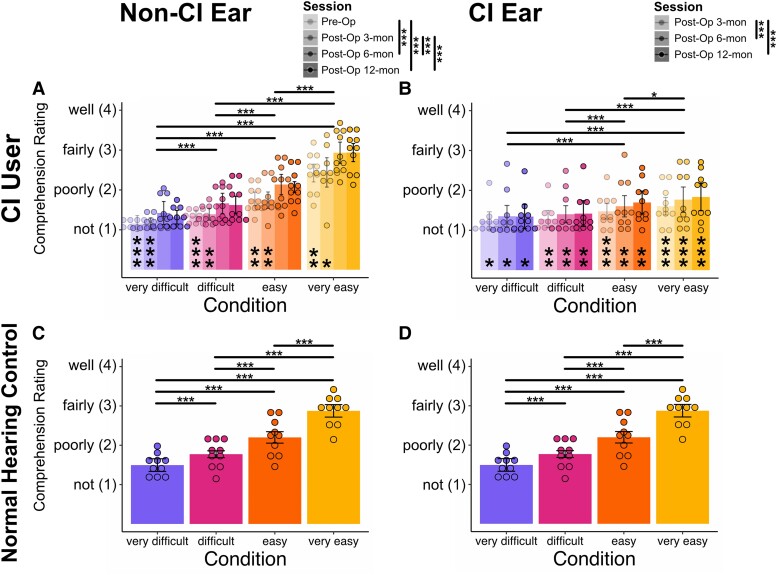
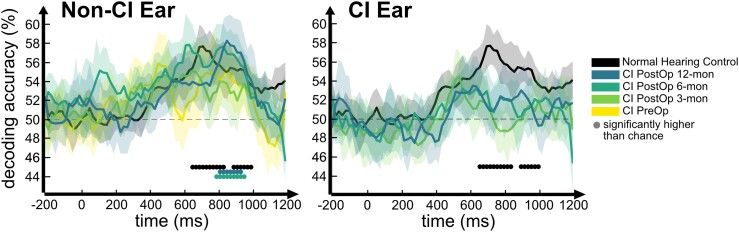
Former studies have established that individuals with a cochlear implant (CI) for treating single-sided deafness experience improved speech processing after implantation. However, it is not clear how each ear contributes separately to improve speech perception over time at the behavioural and neural level. In this longitudinal EEG study with four different time points, we measured neural activity in response to various temporally and spectrally degraded spoken words presented monaurally to the CI and non-CI ears (5 left and 5 right ears) in 10 single-sided CI users and 10 age- and sex-matched individuals with normal hearing. Subjective comprehension ratings for each word were also recorded. Data from single-sided CI participants were collected pre-CI implantation, and at 3, 6 and 12 months after implantation. We conducted a time-resolved representational similarity analysis on the EEG data to quantify whether and how neural patterns became more similar to those of normal hearing individuals. At 6 months after implantation, the speech comprehension ratings for the degraded words improved in both ears. Notably, the improvement was more pronounced for the non-CI ears than the CI ears. Furthermore, the enhancement in the non-CI ears was paralleled by increased similarity to neural representational patterns of the normal hearing control group. The maximum of this effect coincided with peak decoding accuracy for spoken-word comprehension (600-1200 ms after stimulus onset). The present data demonstrate that cortical processing gradually normalizes within months after CI implantation for speech presented to the non-CI ear. CI enables the deaf ear to provide afferent input, which, according to our results, complements the input of the non-CI ear, gradually improving its function. These novel findings underscore the feasibility of tracking neural recovery after auditory input restoration using advanced multivariate analysis methods, such as representational similarity analysis.
以往的研究已经证实,植入人工耳蜗(CI)以治疗单侧耳聋的个体在植入后语音处理能力有所改善。然而,目前尚不清楚随着时间的推移,每只耳朵在行为和神经层面上是如何分别对语音感知的改善做出贡献的。在这项具有四个不同时间点的纵向脑电图研究中,我们测量了10名单侧人工耳蜗使用者和10名年龄及性别匹配的听力正常个体对单耳呈现给人工耳蜗耳和非人工耳蜗耳(5只左耳和5只右耳)的各种时间和频谱上退化的口语单词的神经活动。还记录了每个单词的主观理解评分。单侧人工耳蜗参与者的数据在植入前以及植入后3个月、6个月和12个月收集。我们对脑电图数据进行了时间分辨表征相似性分析,以量化神经模式是否以及如何变得与听力正常个体的神经模式更加相似。植入后6个月,两只耳朵对退化单词的语音理解评分均有所提高。值得注意的是,非人工耳蜗耳的改善比人工耳蜗耳更为明显。此外,非人工耳蜗耳的增强与与听力正常对照组神经表征模式的相似度增加并行。这种效应的最大值与口语单词理解的峰值解码准确率(刺激开始后600 - 1200毫秒)一致。目前的数据表明,对于呈现给非人工耳蜗耳的语音,人工耳蜗植入后数月内皮质处理逐渐正常化。人工耳蜗使聋耳能够提供传入输入,根据我们的结果,这补充了非人工耳蜗耳的输入,逐渐改善其功能。这些新发现强调了使用先进的多变量分析方法(如表征相似性分析)跟踪听觉输入恢复后神经恢复的可行性。