Ngnindji-Youdje Yannick, Lontsi-Demano Michel, Diarra Adama Zan, Foyet Juluis, Tchuinkam Timolèon, Parola Philippe
Aix Marseille Univ, Marseille, France.
IHU-Méditerranée Infection, 19-21 Boulevard Jean Moulin, 13005 Marseille, France.
One Health. 2024 Dec 9;20:100949. doi: 10.1016/j.onehlt.2024.100949. eCollection 2025 Jun.
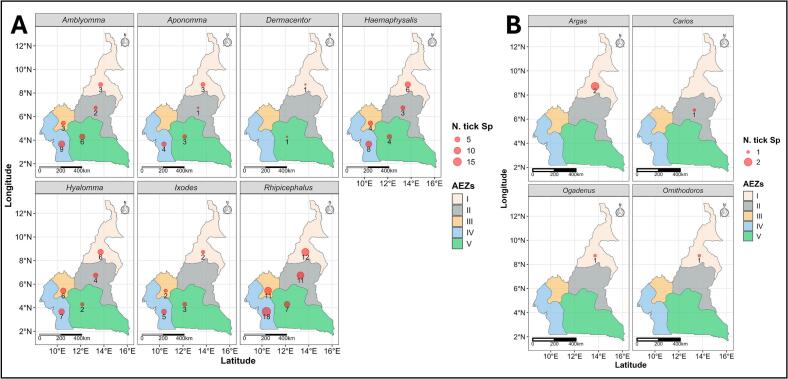
Despite the high burden of human and animal infectious diseases in Cameroon, implementing integrative approaches to managing and controlling arthropods and their pathogens remains challenging. Surveillance should be designed to detect diseases and provide relevant field-based data for developing and implementing effective control measures to prevent outbreaks before significant public and animal health consequences can occur. Nowadays, ticks are considered the primary vectors of animal diseases in the world, and the second vector of human diseases after mosquitoes. Knowledge of their biodiversity and distribution in any given area is a crucial step towards a better implementation of control strategies. The infections transmitted by ticks remain poorly known or underestimated in Cameroon. Despite the existence of several studies on ticks and associated pathogens, no single review to date summarises all the data available in this field in Cameroon. Following a comprehensive literature search, an inventory of the diversity and distribution of ticks, as well as the different tick-borne diseases (viral, bacteria and protozoa) found in Cameroon was prepared. To date, about 71 species, comprising ten species., eight spp., 26 spp., 11 spp. seven spp. five spp. (currently the species), one and four soft tick species of minimal or unknown medical and veterinary importance, namely and have been collected in Cameroon. Many zoonotic tick-borne diseases, such as babesiosis, theileriosis, anaplasmosis, ehrlichiosis, rickettsioses, and Q fever have been reported in the country. Knowledge about tick species and their distribution will aid in designing integrated vector management programs to monitor tick-borne diseases in Cameroon.
尽管喀麦隆人畜传染病负担沉重,但实施综合方法来管理和控制节肢动物及其病原体仍然具有挑战性。监测应旨在发现疾病,并提供相关实地数据,以便在重大公共卫生和动物健康后果发生之前,制定和实施有效的控制措施以预防疫情爆发。如今,蜱被认为是世界上动物疾病的主要传播媒介,也是仅次于蚊子的人类疾病传播媒介。了解其在任何特定地区的生物多样性和分布情况,是更好地实施控制策略的关键一步。在喀麦隆,蜱传播的感染仍鲜为人知或被低估。尽管已经有多项关于蜱及相关病原体的研究,但迄今为止,尚无单一综述总结喀麦隆该领域的所有现有数据。在进行全面的文献检索后,编制了喀麦隆蜱的多样性和分布清单,以及发现的不同蜱传疾病(病毒、细菌和原生动物)。迄今为止,在喀麦隆已采集到约71种蜱,包括10种硬蜱、8种硬蜱、26种硬蜱、11种硬蜱、7种硬蜱、5种硬蜱(目前为该种)、1种软蜱和4种医学和兽医重要性极小或未知的软蜱,即 和 。该国已报告了许多人畜共患的蜱传疾病,如巴贝斯虫病、泰勒虫病、无浆体病、埃立克体病、立克次体病和Q热。了解蜱的种类及其分布将有助于设计综合病媒管理计划,以监测喀麦隆的蜱传疾病。