Qiu Piaopiao, Dong Bo, Cao Rongkai, Hu Junli, Yang Jiaao, Yu Ruoqi, Fan Zhen
Shanghai Engineering Research Center of Tooth Restoration and Regeneration & Tongji Research Institute of Stomatology & Department of Implantology, Stomatological Hospital and Dental School, Tongji University, Shanghai, People's Republic of China.
Risk Manag Healthc Policy. 2025 Jan 11;18:131-141. doi: 10.2147/RMHP.S498108. eCollection 2025.
This study aimed to investigate the relationship between physical activity levels and periodontal health status among college students in Shanghai, with the goal of informing oral health policy recommendations.
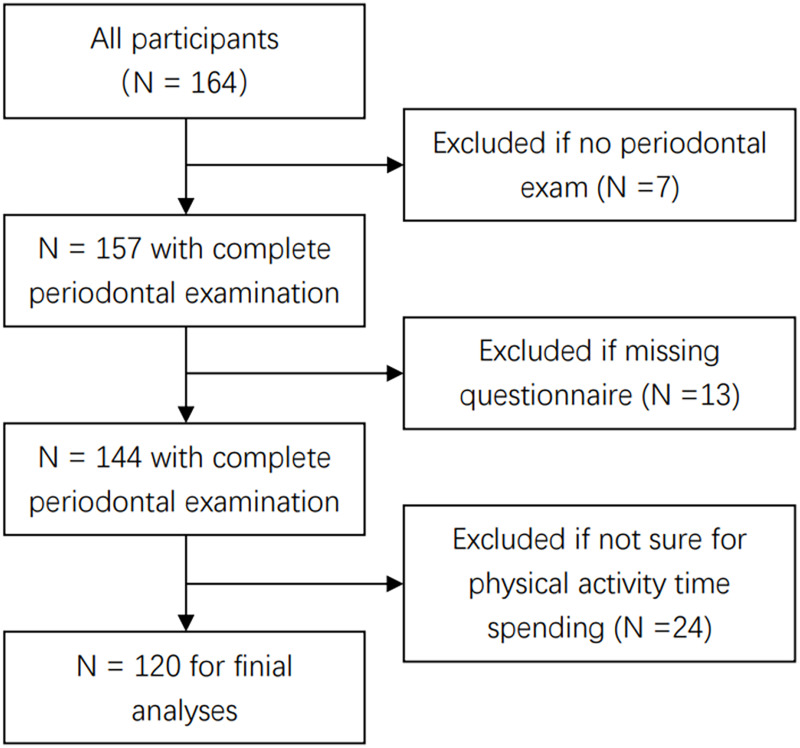
A cross-sectional study was conducted from March 2023 to March 2024 involving 120 university students aged 18-29. Data was collected using the World Health Organization (WHO) oral health survey methods. Periodontal status was assessed using the Community Periodontal Index (CPI), and physical activity was measured with a simplified version of the International Physical Activity Questionnaire (IPAQ). Data analysis was performed using Statistical Package for the Social Sciences (SPSS) version 27.0 (IBM, USA), employing chi-square tests and multivariable logistic regression.
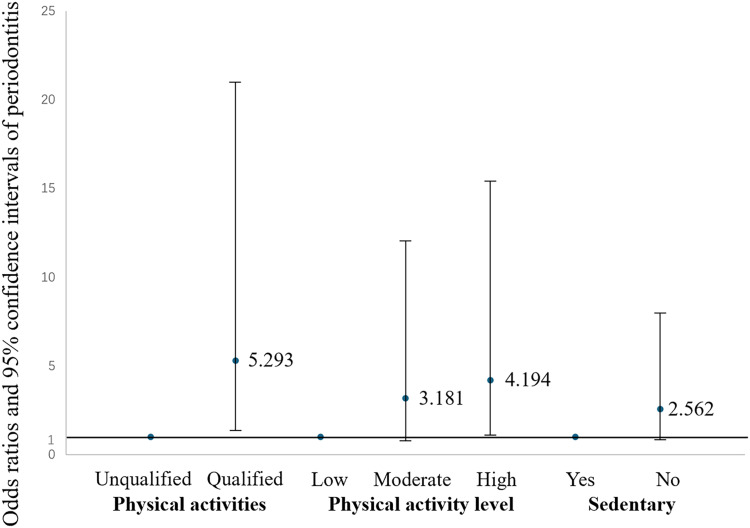
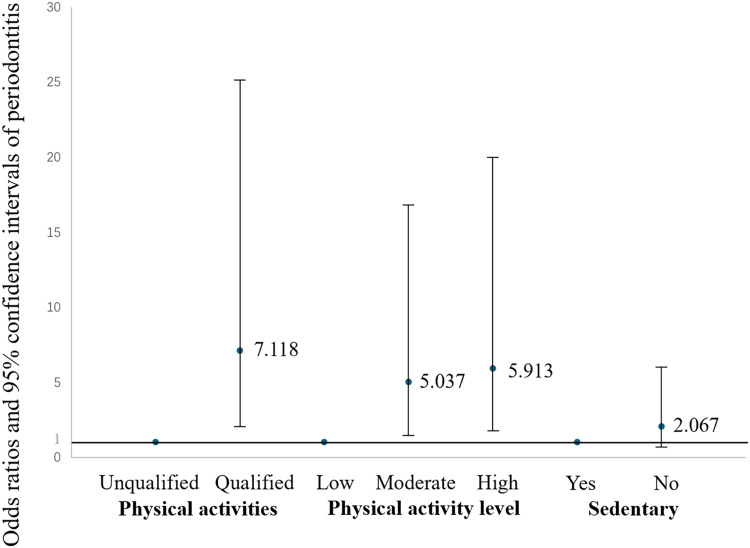
Among the participants (77 males, 43 females), 70% met physical activity guidelines. Adjusting for gender, age, tooth brushing frequency, and dental floss use, insufficient physical activity was associated with higher odds of periodontitis (adjusted model: OR = 5.293, 95% CI = 1.334 to 20.993, = 0.018). High-intensity physical activity significantly reduced the incidence of periodontitis ( = 0.006), while sedentary behavior showed no significant correlation ( = 0.176).
Promoting physical activity among college students may enhance periodontal health, underscoring the need to integrate oral and public health initiatives.
本研究旨在调查上海大学生的身体活动水平与牙周健康状况之间的关系,为口腔健康政策建议提供依据。
于2023年3月至2024年3月进行了一项横断面研究,涉及120名年龄在18至29岁之间的大学生。使用世界卫生组织(WHO)的口腔健康调查方法收集数据。采用社区牙周指数(CPI)评估牙周状况,并用国际体力活动问卷(IPAQ)的简化版测量身体活动。使用社会科学统计软件包(SPSS)27.0版(美国IBM公司)进行数据分析,采用卡方检验和多变量逻辑回归。
在参与者中(77名男性,43名女性),70%符合身体活动指南。在调整性别、年龄、刷牙频率和使用牙线情况后,身体活动不足与牙周炎的较高几率相关(调整模型:OR = 5.293,95% CI = 1.334至20.993, = 0.018)。高强度身体活动显著降低了牙周炎的发病率( = 0.006),而久坐行为无显著相关性( = 0.176)。
促进大学生的身体活动可能会改善牙周健康,强调了整合口腔和公共卫生举措的必要性。