Counts Nathaniel Z, Kreif Noemi, Creedon Timothy B, Bloom David E
The Kennedy Forum, Brigantine, New Jersey, United States of America.
Department of Health Policy and Management, Columbia University Mailman School of Public Health, New York, New York, United States of America.
PLoS Med. 2025 Jan 16;22(1):e1004506. doi: 10.1371/journal.pmed.1004506. eCollection 2025 Jan.
Federal policy impact analyses in the United States do not incorporate the potential economic benefits of adolescent mental health policies. Understanding the extent to which economic benefits may offset policy costs would support more effective policymaking. This study estimates the relationship between adolescent psychological distress and later health and economic outcomes and uses these estimates to determine the potential economic effects of a hypothetical policy.
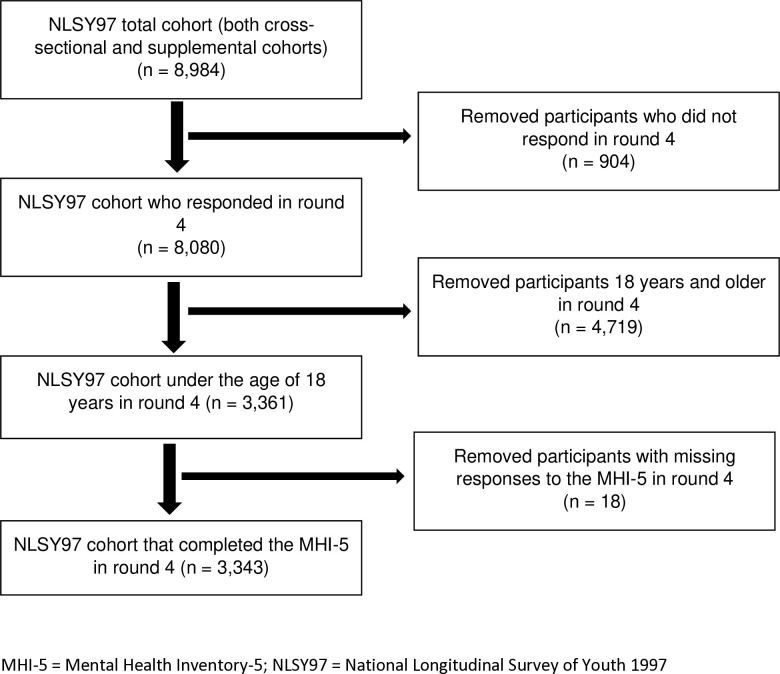
This analysis estimated the relationship between psychological distress in those aged 15 to 17 years in 2000 and economic and health outcomes approximately 10 years later, accounting for an array of explanatory variables using machine learning-enabled methods. The cohort was from the National Longitudinal Study of Youth 1997 and nationally representative of those aged 12 to 18 years in 1997. The cohort included 3,343 individuals under age 18 years in round 4 who completed the Mental Health Inventory-5 (MHI-5). Round 1 captured 50 explanatory variables that covered domains of potential confounders, including basic demographics, neighborhood environment, family resources, family processes, physical health, school quality, and academic skills. The exposure included a binary variable of clinically significant psychological distress (MHI-5 score of less than or equal to 3) and a categorical variable of symptom severity on the MHI-5. Outcomes covered domains of employment, income, total assets at age 30 years, education, and health approximately 10 years later. Forty-seven percent of the cohort were black and Hispanic, and 4.4% had past-month clinically significant psychological distress. Past-month clinically significant psychological distress in adolescence led to a 6-percentage-point (95% confidence interval [CI] [-0.08, -0.03]) reduction in past-year labor force participation 10 years later and $5,658 (95% CI [-6,772, -4,545]) USD fewer past-year wages earned. We used these results to model the labor market impacts of a hypothetical policy that expanded access to mental health preventive care and reached 10% of youth who would have otherwise developed clinically significant psychological distress. We found that the hypothetical policy could lead to $52 (95% credible interval [51,54]) billion USD in federal budget benefits over 10 years from labor supply impacts alone. This study faced limitations, including potential unmeasured confounding, missing data, and challenges to generalizability.
Our findings showed the impacts of adolescent mental health policies on the federal budget and found potentially large effects on the economy if policies achieve population-level change.
美国的联邦政策影响分析未纳入青少年心理健康政策的潜在经济效益。了解经济效益在多大程度上可以抵消政策成本将有助于制定更有效的政策。本研究估计了青少年心理困扰与后期健康和经济结果之间的关系,并利用这些估计来确定一项假设政策的潜在经济影响。
本分析估计了2000年15至17岁人群的心理困扰与大约10年后的经济和健康结果之间的关系,使用机器学习方法考虑了一系列解释变量。该队列来自1997年全国青少年纵向研究,在1997年全国范围内代表12至18岁的人群。该队列在第4轮中有3343名18岁以下的个体完成了心理健康量表-5(MHI-5)。第1轮收集了50个解释变量,涵盖潜在混杂因素的领域,包括基本人口统计学、邻里环境、家庭资源、家庭过程、身体健康、学校质量和学术技能。暴露因素包括具有临床意义的心理困扰的二元变量(MHI-5得分小于或等于3)和MHI-5上症状严重程度的分类变量。结果涵盖就业、收入、30岁时的总资产、教育以及大约10年后的健康等领域。该队列中47%为黑人和西班牙裔,4.4%在过去一个月有具有临床意义的心理困扰。青少年过去一个月有具有临床意义的心理困扰会导致10年后过去一年劳动力参与率降低6个百分点(95%置信区间[CI][-0.08,-0.03]),过去一年赚取的工资减少5658美元(95%CI[-6772,-4545])。我们利用这些结果对一项假设政策的劳动力市场影响进行建模,该政策扩大了心理健康预防护理的可及性,惠及了10%原本会出现具有临床意义的心理困扰的青少年。我们发现,仅从劳动力供应影响来看,这项假设政策在10年内可能带来520亿美元(95%可信区间[510,540])的联邦预算收益。本研究存在局限性,包括潜在的未测量混杂因素、数据缺失以及普遍性方面的挑战。
我们的研究结果显示了青少年心理健康政策对联邦预算的影响,并发现如果政策实现了人群层面的改变,可能对经济产生巨大影响。