Llenas-García Jara, González Beiro Roberto, Ramos-Rincón José-Manuel, Wikman-Jorgensen Philip
Vega Baja Hospital, Orihuela, Spain.
CIBERINFEC, Carlos III Health Institute, Madrid, Spain.
Mycoses. 2025 Jan;68(1):e70021. doi: 10.1111/myc.70021.
Systemic endemic mycoses are systemic fungal infections typically found in tropical and subtropical regions. Their global incidence is rising, including in nonendemic countries, mainly due to migration and international travel. They are a major cause of morbidity and mortality worldwide, especially in immunocompromised patients. This study aimed to analyse incidence trends of endemic mycoses and their presentation in hospitalised patients in Spain from 1997 to 2021.
This retrospective, observational study drew data from the Spanish National Hospital Discharge Database. We used the diagnostic codes of the 9th and 10th International Classification of Diseases for histoplasmosis, coccidioidomycosis, paracoccidioidomycosis and talaromycosis, retrieving systemic endemic mycoses cases from the national public registry.
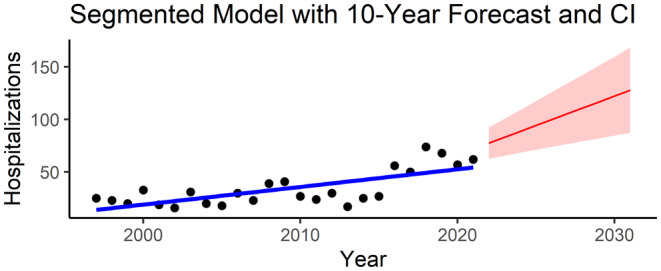
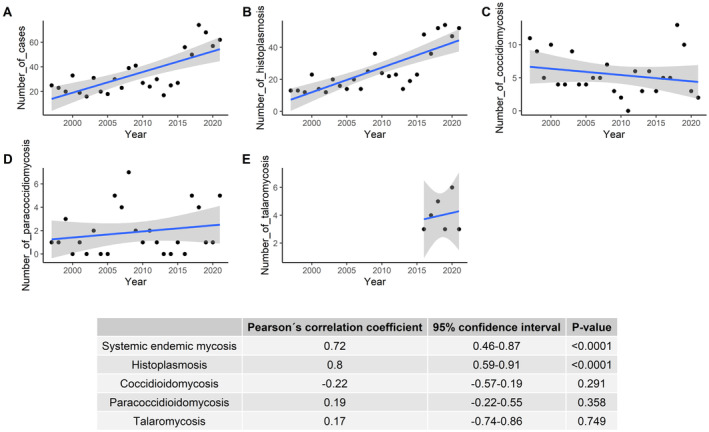
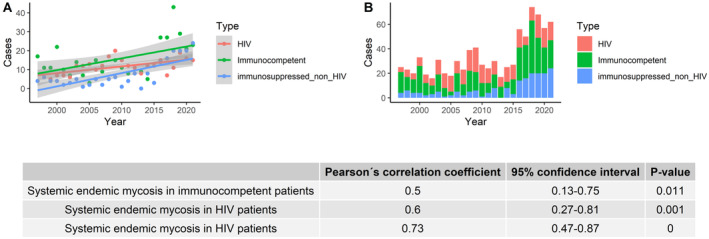
Over the study period, 646 cases of histoplasmosis, 138 of coccidioidomycosis, 47 of paracoccidioidomycosis and 24 talaromycosis were reported, with a rising number of cases annually, driven mainly by an increase in histoplasmosis. A segmented linear regression predictive model with a 10-year forecast showed a steady increase, reaching 128 hospitalisations (95% confidence interval [CI] 87-168) in Spain in 2031. Overall, in-hospital mortality was 10.9%, higher in histoplasmosis (11.3%) and coccidioidomycosis (10.9%) and independently associated with immunosuppression for both histoplasmosis (adjusted odds ratio [aOR] 3.28, 95% CI 1.72-6.24; p < 0.001) and coccidioidomycosis (aOR 4.05, 95% CI 1.22-13.44; p = 0.022).
Hospitalisations for systemic endemic mycoses, especially histoplasmosis, are on the rise in Spain. Mortality is significant and primarily associated with immunosuppression. This trend is expected to continue in the coming years, underscoring the importance of maintaining hospital-based surveillance of endemic mycoses in nonendemic regions.
系统性地方性真菌病是一种系统性真菌感染,通常见于热带和亚热带地区。其全球发病率正在上升,包括在非流行国家,主要原因是移民和国际旅行。它们是全球发病和死亡的主要原因,尤其是在免疫功能低下的患者中。本研究旨在分析1997年至2021年西班牙住院患者中地方性真菌病的发病率趋势及其表现。
这项回顾性观察研究从西班牙国家医院出院数据库中提取数据。我们使用国际疾病分类第9版和第10版中组织胞浆菌病、球孢子菌病、副球孢子菌病和马拉色菌病的诊断代码,从国家公共登记处检索系统性地方性真菌病病例。
在研究期间,共报告了646例组织胞浆菌病、138例球孢子菌病、47例副球孢子菌病和24例马拉色菌病病例,病例数逐年增加,主要由组织胞浆菌病的增加推动。一个具有10年预测期的分段线性回归预测模型显示病例数稳步上升,到2031年西班牙将达到128例住院病例(95%置信区间[CI]87 - 168)。总体而言,住院死亡率为10.9%,组织胞浆菌病(11.3%)和球孢子菌病(10.9%)的死亡率更高且与免疫抑制独立相关,组织胞浆菌病(调整优势比[aOR]3.28,95%CI 1.72 - 6.24;p < 0.001)和球孢子菌病(aOR 4.05,95%CI 1.22 - 13.44;p = 0.022)。
西班牙系统性地方性真菌病,尤其是组织胞浆菌病的住院病例数正在上升。死亡率较高且主要与免疫抑制相关。预计这一趋势在未来几年将持续,凸显了在非流行地区维持基于医院的地方性真菌病监测的重要性。