Asla Queralt, Garrido Maite, Urgell Eulàlia, Terzan Sílvia, Santos Alicia, Fernández Mercè, Varghese Nimmy, Atila Cihan, Calabrese Anna, Biagetti Betina, Plessow Franziska, Gich Ignasi, Christ-Crain Mirjam, Eckert Anne, Webb Susan M, Lawson Elizabeth A, Aulinas Anna
Department of Endocrinology and Nutrition, Hospital de la Santa Creu i Sant Pau, IR-SANT PAU, CIBERER-U747 ISCIII, ENDO-ERN, Barcelona, Spain.
Faculty of Medicine, University of Vic-Central University of Catalonia (UVic-UCC), Vic/Manresa, Catalonia, Spain.
Sci Rep. 2025 Jan 18;15(1):2360. doi: 10.1038/s41598-025-86566-y.
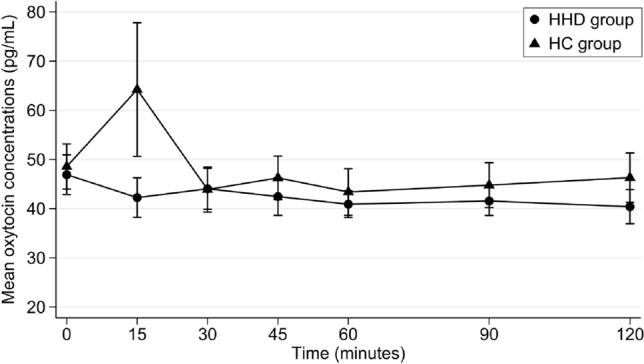
Increasing evidence supports the presence of oxytocin deficiency (OXT-D) in patients with hypopituitarism and hypothalamic damage (HHD), that might be associated with neuropsychological deficits and sexual dysfunction, leading to worse quality of life (QoL). Therefore, identifying a provocative test to diagnose an OXT-D will be important. Corticotropin-releasing hormone (CRH) is a candidate for such a test as it increases oxytocin secretion in animal models. This study aimed to examine the effects of CRH on oxytocin release in HHD compared to healthy controls (HC) and to describe the psychopathology, sexual function and QoL and their associations with oxytocin. This is a single-blind, randomized, placebo-controlled, proof-of-concept study (NCT04902235) with crossover assignment (CRH vs. placebo). Nineteen HHD patients (10 females) and 20 HC (11 females) completed two visits, receiving CRH or placebo in random order and completed validated questionnaires to assess psychopathology, sexual function and QoL. Samples were collected over 120 min to assess oxytocin. Linear mixed-effects regression model evaluated the change in oxytocin after CRH/placebo in HHD vs. HC. CRH administration did not impact oxytocin concentrations across groups over time (p = 0.97). HHD had greater psychopathology (most ps < 0.05), sexual dysfunction (p < 0.03) and worse QoL (p < 0.001) compared to HC, nevertheless, baseline oxytocin concentrations and area under the curve of oxytocin were not significantly associated with psychopathology, sexual function or QoL, neither in HHD or HC. In conclusion, CRH administration does not appear to be a suitable provocative test for diagnosing OXT-D in HHD. Identifying a reliable diagnostic test for OXT-D remains crucial. Alternative provocative tests or biomarkers should be explored.
越来越多的证据支持垂体功能减退症和下丘脑损伤(HHD)患者存在催产素缺乏(OXT-D),这可能与神经心理缺陷和性功能障碍有关,进而导致生活质量(QoL)下降。因此,确定一种激发试验来诊断OXT-D将具有重要意义。促肾上腺皮质激素释放激素(CRH)是此类试验的一个候选药物,因为它在动物模型中可增加催产素分泌。本研究旨在探讨与健康对照(HC)相比,CRH对HHD患者催产素释放的影响,并描述精神病理学、性功能和生活质量及其与催产素的关联。这是一项单盲、随机、安慰剂对照的概念验证研究(NCT04902235),采用交叉设计(CRH与安慰剂)。19例HHD患者(10例女性)和20例HC(11例女性)完成了两次访视,随机顺序接受CRH或安慰剂,并完成经过验证的问卷以评估精神病理学、性功能和生活质量。在120分钟内采集样本以评估催产素。线性混合效应回归模型评估了HHD与HC在接受CRH/安慰剂后催产素的变化。随着时间的推移,CRH给药对各组的催产素浓度没有影响(p = 0.97)。与HC相比,HHD患者有更严重的精神病理学(大多数p < 0.05)、性功能障碍(p < 0.03)和更差的生活质量(p < 0.001),然而,无论是在HHD患者还是HC中,基线催产素浓度和催产素曲线下面积与精神病理学、性功能或生活质量均无显著关联。总之,CRH给药似乎不是诊断HHD患者OXT-D的合适激发试验。确定一种可靠的OXT-D诊断试验仍然至关重要。应探索替代的激发试验或生物标志物。