Louis Mena, Vivekanandan Deepak Dev, Grabill Nathaniel, Kumar Gagan, Singh Hardeep, Hastings J Clifton, Ramalingam Vijaya
General Surgery Department, Northeast Georgia Medical Center, Gainesville, GA, USA.
Critical Care Medicine, Northeast Georgia Medical Center, Gainesville, GA, USA.
J Thorac Dis. 2024 Dec 31;16(12):8602-8610. doi: 10.21037/jtd-24-1256. Epub 2024 Dec 28.
Empyema, characterized by the accumulation of pus in the pleural cavity, poses significant treatment challenges. While intrapleural tissue plasminogen activator (tPA) and deoxyribonuclease (DNase) therapy is effective for many patients, a substantial proportion require surgical intervention, such as video-assisted thoracoscopic surgery (VATS), following treatment failure. Identifying tPA/DNase treatment failure-associated predictors is crucial for optimizing patient management and improving outcomes. This study aims to identify clinical and biochemical predictors of tPA/DNase treatment failure in empyema patients, facilitating early and targeted interventions.
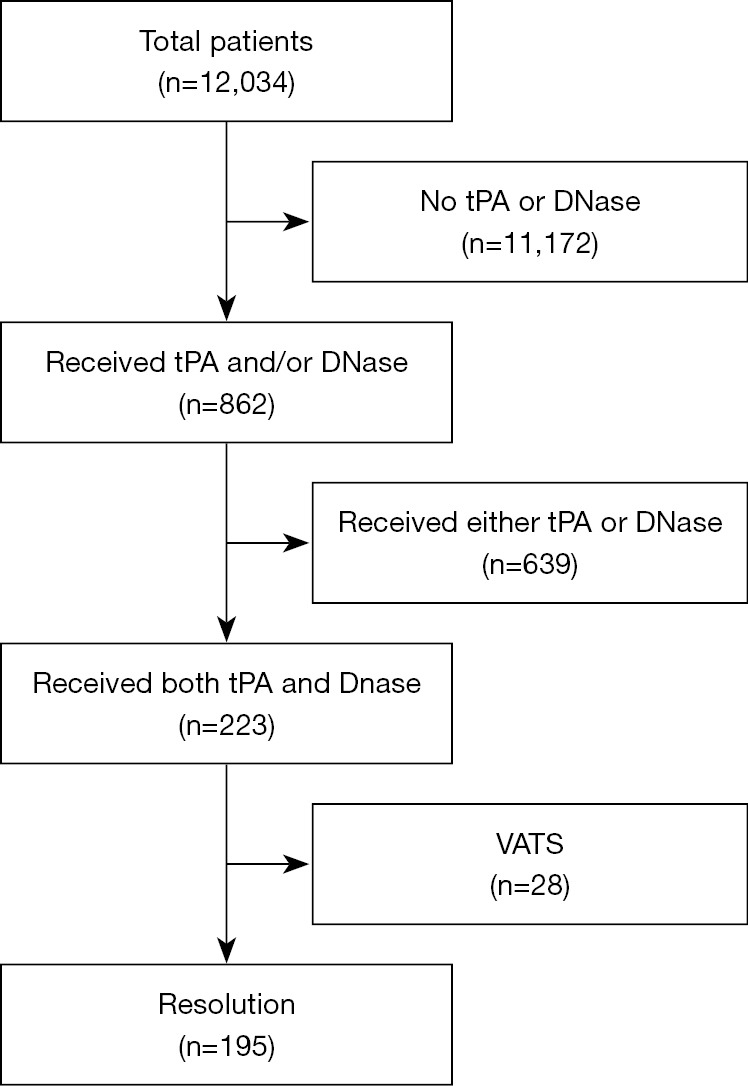
We conducted a retrospective analysis of 223 empyema patients treated with tPA/DNase at Northeast Georgia Medical Center between January 2018 and December 2023. Data were collected on demographics, comorbidities, pleural fluid analysis, radiological findings, and laboratory results. Multivariable logistic regression was used to identify predictors of treatment failure, with statistical significance set at a P value <0.05.
Of the 223 patients, 28 (12.6%) experienced treatment failure and required VATS. Several predictors of treatment failure were identified. Younger age was associated with a higher likelihood of treatment failure [odds ratio (OR) =0.97; 95% confidence interval (CI): 0.94-0.99; P=0.03]. The presence of () infection significantly predicted treatment failure (OR =4.1; 95% CI: 1.2-14.5; P=0.03). Biochemical markers in pleural fluid, such as pH, lactate dehydrogenase (LDH), and protein levels, were not associated with tPA/DNase failure.
Key predictors of tPA/DNase treatment failure in empyema patients include younger age (median age of 60.5 67 years old) and infection. Recognizing these predictors can guide clinicians in identifying high-risk patients and considering early surgical intervention. Future studies should aim to validate these findings in diverse populations to refine and confirm these predictive models.
脓胸的特征是胸腔内积聚脓液,带来了重大的治疗挑战。虽然胸膜腔内组织纤溶酶原激活剂(tPA)和脱氧核糖核酸酶(DNase)治疗对许多患者有效,但相当一部分患者在治疗失败后需要手术干预,如电视辅助胸腔镜手术(VATS)。识别与tPA/DNase治疗失败相关的预测因素对于优化患者管理和改善治疗结果至关重要。本研究旨在确定脓胸患者tPA/DNase治疗失败的临床和生化预测因素,以促进早期和有针对性的干预。
我们对2018年1月至2023年12月期间在佐治亚州东北部医疗中心接受tPA/DNase治疗的223例脓胸患者进行了回顾性分析。收集了人口统计学、合并症、胸腔积液分析、影像学检查结果和实验室检查结果等数据。采用多变量逻辑回归分析确定治疗失败的预测因素,统计学显著性设定为P值<0.05。
在223例患者中,28例(12.6%)治疗失败并需要进行VATS手术。确定了几个治疗失败的预测因素。年龄较小与治疗失败的可能性较高相关[比值比(OR)=0.97;95%置信区间(CI):0.94-0.99;P=0.03]。(此处原文括号内容缺失,无法准确翻译)感染显著预测治疗失败(OR =4.1;95%CI:1.2-14.5;P=0.03)。胸腔积液中的生化标志物,如pH值、乳酸脱氢酶(LDH)和蛋白质水平,与tPA/DNase治疗失败无关。
脓胸患者tPA/DNase治疗失败的关键预测因素包括年龄较小(中位年龄60.5岁对67岁)和(此处原文括号内容缺失,无法准确翻译)感染。认识到这些预测因素可以指导临床医生识别高危患者并考虑早期手术干预。未来的研究应旨在在不同人群中验证这些发现,以完善和确认这些预测模型。