Yan Bingwen, Hong Xuezhe, Hao Dongyue, Zhang Juan, Pei Jiaomiao, Sun Liming, Cang Zhengqiang, Chen Yongjun, Ma Ying, Song Baoqiang, Liu Chaohua
Department of Plastic and Reconstructive Surgery, Xijing Hospital, Fourth Military Medical University, Xi'an, Shaanxi, China.
Medicine (Baltimore). 2025 Jan 17;104(3):e41299. doi: 10.1097/MD.0000000000041299.
Gynecomastia, characterized by abnormal enlargement of male breast tissue, can lead to significant psychological distress, particularly among younger men. Traditional surgical options, such as subcutaneous mastectomy and liposuction, often result in visible scarring and contour deformities. This study introduces the "Stab Flatten" technique, a novel, minimally invasive approach for treating severe gynecomastia, designed to preserve chest aesthetics while minimizing postoperative complications, including scarring and contour irregularities.
A 28-year-old male with a 15-year history of progressive bilateral breast enlargement presented with psychological distress and concerns about the cosmetic outcomes of traditional surgery. He sought a minimally invasive procedure to address both physical discomfort and aesthetic concerns, aiming for minimal scarring.
The patient was diagnosed with grade III gynecomastia according to Simon classification, characterized by significant glandular hypertrophy and excess skin. Diagnostic imaging and laboratory tests confirmed the absence of underlying medical conditions.
The patient underwent the "Stab Flatten" technique, which involved exclusive liposuction with glandular tissue redistribution. A 4-mm incision was made at the inframammary crease, and power-assisted liposuction was used to flatten fibroglandular tissue without excision. Postoperative care included a compression garment for 6 months.
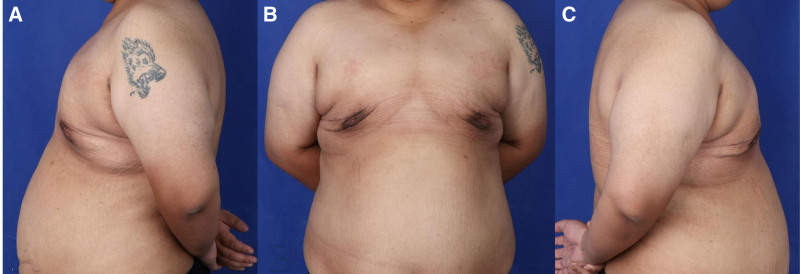
At the 6-month follow-up, the patient showed excellent cosmetic results, with significant improvement in breast contour and symmetry. There were no complications such as hematoma, seroma, or nipple-areola complex deformities. The patient reported high satisfaction with the aesthetic outcome, alongside improved psychological well-being and physical comfort.
This study is limited by its single-patient case report, which restricts the generalizability of the findings. Long-term outcomes of the "Stab Flatten" technique require further validation through larger, prospective studies with more diverse patient populations. Additionally, the technique may not be applicable to all grades of gynecomastia or patients with more complex conditions.
The "Stab Flatten" technique offers an effective, minimally invasive alternative for treating severe gynecomastia, providing excellent cosmetic and functional outcomes while minimizing scarring. This method may enhance patient satisfaction and reduce recovery times compared to traditional surgical approaches. However, further studies with larger cohorts are necessary to validate its efficacy and generalizability.
男性乳房肥大以男性乳腺组织异常增大为特征,可导致严重的心理困扰,尤其是在年轻男性中。传统的手术方法,如皮下乳房切除术和抽脂术,往往会导致明显的疤痕和外形畸形。本研究介绍了“穿刺整平”技术,这是一种治疗重度男性乳房肥大的新型微创方法,旨在在尽量减少术后并发症(包括疤痕和外形不规则)的同时保持胸部美观。
一名28岁男性,有15年双侧乳房渐进性增大病史,出现心理困扰,并担心传统手术的美容效果。他寻求一种微创手术来解决身体不适和美容问题,目标是尽量减少疤痕。
根据西蒙分类法,该患者被诊断为III级男性乳房肥大,其特征为明显的腺体肥大和皮肤过多。诊断性影像学检查和实验室检查证实无潜在疾病。
患者接受了“穿刺整平”技术,该技术包括单纯抽脂并重新分布腺体组织。在乳房下皱襞处做一个4毫米的切口,使用动力辅助抽脂术使纤维腺体组织变平而不进行切除。术后护理包括佩戴压迫性衣物6个月。
在6个月的随访中,患者的美容效果极佳,乳房外形和对称性有显著改善。没有出现血肿、血清肿或乳头乳晕复合体畸形等并发症。患者对美容效果表示高度满意,同时心理状态和身体舒适度也有所改善。
本研究受限于其单病例报告,限制了研究结果的可推广性。“穿刺整平”技术的长期效果需要通过对更多样化患者群体进行的更大规模前瞻性研究进一步验证。此外,该技术可能不适用于所有级别的男性乳房肥大或病情更复杂的患者。
“穿刺整平”技术为治疗重度男性乳房肥大提供了一种有效、微创的替代方法,在尽量减少疤痕的同时提供了出色的美容和功能效果。与传统手术方法相比,这种方法可能会提高患者满意度并缩短恢复时间。然而,需要更多队列的进一步研究来验证其疗效和可推广性。