Yuan Zhichao, Peng Chenggen, Yang Linlin, Chen Houjin
College of Sports, ChangSha Normal University, Changsha, Hunan, China.
College of Sports, Hunan Agricultural University, Changsha, Hunan, China.
Medicine (Baltimore). 2025 Jan 17;104(3):e41139. doi: 10.1097/MD.0000000000041139.
Although it is often known that physical activity can effectively reduce anxiety and despair, differing results have been found for patients with posttraumatic stress disorder (PTSD) symptoms. This study sought to comprehensively examine how physical activity affected the quality of sleep, anxiety, sadness, and PTSD in individuals suffering from PTSD.
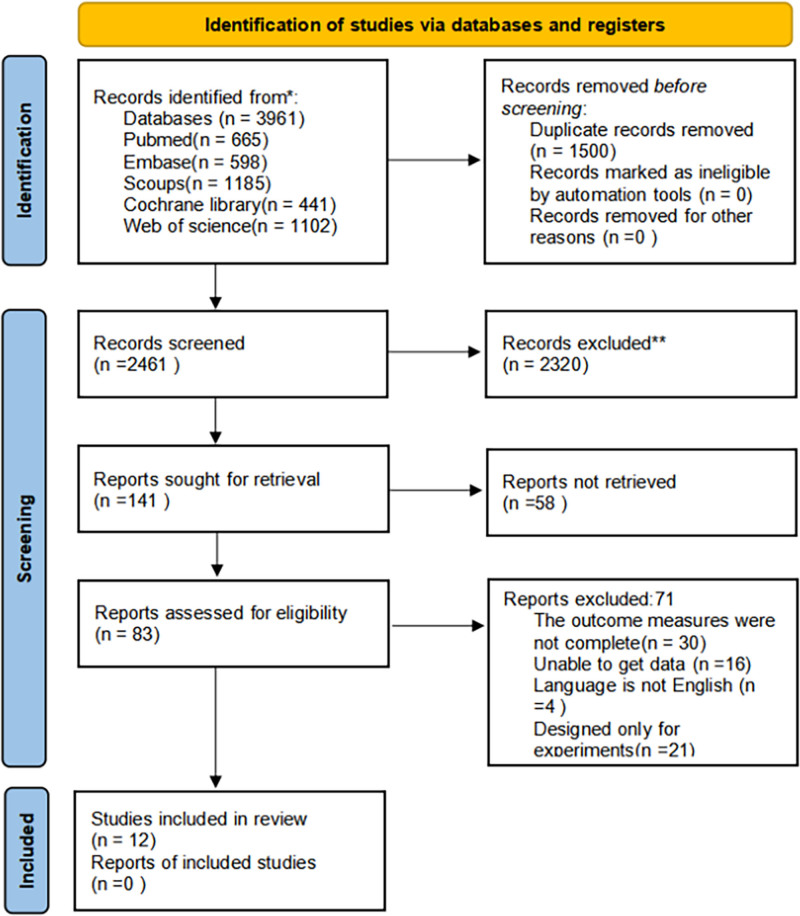
The Cochrane Library, PubMed, Web of Science, EMBASE, and Scopus databases in English were examined. Included were all randomized controlled trials (RCTs) that examined physical activity as a psychosocial remedy for PTSD sufferers. By the time of the meta-analysis search (February 2024), we had 12 RCT studies that met the eligibility requirements.
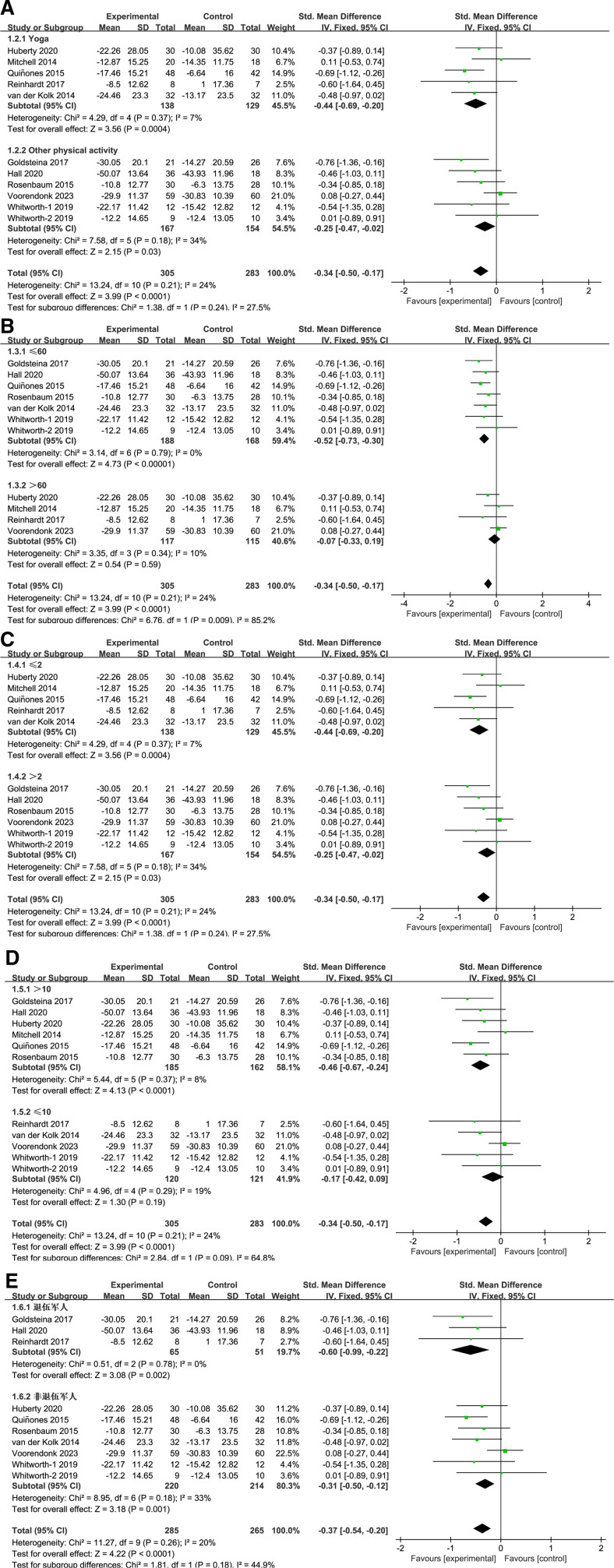
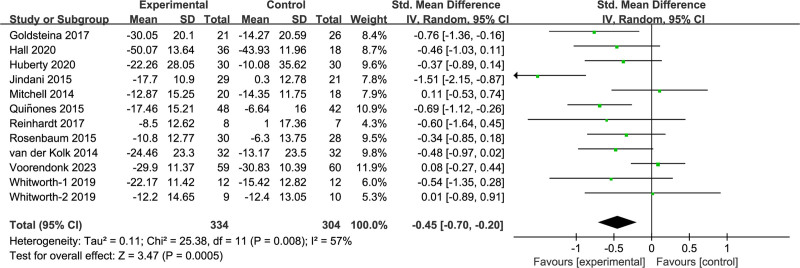
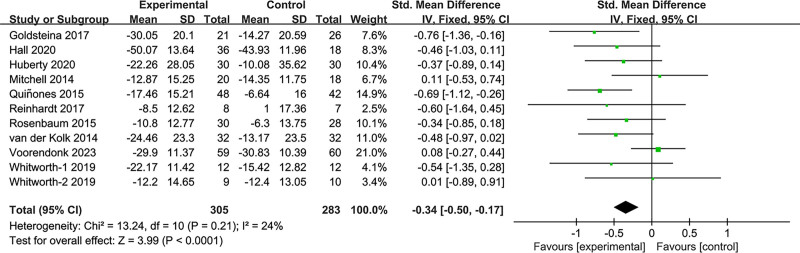
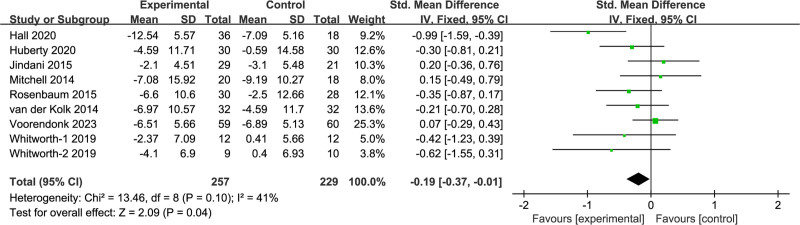
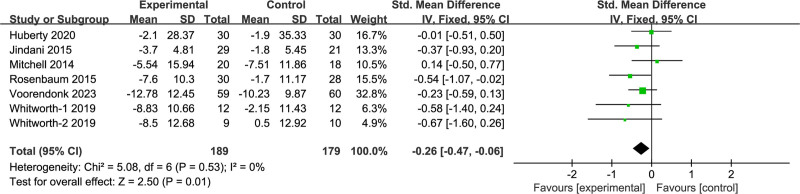
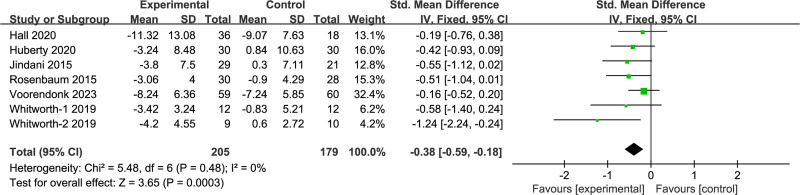
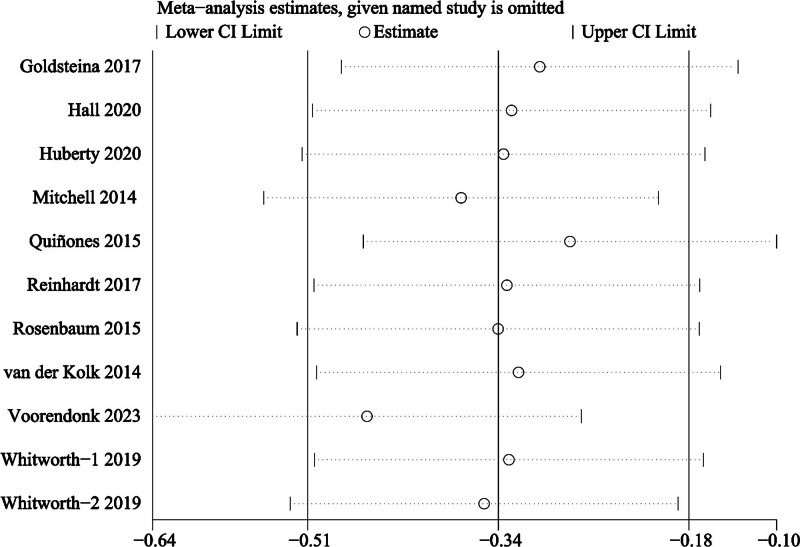
The study's findings demonstrated that physical activity improved sleep quality (standardized mean differences [SMD] = -0.38, 95% CI [-0.59, -0.18], Z = 3.65, P = .0003), anxiety (SMD = -0.26, 95% CI [-0.47, -0.06], Z = 2.5, P = .01), depression (SMD = -0.19, 95% CI [-0.37, -0.01], Z = 2.09, P = .04), and PTSD (SMD = -0.34, 95% CI [-0.50, -0.17], Z = 3.99, P < .0001). Each intervention ≤ 60 (SMD = -0.52, I2 = 0%, P < .00001), frequency of interventions ≤ 2 per week (SMD = -0.44, I2 = 7%, P = .0004), intervention cycles > 10 (SMD = -0.46, I2 = 8%, P < .0001), and the yoga group (SMD = -0.44, I2 = 7%, P = .0004) had the best impact, according to subgroup analyses. Veterans with PTSD responded most significantly to physical activity (SMD = -0.60, I2 = 0%, P = .002).
It was discovered that people with PTSD can benefit from physical activity as an adjuvant method to enhance their PTSD, anxiety, despair, and sleep quality. Yoga has been found through research to help the symptoms of people with PTSD more than other sports. Due to limitations such as small sample size and some heterogeneity in this meta-analysis, further confirmation through more scientific and objective RCTs is needed in order to obtain definitive conclusions on physical activity for patients with PTSD.
尽管人们普遍知道体育活动能有效减轻焦虑和抑郁,但创伤后应激障碍(PTSD)患者的相关研究结果却不尽相同。本研究旨在全面探讨体育活动如何影响PTSD患者的睡眠质量、焦虑、抑郁及PTSD症状。
检索了英文的Cochrane图书馆、PubMed、科学网、EMBASE和Scopus数据库。纳入所有将体育活动作为PTSD患者心理社会治疗方法的随机对照试验(RCT)。截至荟萃分析检索时(2024年2月),有12项RCT研究符合纳入标准。
研究结果表明,体育活动改善了睡眠质量(标准化均数差[SMD]=-0.38,95%可信区间[-0.59,-0.18],Z=3.65,P=0.0003)、焦虑(SMD=-0.26,95%可信区间[-0.47,-0.06],Z=2.5,P=0.01)、抑郁(SMD=-0.19,95%可信区间[-0.37,-0.01],Z=2.09,P=0.04)和PTSD症状(SMD=-0.34,95%可信区间[-0.50,-0.17],Z=3.99,P<0.0001)。亚组分析显示,每次干预≤60分钟(SMD=-0.52,I²=0%,P<0.00001)、干预频率≤每周2次(SMD=-0.44,I²=7%,P=0.0004)、干预周期>10次(SMD=-0.46,I²=8%,P<0.0001)以及瑜伽组(SMD=-0.44,I²=7%,P=0.0004)的效果最佳。患有PTSD的退伍军人对体育活动的反应最为显著(SMD=-0.60,I²=0%,P=0.002)。
发现PTSD患者可通过体育活动作为辅助方法来改善其PTSD、焦虑、抑郁和睡眠质量。研究发现,与其他运动相比,瑜伽对PTSD患者症状的改善作用更大。由于本荟萃分析存在样本量小和一些异质性等局限性,需要通过更科学、客观的RCT进行进一步验证,以便得出关于体育活动对PTSD患者的确切结论。