Castagnoli Lorenzo, Franceschini Alma, Cancila Valeria, Dugo Matteo, Bigliardi Martina, Chiodoni Claudia, Toneguzzo Paolo, Regondi Viola, Corsetto Paola A, Pietrantonio Filippo, Mazzucchelli Serena, Corsi Fabio, Belfiore Antonio, Vingiani Antonio, Pruneri Giancarlo, Ligorio Francesca, Colombo Mario P, Tagliabue Elda, Tripodo Claudio, Vernieri Claudio, Triulzi Tiziana, Pupa Serenella M
Microenvironment and Biomarkers of Solid Tumors Unit, Department of Experimental Oncology, Amadeolab Fondazione IRCCS Istituto Nazionale Dei Tumori Di Milano, Milan, Italy.
Tumor Immunology Unit, Department PROMISE, Universita' Di Palermo, Palermo, Italy.
J Exp Clin Cancer Res. 2025 Jan 20;44(1):19. doi: 10.1186/s13046-025-03276-z.
Growing evidence shows that the reprogramming of fatty acid (FA) metabolism plays a key role in HER2-positive (HER2 +) breast cancer (BC) aggressiveness, therapy resistance and cancer stemness. In particular, HER2 + BC has been defined as a "lipogenic disease" due to the functional and bi-directional crosstalk occurring between HER2-mediated oncogenic signaling and FA biosynthesis via FA synthase activity. In this context, the functional role exerted by the reprogramming of CD36-mediated FA uptake in HER2 + BC poor prognosis and therapy resistance remains unclear. In this study, we aimed to elucidate whether enhanced CD36 in mesenchymal HER2 + cancer stem cells (CSCs) is directly involved in anti-HER2 treatment refractoriness in HER2 + BC and to design future metabolism-based approaches targeting both FA reprogramming and the "root" of cancer.
Molecular, biological and functional characterization of CD36-mediated FA uptake was investigated in HER2 + BC patients, cell lines, epithelial and mesenchymal CSCs. Cell proliferation was analyzed by SRB assay upon treatment with lapatinib, CD36 inhibitor, or Wnt antagonist/agonist. Engineered cell models were generated via lentivirus infection and transient silencing. CSC-like properties and tumorigenesis of HER2 + BC cells with or without CD36 depletion were examined by mammosphere forming efficiency assay, flow cytometry, cell sorting, ALDH activity assay and xenograft mouse model. FA uptake was examined by flow cytometry with FA BODIPY FL C16. Intratumor expression of CSC subsets was evaluated via multiplex immunostaining and immunolocalization analysis.
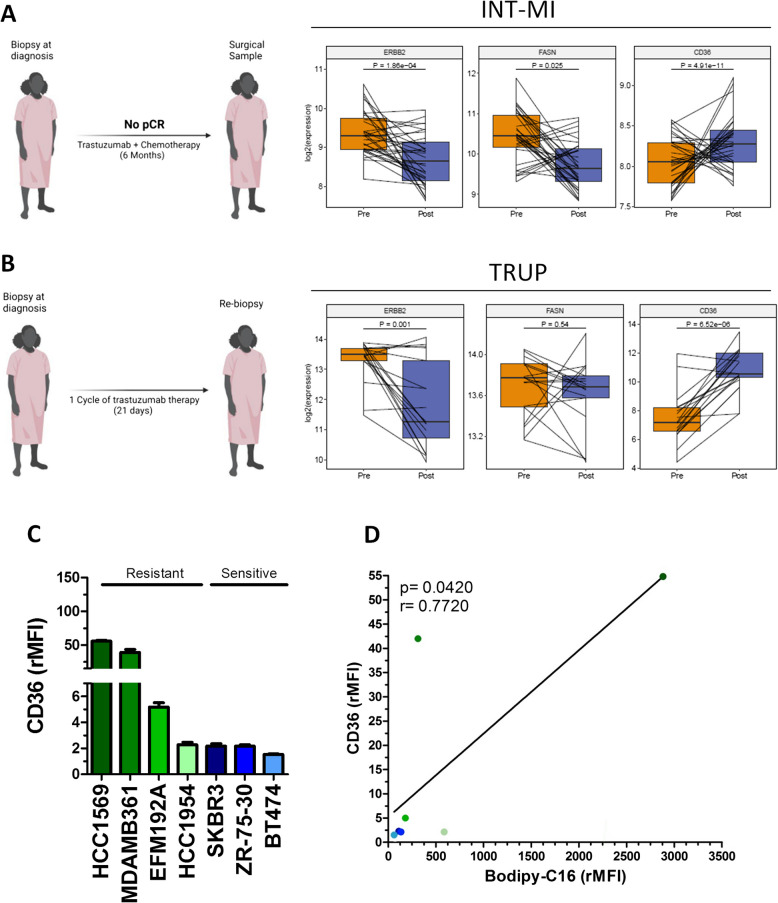
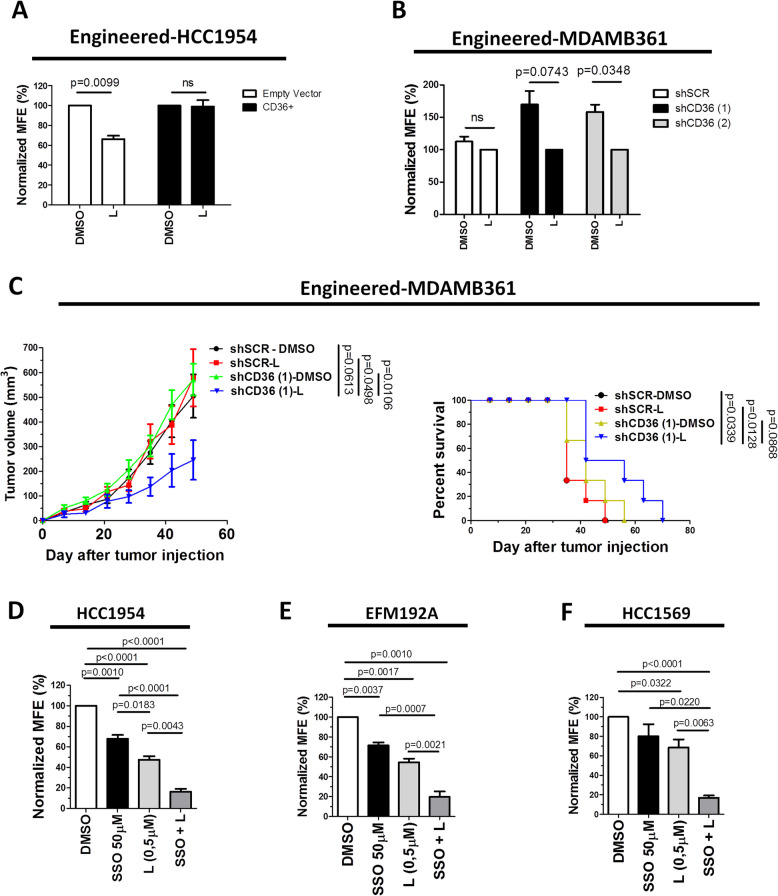
Molecular data demonstrated that CD36 is significantly upmodulated on treatment in therapy resistant HER2 + BC patients and its expression levels in BC cells is correlated with FA uptake. We provided evidence of a consistent enrichment of CD36 in HER2 + epithelial-mesenchymal transition (EMT)-like CSCs from all tested resistant cell models that mechanistically occurs via Wnt signaling pathway activation. Consistently, both in vitro and in vivo dual blockade of CD36 and HER2 increased the anti-CSC efficacy of anti-HER2 drugs favoring the transition of the therapy resistant mesenchymal CSCs into therapy-sensitive mesenchymal-epithelial transition (MET)-like epithelial state. In addition, expression of CD36 in intratumor HER2 + mesenchymal CSCs is significantly associated with resistance to trastuzumab in HER2 + BC patients.
These results support the metabolo-oncogenic nature of CD36-mediated FA uptake in HER2 + therapy-refractory BC. Our study provides evidence that targeting CD36 might be an effective metabolic therapeutic strategy in the treatment of this malignancy.
越来越多的证据表明,脂肪酸(FA)代谢重编程在人表皮生长因子受体2阳性(HER2 +)乳腺癌(BC)的侵袭性、治疗耐药性和癌症干性中起关键作用。特别是,由于HER2介导的致癌信号与通过脂肪酸合酶活性进行的FA生物合成之间存在功能性和双向串扰,HER2 + BC被定义为一种“脂肪生成性疾病”。在此背景下,CD36介导的FA摄取重编程在HER2 + BC预后不良和治疗耐药性中发挥的功能作用仍不清楚。在本研究中,我们旨在阐明间充质HER2 + 癌症干细胞(CSCs)中增强的CD36是否直接参与HER2 + BC的抗HER2治疗难治性,并设计未来基于代谢的方法来靶向FA重编程和癌症“根源”。
在HER2 + BC患者、细胞系、上皮和间充质CSCs中研究了CD36介导的FA摄取的分子、生物学和功能特征。在用拉帕替尼、CD36抑制剂或Wnt拮抗剂/激动剂处理后,通过SRB测定法分析细胞增殖。通过慢病毒感染和瞬时沉默生成工程细胞模型。通过乳腺球形成效率测定、流式细胞术、细胞分选、ALDH活性测定和异种移植小鼠模型检查有无CD36缺失的HER2 + BC细胞的CSC样特性和肿瘤发生。用FA BODIPY FL C16通过流式细胞术检测FA摄取。通过多重免疫染色和免疫定位分析评估肿瘤内CSC亚群的表达。
分子数据表明,在治疗耐药的HER2 + BC患者中,CD36在治疗后显著上调,其在BC细胞中的表达水平与FA摄取相关。我们提供的证据表明,在所有测试的耐药细胞模型中,HER2 + 上皮-间质转化(EMT)样CSCs中CD36持续富集,这一过程通过Wnt信号通路激活在机制上发生。一致地,在体外和体内对CD36和HER2的双重阻断增加了抗HER2药物的抗CSC疗效,有利于将治疗耐药的间充质CSCs转变为治疗敏感的间质-上皮转化(MET)样上皮状态。此外,HER2 + BC患者肿瘤内HER2 + 间充质CSCs中CD36的表达与曲妥珠单抗耐药显著相关。
这些结果支持了CD36介导的FA摄取在HER2 + 难治性BC中的代谢致癌性质。我们的研究提供了证据表明,靶向CD36可能是治疗这种恶性肿瘤的一种有效的代谢治疗策略。