Tooby James, Rowson Steve, Till Kevin, Allan David, Bussey Melanie Dawn, Cazzola Dario, Falvey Éanna, Friesen Kenzie, Gardner Andrew J, Owen Cameron, Roe Gregory, Sawczuk Thomas, Starling Lindsay, Stokes Keith, Tierney Gregory, Tucker Ross, Jones Ben
Carnegie Applied Rugby Research (CARR) Centre, Carnegie School of Sport, Leeds Beckett University, Leeds, UK.
Biomedical Engineering and Mechanics, Virginia Tech, Blacksburg, VA, USA.
Ann Biomed Eng. 2025 Apr;53(4):923-933. doi: 10.1007/s10439-025-03679-1. Epub 2025 Jan 21.
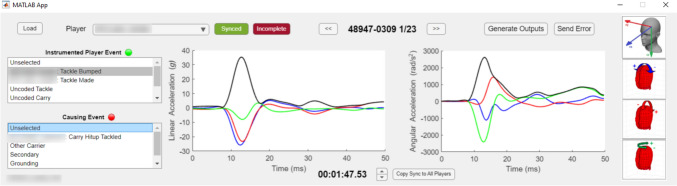
Head acceleration events (HAEs) are a growing concern in contact sports, prompting two rugby governing bodies to mandate instrumented mouthguards (iMGs). This has resulted in an influx of data imposing financial and time constraints. This study presents two computational methods that leverage a dataset of video-coded match events: cross-correlation synchronisation aligns iMG data to a video recording, by providing playback timestamps for each HAE, enabling analysts to locate them in video footage; and post-synchronisation event matching identifies the coded match event (e.g. tackles and ball carries) from a video analysis dataset for each HAE, this process is important for calculating the probability of match events resulting in HAEs. Given the professional context of iMGs in rugby, utilising commercial sources of coded match event datasets may expedite iMG analysis.
Accuracy and validity of the methods were assessed via video verification during 60 rugby matches. The accuracy of cross-correlation synchronisation was determined by calculating synchronisation error, whilst the validity of post-synchronisation event matching was evaluated using diagnostic accuracy measures (e.g. positive predictive value [PPV] and sensitivity).
Cross-correlation synchronisation yielded mean synchronisation errors of 0.61-0.71 s, with all matches synchronised within 3 s' error. Post-synchronisation event matching achieved PPVs of 0.90-0.95 and sensitivity of 0.99-1.00 for identifying correct match events for SAEs.
Both methods achieved high accuracy and validity with the data sources used in this study. Implementation depends on the availability of a dataset of video-coded match events; however, integrating commercially available video-coded datasets offers the potential to expedite iMG analysis, improve feedback timeliness, and augment research analysis.
头部加速事件(HAEs)在接触性运动中日益受到关注,促使两个橄榄球管理机构强制使用仪器化护齿(iMGs)。这导致了大量数据的涌入,带来了财务和时间限制。本研究提出了两种利用视频编码比赛事件数据集的计算方法:互相关同步通过为每个HAE提供回放时间戳,将iMG数据与视频记录对齐,使分析人员能够在视频片段中定位它们;后同步事件匹配从每个HAE的视频分析数据集中识别编码的比赛事件(例如擒抱和带球),这一过程对于计算导致HAEs的比赛事件概率很重要。鉴于iMGs在橄榄球中的专业背景,利用编码比赛事件数据集的商业来源可能会加快iMG分析。
通过对60场橄榄球比赛进行视频验证,评估了这些方法的准确性和有效性。互相关同步的准确性通过计算同步误差来确定,而后同步事件匹配的有效性则使用诊断准确性指标(例如阳性预测值[PPV]和敏感性)进行评估。
互相关同步产生的平均同步误差为0.61 - 0.71秒,所有比赛的同步误差均在3秒以内。后同步事件匹配在识别SAEs的正确比赛事件时,PPV为0.90 - 0.95,敏感性为0.99 - 1.00。
本研究中使用的数据源使这两种方法都具有很高的准确性和有效性。实施取决于视频编码比赛事件数据集的可用性;然而,整合商业可用的视频编码数据集有可能加快iMG分析、提高反馈及时性并增强研究分析。