Colaneri Marta, Canuti Marta, Torrigiani Ginevra, Dall'Olio Lucia, Bobbio Chiara, Baldi Sante L, Nobili Alessandro, Puoti Massimo, Marchetti Giulia, Piva Simone, Plebani Pierluigi, Raviglione Mario, Gori Andrea, Cereda Danilo, Leoni Olivia, Fortino Ida, Ojeda-Fernandez Maria Luisa, Baviera Marta, Tettamanti Mauro, Bandera Alessandra
Department of Biomedical and Clinical Sciences, Infectious and Tropical Diseases Operational Unit ASST Fatebenefratelli Sacco, "L. Sacco" University Hospital, Via Giovanni Battista Grassi, 20157, Milan, Italy.
Department of Veterinary and Animal Sciences, University of Copenhagen, Stigbøjlen 4, 2000, Frederiksberg, Denmark.
Infect Dis Ther. 2025 Feb;14(2):447-461. doi: 10.1007/s40121-024-01107-w. Epub 2025 Jan 21.
Predictors of coronavirus disease 2019 (COVID-19)-related rehospitalization remain underexplored. This study aims to identify the main risk factors associated with rehospitalizations due to severe acute respiratory syndrome coronavirus 2 (SARS-CoV-2) reinfections among residents of Lombardy, northern Italy.
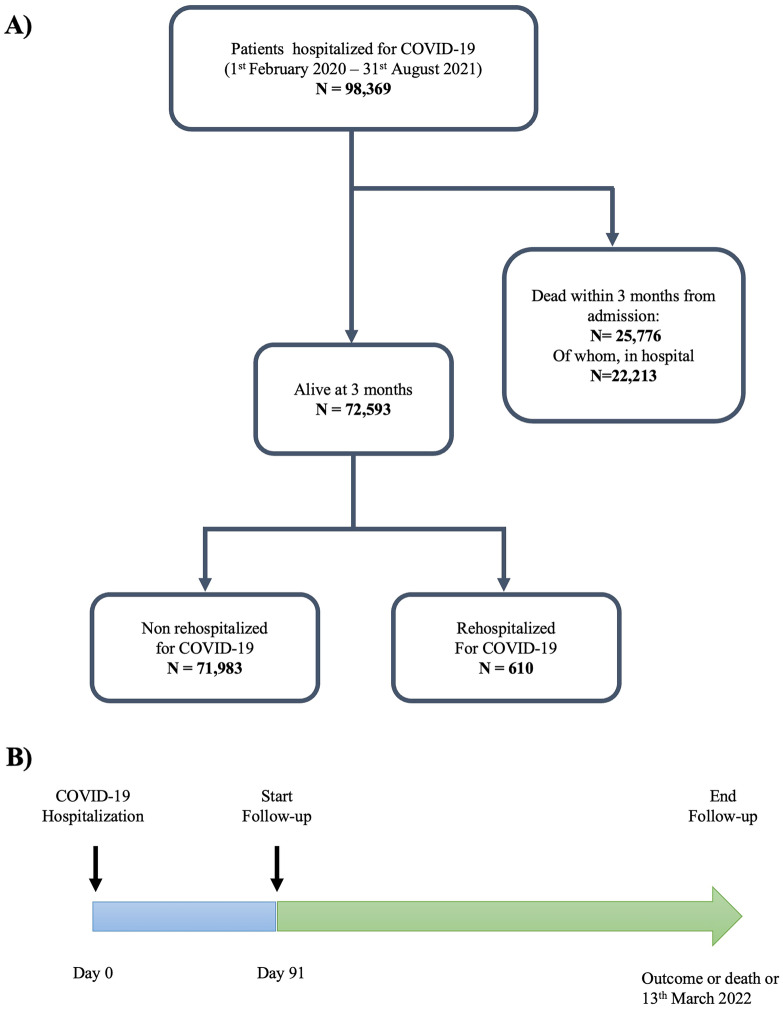
A retrospective observational study was conducted using two linked administrative databases covering demographic data, comorbidities, hospital records, and COVID-19 data of Lombardy residents. The study population included patients hospitalized for COVID-19 between February 2020 and August 2021. Rehospitalization was defined as a second COVID-19-related hospitalization occurring at least 90 days after the first admission. The Fine-Gray subdistribution hazard model was used to identify risk factors, accounting for death as a competing risk.
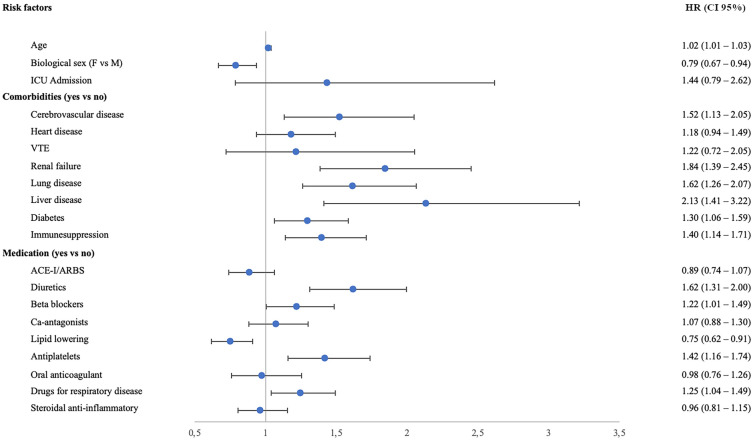
Out of 98,369 patients hospitalized for COVID-19 between February 1, 2020 and August 31, 2021, 72,593 were alive 90 days after admission and 610 of these (0.8%) were rehospitalized. A higher rehospitalization risk was observed in older male patients with multiple comorbidities. Renal failure, liver disease, and use of diuretics were significantly associated with rehospitalization risk, while female biological sex and the use of lipid-lowering drugs were associated with a lower risk.
This is the first study conducted on regional administrative databases to investigate COVID-19 rehospitalizations. Through the availability of a huge cohort, it provides a groundwork for optimizing care for individuals at higher risk for COVID-19-related rehospitalizations. It underlines the need for patient-management approaches that extend beyond the initial recovery. This stresses the importance of ongoing monitoring and personalized interventions for those at heightened risk not only of SARS-CoV-2 reinfection but also related rehospitalizations.
2019年冠状病毒病(COVID-19)相关再住院的预测因素仍未得到充分研究。本研究旨在确定意大利北部伦巴第地区居民中因严重急性呼吸综合征冠状病毒2(SARS-CoV-2)再次感染而导致再住院的主要风险因素。
采用回顾性观察研究,使用两个相关的行政数据库,涵盖伦巴第地区居民的人口统计学数据、合并症、医院记录和COVID-19数据。研究人群包括2020年2月至2021年8月期间因COVID-19住院的患者。再住院定义为首次入院至少90天后发生的第二次COVID-19相关住院。使用Fine-Gray亚分布风险模型来识别风险因素,并将死亡作为竞争风险进行考虑。
在2020年2月1日至2021年8月31日期间因COVID-19住院的98369名患者中,72593人在入院90天后仍存活,其中610人(0.8%)再次住院。在患有多种合并症的老年男性患者中观察到较高的再住院风险。肾衰竭、肝病和使用利尿剂与再住院风险显著相关,而女性性别和使用降脂药物与较低风险相关。
这是第一项基于地区行政数据库对COVID-19再住院情况进行调查的研究。通过大量队列的可用性,它为优化对COVID-19相关再住院风险较高个体的护理提供了基础。它强调了超越初始康复阶段的患者管理方法的必要性。这凸显了对那些不仅有SARS-CoV-2再次感染风险而且有相关再住院风险的高危人群进行持续监测和个性化干预的重要性。