Lerolle Apolline, Micoulaud-Franchi Jean-Arthur, Fourneret Pierre, Heeren Alexandre, Gauld Christophe
Service Psychopathologie du Développement de l'Enfant et de l'Adolescent, Hospices Civils de Lyon & Université de Lyon 1, Lyon, France.
University Sleep Medicine Department, University Hospital of Bordeaux, Bordeaux, France.
Front Psychol. 2025 Jan 7;15:1408835. doi: 10.3389/fpsyg.2024.1408835. eCollection 2024.
A limited number of studies have explored the connection between eco-anxiety, anxiety, and depression in adolescents. However, the relation between eco-anxiety and suicide remains unexamined. This cross-sectional observational study aims to bridge this gap by investigating the correlation between eco-anxiety intensity and suicide risk severity in adolescents.
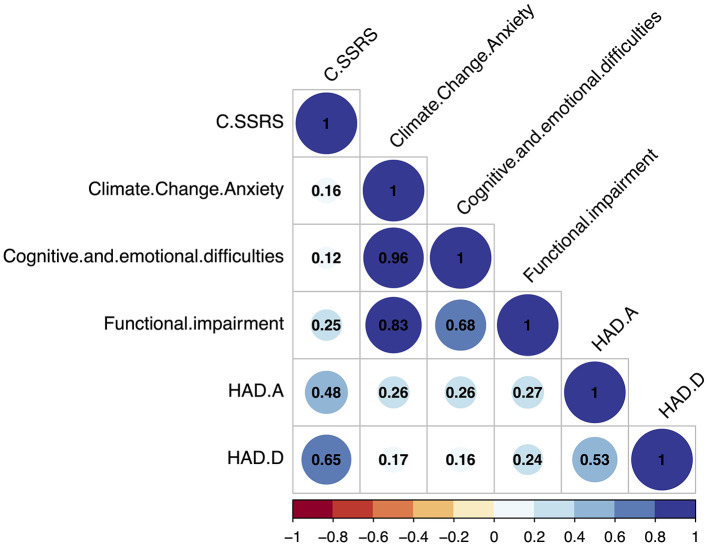
We used validated French versions of the Climate Anxiety Scale (CAS) and its two key dimensions (cognitive and emotional and functional impairments), alongside the Columbia Suicide Severity Rating Scale (C-SSRS) and the Hospital Anxiety and Depression scale (HAD).
Our study involved 87 hospitalized adolescent patients, aged 12-16. Although, the univariate model indicated a significant association between the CAS and the C-SSRS (β = 2.58; = 0.049), the cognitive/emotional difficulties and functional impairment dimensions of eco-anxiety, considering different confounding factors, did not show statistical associations with the severity of suicide risk (respectively, = 0.81 and = 0.76).
In an expansive literature, these results show for the first time that eco-anxiety may not be the priority of adolescents seen by adolescent psychiatrists. Such an observation would imply not overmedicalizing a dimension of life which perhaps does not fall solely within the field of medicine, but which concerns environmental issues broader than medical field. However, an ethical and prudent approach in mental health care for this particularly fragile population remains necessary. This intersection of eco-anxiety and suicide in youth opens up new avenues of research in the realm of environmental and mental health studies.
仅有少数研究探讨了青少年生态焦虑、焦虑和抑郁之间的联系。然而,生态焦虑与自杀之间的关系仍未得到研究。这项横断面观察性研究旨在通过调查青少年生态焦虑强度与自杀风险严重程度之间的相关性来填补这一空白。
我们使用了经过验证的法语版气候焦虑量表(CAS)及其两个关键维度(认知、情绪和功能障碍),以及哥伦比亚自杀严重程度评定量表(C-SSRS)和医院焦虑抑郁量表(HAD)。
我们的研究纳入了87名年龄在12至16岁之间的住院青少年患者。虽然单变量模型表明CAS与C-SSRS之间存在显著关联(β = 2.58;P = 0.049),但考虑到不同的混杂因素,生态焦虑的认知/情绪困难和功能障碍维度与自杀风险严重程度未显示出统计学关联(分别为P = 0.81和P = 0.76)。
在大量文献中,这些结果首次表明生态焦虑可能不是青少年精神科医生所诊治青少年的首要问题。这样的观察结果意味着不要过度医疗化生活中的一个维度,这个维度可能不完全属于医学领域,而是涉及比医学领域更广泛的环境问题。然而,对于这个特别脆弱的人群,在精神卫生保健中采取道德和谨慎的方法仍然是必要的。青少年中生态焦虑与自杀的这种交叉为环境与精神卫生研究领域开辟了新的研究途径。