
特发性早发性脊柱侧弯支具治疗至骨骼成熟时的有效性:一项系统评价与荟萃分析
Bracing effectiveness in idiopathic early onset scoliosis followed to skeletal maturity: a systematic review and meta-analysis.
作者信息
Bellamy Matthew, Tung Wei Shao, Jayasuriya Raveen, Hind Daniel, Swaby Lizzie, Totton Nikki, Cole Ashley
机构信息
The Medical School, University of Sheffield, Beech Hill Road, Sheffield, S10 2RX, UK.
Department of Paediatric Orthopaedics and Spinal Surgery, Sheffield Children's Hospital, Clarkson Street, Broomhall, Sheffield, S10 2TH, UK.
出版信息
Spine Deform. 2025 May;13(3):939-950. doi: 10.1007/s43390-025-01043-w. Epub 2025 Jan 22.
PURPOSE
Treating idiopathic Early Onset Scoliosis (idiopathic EOS) is challenging due to ongoing growth and extensive follow-ups. While bracing is effective for Adolescent Idiopathic Scoliosis (AIS), its value for children under 10 remains debated. This systematic review and meta-analysis evaluates the effectiveness of spinal bracing in idiopathic EOS, followed to skeletal maturity.
METHODS
We searched Ovid Medline and Web of Science until November 1st, 2023. Studies included idiopathic EOS patients between the ages of 3 and 10 (corresponding to Juvenile Idiopathic Scoliosis), followed to skeletal maturity, with no more than 25% initiating bracing after age 11. The primary outcome was the percentage undergoing scoliosis surgery. Pooled outcomes were calculated using a random effects model and 95% confidence intervals.
RESULTS
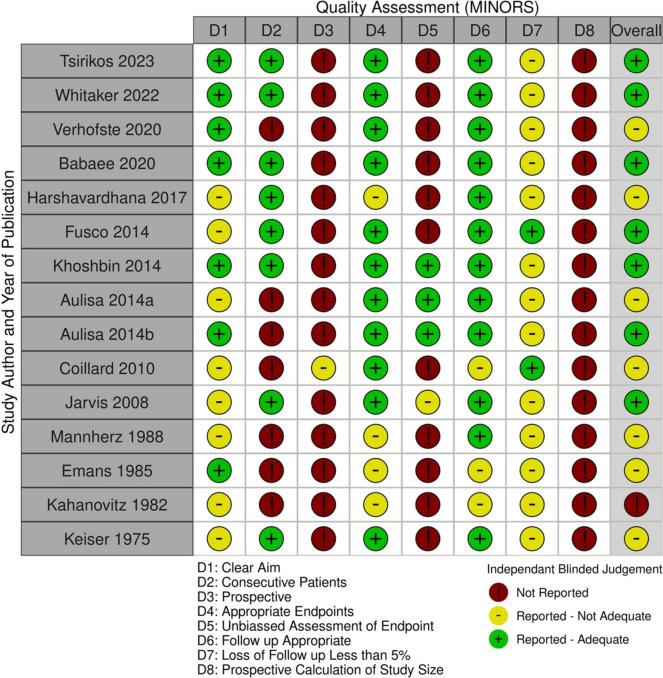
Out of 417 studies, 15 met the inclusion criteria, encompassing 868 patients. All were observational with a high risk of bias. The pooled percentage of patients undergoing surgery was 40% (95% CI 27-55%). The percentage of patients with a 5-degree progression or more and those progressing beyond 45 degrees were 44% (95% CI 24-66%) and 33% (95% CI 17-54%), respectively. Factors including larger initial Cobb angles, younger age, smaller in-brace correction, and poor compliance were identified as progression risk factors.
CONCLUSIONS
Bracing may prevent progression to surgery in idiopathic EOS when initiated early, but progression and surgery are still more common compared to adolescents. This is the first systematic review and meta-analysis looking at the success of bracing in idiopathic EOS, followed up to skeletal maturity. The high bias and variability of included studies limit the strength of these conclusions, highlighting the need for high-quality research with innovative trial designs.
LEVEL OF EVIDENCE
IV (systematic review of level IV studies).
目的
由于患儿仍在生长且需要长期随访,治疗特发性早发性脊柱侧凸(特发性EOS)具有挑战性。虽然支具治疗对青少年特发性脊柱侧凸(AIS)有效,但其对10岁以下儿童的价值仍存在争议。本系统评价和荟萃分析评估了脊柱支具治疗特发性EOS直至骨骼成熟的有效性。
方法
我们检索了Ovid Medline和Web of Science数据库,检索截至2023年11月1日的文献。纳入的研究对象为年龄在3至10岁之间的特发性EOS患者(相当于青少年特发性脊柱侧凸),随访至骨骼成熟,且11岁后开始使用支具的患者不超过25%。主要结局是接受脊柱侧凸手术的患者百分比。采用随机效应模型计算合并结局及95%置信区间。
结果
在417项研究中,15项符合纳入标准,共纳入868例患者。所有研究均为观察性研究,存在较高的偏倚风险。接受手术的患者合并百分比为40%(95%CI 27-55%)。Cobb角进展5度或以上以及进展超过45度的患者百分比分别为44%(95%CI 24-66%)和33%(95%CI 17-54%)。初始Cobb角较大、年龄较小、支具内矫正较小以及依从性差等因素被确定为进展危险因素。
结论
早期使用支具可能预防特发性EOS进展至手术,但与青少年相比,进展和手术仍更为常见。这是第一项系统评价和荟萃分析,观察了支具治疗特发性EOS直至骨骼成熟的成功率。纳入研究的高偏倚性和变异性限制了这些结论的可信度,凸显了采用创新试验设计进行高质量研究的必要性。
证据级别
IV级(IV级研究的系统评价)。




 Zotero 插件