Elsayed Abdelrahman M, Kittaneh Muaiad, Cebulla Colleen M, Abdel-Rahman Mohamed H
Havener Eye Institute, Department of Ophthalmology and Visual Science, The Ohio State University Wexner Medical Center, Columbus, OH 43210, USA; Department of Pharmacology and Toxicology, Faculty of Pharmacy, Al-Azhar University, Cairo 11651, Egypt.
Department of Oncology, Loyola University Chicago, Maywood, IL 60660, USA.
Biochim Biophys Acta Rev Cancer. 2025 Apr;1880(2):189267. doi: 10.1016/j.bbcan.2025.189267. Epub 2025 Jan 21.
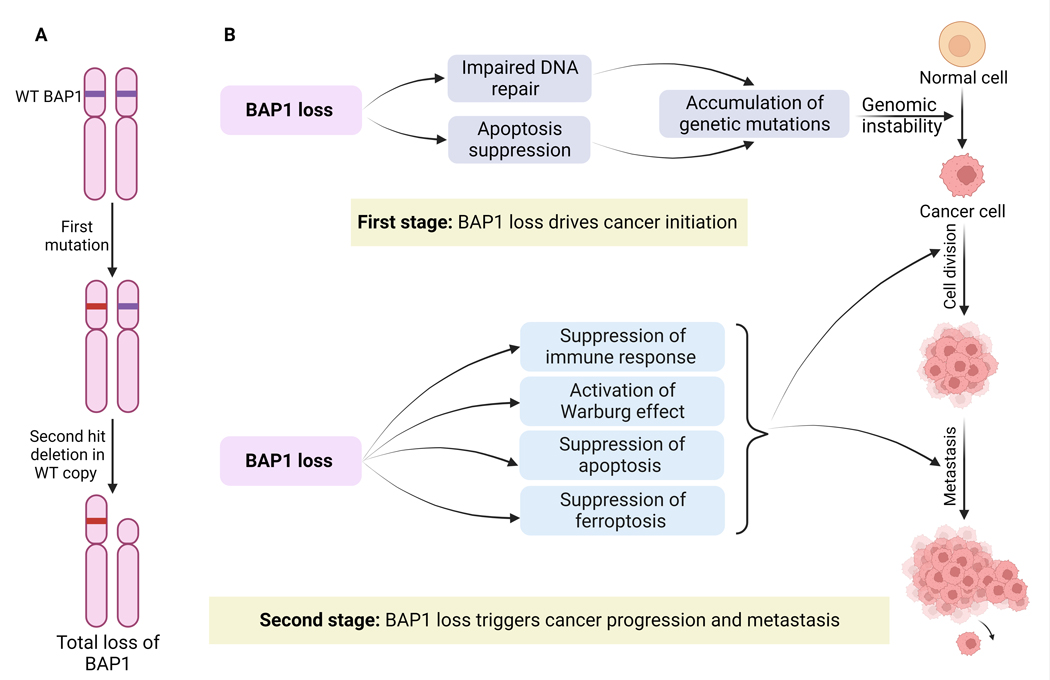
BRCA1-associated protein 1 (BAP1) is a tumor suppressor gene that was first identified in 1998. Germline loss-of-function variants in BAP1 are associated with a tumor predisposition syndrome with at least four cancers: uveal melanoma (UM), malignant mesothelioma (MMe), renal cell carcinoma (RCC), and cutaneous melanoma (CM). Furthermore, somatic BAP1 mutations are important drivers for several cancers most notably UM, MMe, RCC, intrahepatic cholangiocarcinoma (ICC) and hepatocellular carcinoma (HCC). Emerging evidence substantiates the fundamental role of BAP1 in suppressing cancer initiation and progression by tuning DNA damage repair, apoptosis, ferroptosis, immune response, Warburg phenomenon, and metastasis. Multiple treatment strategies such as poly (ADP-ribose) polymerase (PARP) inhibitors, EZH2 inhibitors, alkylating agents, and immunotherapy have been used as potential therapies for BAP1-mutated tumors. Although these agents showed promising results in BAP1-mutated tumors in preclinical studies, the results of most clinical trials are still dismal. The objectives of this review are to summarize the current state of knowledge regarding the biological functions of BAP1, the implications of these functions in tumorigenesis, and the current progress in BAP1-targeted therapy.
乳腺癌1号关联蛋白1(BAP1)是一种肿瘤抑制基因,于1998年首次被发现。BAP1的种系功能丧失变异与一种肿瘤易感性综合征相关,该综合征至少涉及四种癌症:葡萄膜黑色素瘤(UM)、恶性间皮瘤(MMe)、肾细胞癌(RCC)和皮肤黑色素瘤(CM)。此外,BAP1的体细胞突变是多种癌症的重要驱动因素,最显著的是UM、MMe、RCC、肝内胆管癌(ICC)和肝细胞癌(HCC)。新出现的证据证实了BAP1在通过调节DNA损伤修复、细胞凋亡、铁死亡、免疫反应、瓦伯格效应和转移来抑制癌症发生和进展方面的基本作用。多种治疗策略,如聚(ADP-核糖)聚合酶(PARP)抑制剂、EZH2抑制剂、烷化剂和免疫疗法,已被用作BAP1突变肿瘤的潜在治疗方法。尽管这些药物在临床前研究中对BAP1突变肿瘤显示出有希望的结果,但大多数临床试验的结果仍然令人沮丧。本综述的目的是总结关于BAP1生物学功能的当前知识状态、这些功能在肿瘤发生中的意义以及BAP1靶向治疗的当前进展。