Repo Pauliina E, Backlund Michael P, Kivelä Tero T, Turunen Joni A
Eye Genetics Group, Folkhälsan Research Center, Biomedicum Helsinki, Haartmaninkatu 8, FI-00290, Helsinki, Finland.
Ocular Oncology Service, Department of Ophthalmology, University of Helsinki and Helsinki University Hospital, Haartmaninkatu 4 C, PL220, FI-00029 HUS, Helsinki, Finland.
Hum Mol Genet. 2024 Feb 18;33(5):426-434. doi: 10.1093/hmg/ddad193.
Pathogenic germline variants in BRCA1-Associated Protein 1 (BAP1) cause BAP1 tumor predisposition syndrome (BAP1-TPDS). Carriers run especially a risk of uveal (UM) and cutaneous melanoma, malignant mesothelioma, and clear cell renal carcinoma. Approximately half of increasingly reported BAP1 variants lack accurate classification. Correct interpretation of pathogenicity can improve prognosis of the patients through tumor screening with better understanding of BAP1-TPDS.
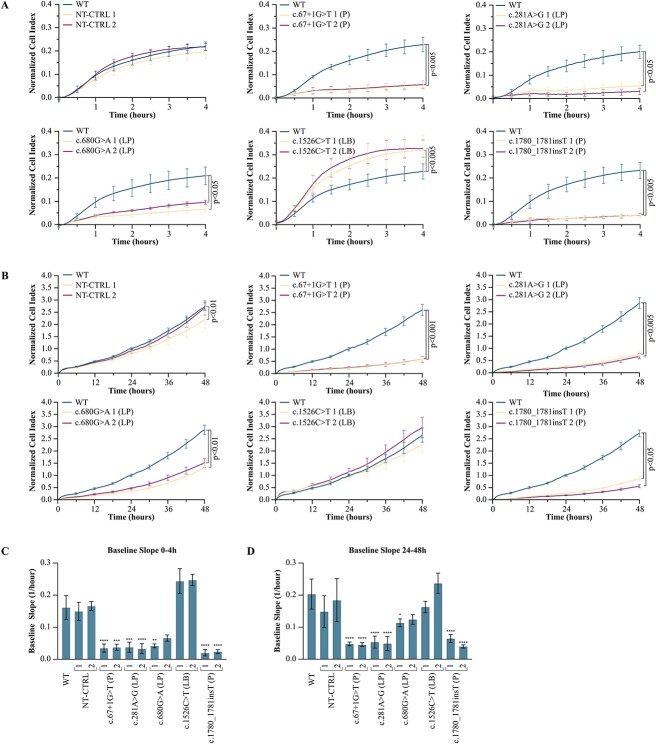
We edited five rare BAP1 variants with differing functional characteristics identified from patients with UM in HAP1 cells using CRISPR-Cas9 and assayed their effect on cell adhesion/spreading (at 4 h) and proliferation (at 48 h), measured as cell index (CI), using xCELLigence real-time analysis system.
In BAP1 knockout HAP1 cultures, cell number was half of wild type (WT) cultures at 48 h (p = 0.00021), reaching confluence later, and CI was 78% reduced (p < 0.0001). BAP1-TPDS-associated null variants c.67+1G>T and c.1780_1781insT, and a likely pathogenic missense variant c.281A>G reduced adhesion (all p ≤ 0.015) and proliferation by 74%-83% (all p ≤ 0.032). Another likely pathogenic missense variant c.680G>A reduced both by at least 50% (all p ≤ 0.032), whereas cells edited with likely benign one c.1526C>T grew similarly to WT.
BAP1 is essential for optimal fitness of HAP1 cells. Pathogenic and likely pathogenic BAP1 variants reduced cell fitness, reflected in adhesion/spreading and proliferation properties. Further, moderate effects were quantifiable. Variant modelling in HAP1 with CRISPR-Cas9 enabled functional analysis of coding and non-coding region variants in an endogenous expression system.
乳腺癌1号相关蛋白1(BAP1)的致病性种系变异会导致BAP1肿瘤易感性综合征(BAP1-TPDS)。携带者尤其有患葡萄膜黑色素瘤(UM)、皮肤黑色素瘤、恶性间皮瘤和透明细胞肾癌的风险。在越来越多报道的BAP1变异中,约有一半缺乏准确的分类。正确解读致病性可通过肿瘤筛查改善患者预后,同时更好地了解BAP1-TPDS。
我们使用CRISPR-Cas9在HAP1细胞中编辑了从UM患者中鉴定出的五个具有不同功能特征的罕见BAP1变异,并使用xCELLigence实时分析系统测定它们对细胞黏附/铺展(4小时时)和增殖(48小时时)的影响,以细胞指数(CI)衡量。
在BAP1基因敲除的HAP1培养物中,48小时时细胞数量是野生型(WT)培养物的一半(p = 0.00021),汇合时间更晚,CI降低了78%(p < 0.0001)。与BAP1-TPDS相关的无效变异c.67+1G>T和c.1780_1781insT,以及一个可能致病的错义变异c.281A>G降低了黏附(所有p≤0.015),并使增殖降低了74%-83%(所有p≤0.032)。另一个可能致病的错义变异c.680G>A使两者至少降低了50%(所有p≤≤0.032),而用可能为良性的变异c.1526C>T编辑的细胞生长情况与WT相似。
BAP1对HAP1细胞的最佳适应性至关重要。致病性和可能致病的BAP1变异降低了细胞适应性,这在黏附/铺展和增殖特性中得到体现。此外,可量化其适度影响。利用CRISPR-Cas9在HAP1中进行变异建模,能够在内源表达系统中对编码区和非编码区变异进行功能分析。