Jarquín-Díaz Víctor Hugo, Dayaram Anisha, Soilemetzidou Eirini S, Desvars-Larrive Amelie, Bohner Julia, Buuveibaatar Bayarbaatar, Kaczensky Petra, Walzer Chris, Greenwood Alex D, Löber Ulrike
Department of Wildlife Diseases, Leibniz Institute for Zoo and Wildlife Research, Alfred- Kowalke Str. 17, 10315, Berlin, Germany.
Experimental and Clinical Research Center, a cooperation between the Max-Delbrück-Center for Molecular Medicine in the Helmholtz Association and the Charité - Universitätsmedizin Berlin, Berlin, Germany.
Sci Rep. 2025 Jan 22;15(1):2767. doi: 10.1038/s41598-025-87216-z.
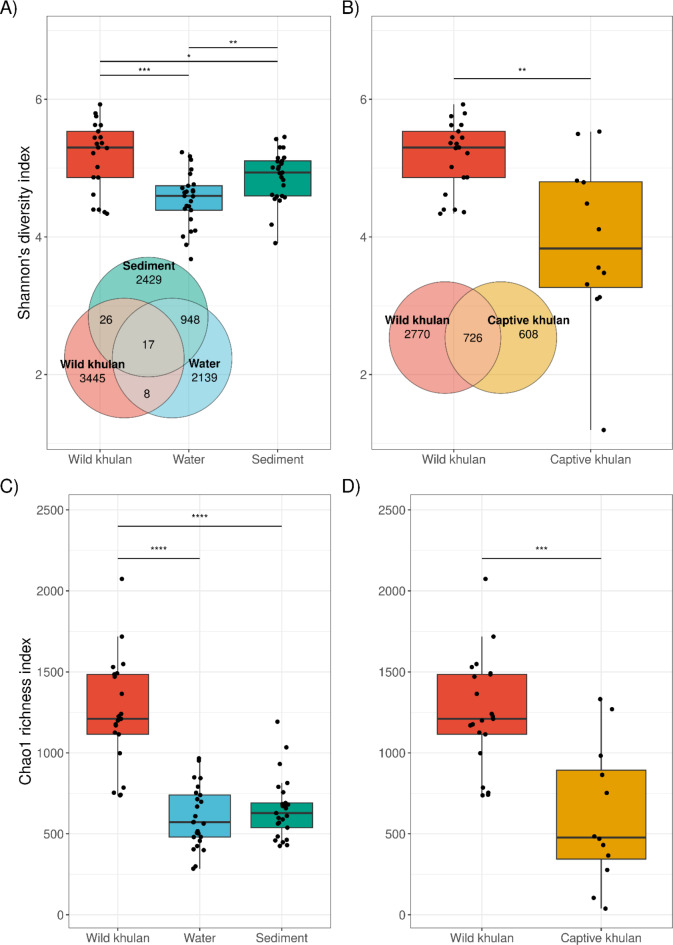
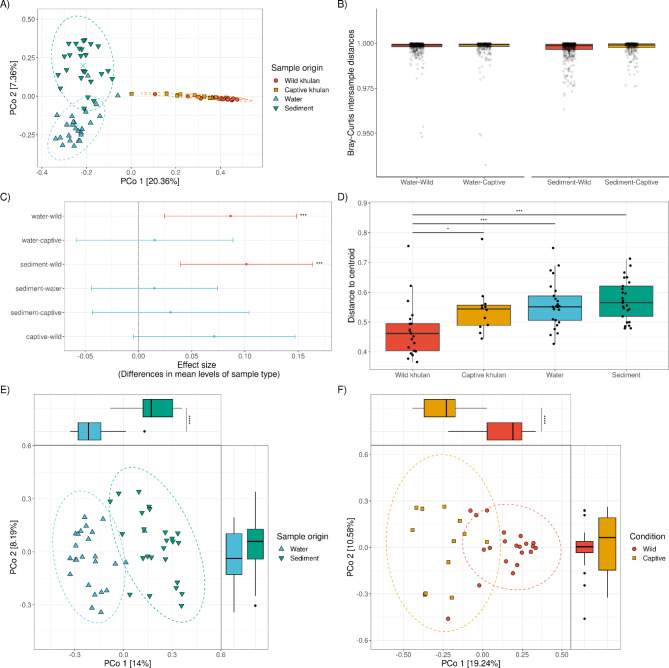
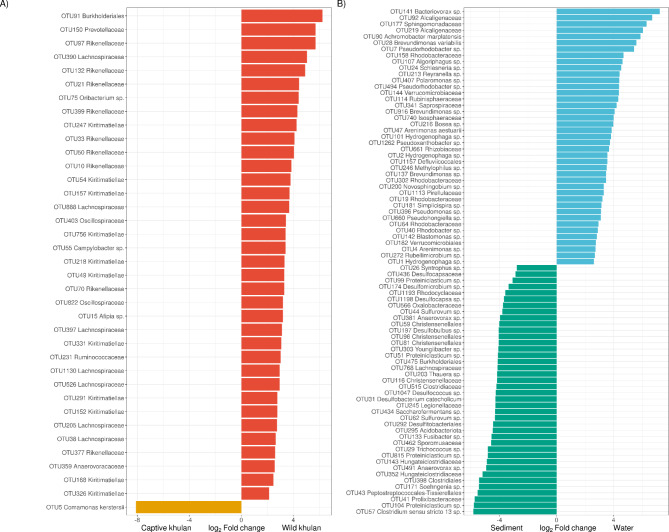
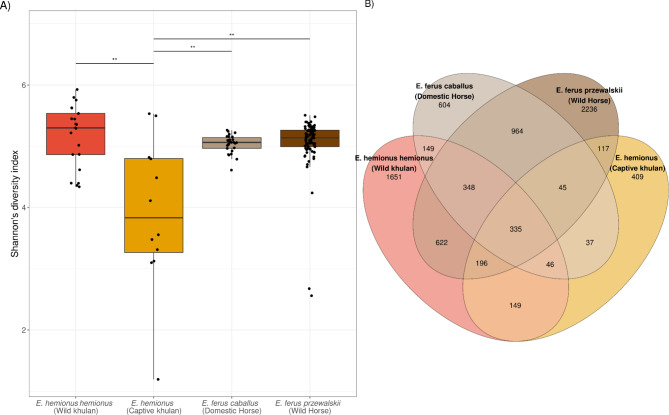
The microbial composition of host-associated microbiomes is influenced by co-evolutionary interactions, host genetics, domestication, and the environment. This study investigates the contribution of environmental microbiota from freshwater bodies to the gastrointestinal microbiomes of wild khulans (Equus hemionus hemionus, n = 21) and compares them with those of captive khulans (n = 12) and other equids-Przewalski's horse (n = 82) and domestic horse (n = 26). Using PacBio technology and the LotuS pipeline for 16S rRNA gene sequencing, we analyze microbial diversity and conduct differential abundance, alpha, and beta diversity analyses. Results indicate limited microbial sharing between wild khulans and their waterhole environments, suggesting minimal environmental influence on their gut microbiomes and low levels of water contamination by khulans. Wild khulans exhibit greater microbial diversity and richness compared to captive ones, likely due to adaptations to the harsh nutritional conditions of the Gobi desert. Conversely, captive khulans show reduced microbial diversity, potentially affected by dietary changes during captivity. These findings highlight the significant impact of environment and lifestyle on the gut microbiomes of equids.
宿主相关微生物群的微生物组成受共同进化相互作用、宿主遗传学、驯化和环境的影响。本研究调查了淡水水体中的环境微生物群对野生藏野驴(Equus hemionus hemionus,n = 21)胃肠道微生物群的贡献,并将其与圈养藏野驴(n = 12)以及其他马科动物——普氏野马(n = 82)和家马(n = 26)的胃肠道微生物群进行比较。我们使用PacBio技术和LotuS流程进行16S rRNA基因测序,分析微生物多样性,并进行差异丰度、α和β多样性分析。结果表明,野生藏野驴与其水坑环境之间的微生物共享有限,这表明环境对其肠道微生物群的影响极小,且藏野驴对水体的污染程度较低。与圈养藏野驴相比,野生藏野驴表现出更高的微生物多样性和丰富度,这可能是由于它们适应了戈壁沙漠恶劣的营养条件。相反,圈养藏野驴的微生物多样性降低,这可能受到圈养期间饮食变化的影响。这些发现突出了环境和生活方式对马科动物肠道微生物群的重大影响。