Metcalf Jessica L, Song Se Jin, Morton James T, Weiss Sophie, Seguin-Orlando Andaine, Joly Frédéric, Feh Claudia, Taberlet Pierre, Coissac Eric, Amir Amnon, Willerslev Eske, Knight Rob, McKenzie Valerie, Orlando Ludovic
Department of Animal Sciences, Colorado State University, Fort Collins, CO, USA.
Department of Pediatrics, University of California San Diego, San Diego, CA, USA.
Sci Rep. 2017 Nov 14;7(1):15497. doi: 10.1038/s41598-017-15375-9.
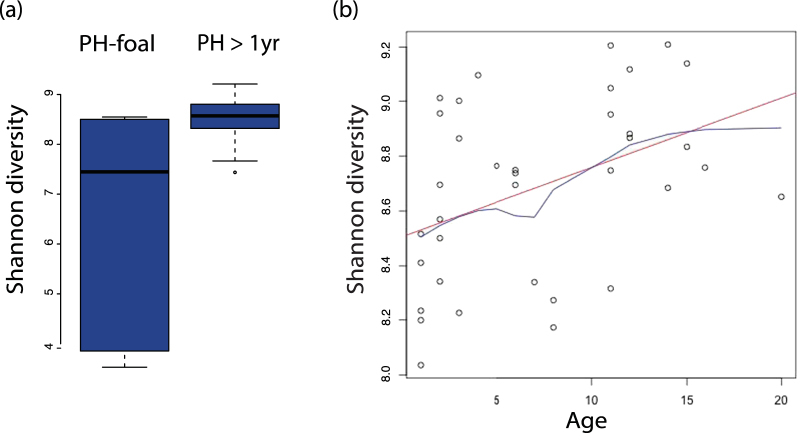
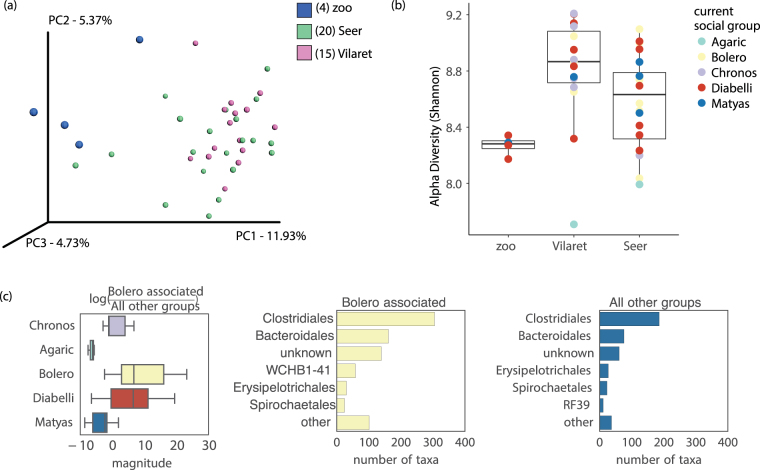
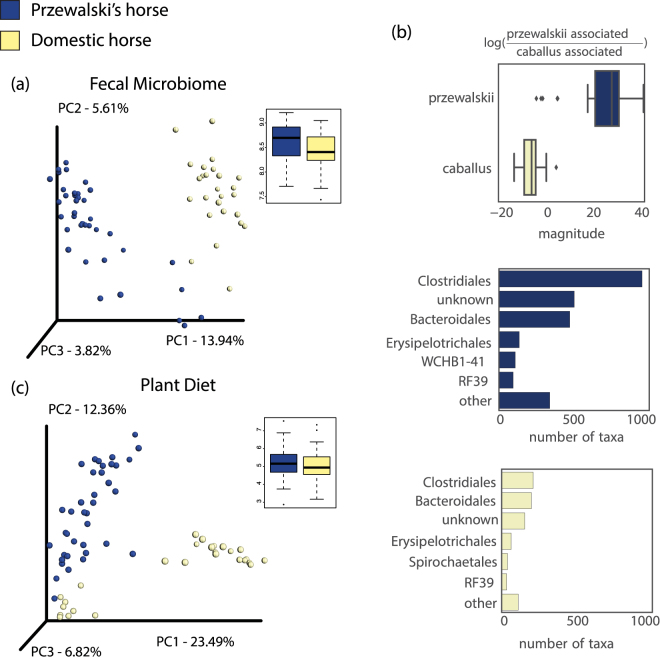
The mammal gut microbiome, which includes host microbes and their respective genes, is now recognized as an essential second genome that provides critical functions to the host. In humans, studies have revealed that lifestyle strongly influences the composition and diversity of the gastrointestinal microbiome. We hypothesized that these trends in humans may be paralleled in mammals subjected to anthropogenic forces such as domestication and captivity, in which diets and natural life histories are often greatly modified. We investigated fecal microbiomes of Przewalski's horse (PH; Equus ferus przewalskii), the only horses alive today not successfully domesticated by humans, and herded, domestic horse (E. f. caballus) living in adjacent natural grasslands. We discovered PH fecal microbiomes hosted a distinct and more diverse community of bacteria compared to domestic horses, which is likely partly explained by different plant diets as revealed by trnL maker data. Within the PH population, four individuals were born in captivity in European zoos and hosted a strikingly low diversity of fecal microbiota compared to individuals born in natural reserves in France and Mongolia. These results suggest that anthropogenic forces can dramatically reshape equid gastrointestinal microbiomes, which has broader implications for the conservation management of endangered mammals.
哺乳动物的肠道微生物群,包括宿主微生物及其各自的基因,现在被认为是一个重要的第二基因组,为宿主提供关键功能。在人类中,研究表明生活方式强烈影响胃肠道微生物群的组成和多样性。我们推测,在受到驯化和圈养等人为因素影响的哺乳动物中,这些人类中的趋势可能会出现,在这些情况下,饮食和自然生活史往往会发生很大改变。我们调查了普氏野马(PH;Equus ferus przewalskii)的粪便微生物群,普氏野马是当今唯一未被人类成功驯化的现存马种,以及生活在相邻天然草原上的放牧家马(E. f. caballus)。我们发现,与家马相比,普氏野马的粪便微生物群拥有一个独特且更多样化的细菌群落,这可能部分是由trnL标记数据揭示的不同植物性饮食所解释。在普氏野马种群中,有四只个体出生在欧洲动物园的圈养环境中,与出生在法国和蒙古自然保护区的个体相比,它们粪便微生物群的多样性极低。这些结果表明,人为因素可显著重塑马科动物的胃肠道微生物群,这对濒危哺乳动物的保护管理具有更广泛的意义。