Ouyang Fangru, Zheng Meige, Li Jianjian, Huang Jinxin, Ye Jianan, Wang Jingwen, Zhao Yuanzhe, Shan Fangli, Li Ziyu, Yu Shuishen, Yao Fei, Tian Dasheng, Cheng Li, Jing Juehua
Department of Orthopedics, The Second Affiliated Hospital of Anhui Medical University, Hefei, 230601, China.
Institute of Orthopedics, Research Center for Translational Medicine, The Second Affiliated Hospital of Anhui Medical University, Hefei, 230601, China.
Sci Rep. 2025 Jan 22;15(1):2867. doi: 10.1038/s41598-025-86991-z.
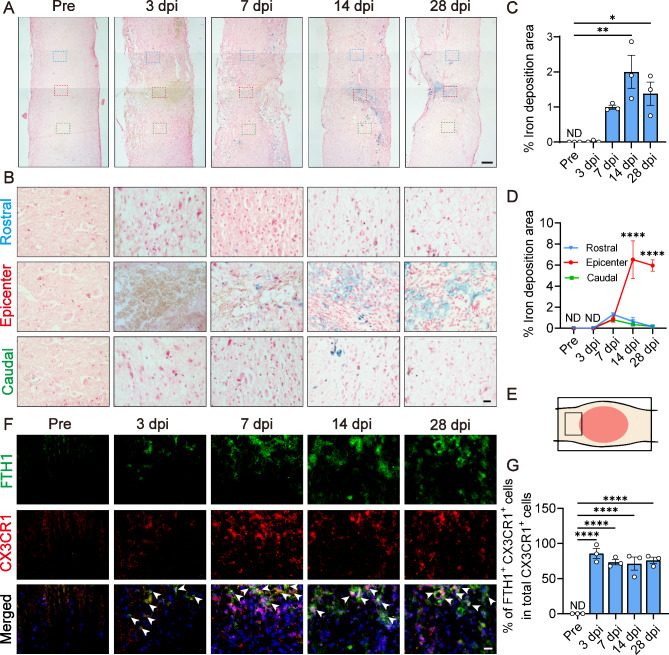
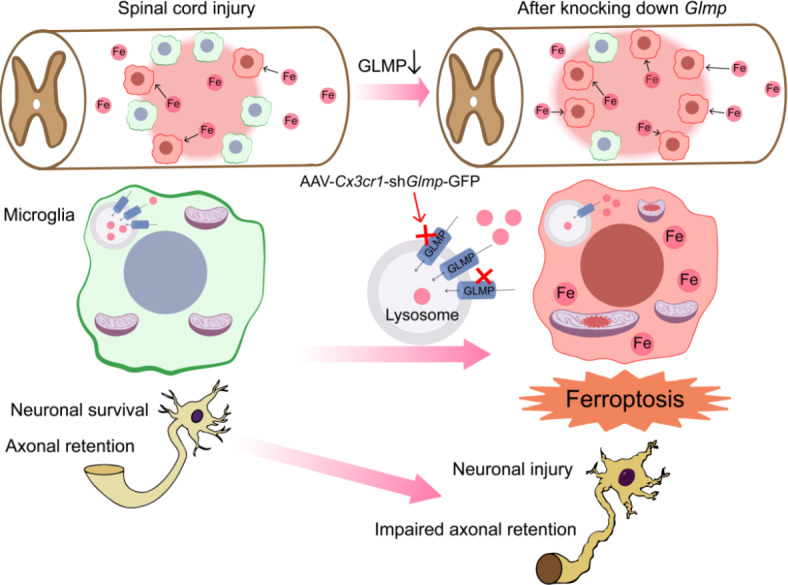
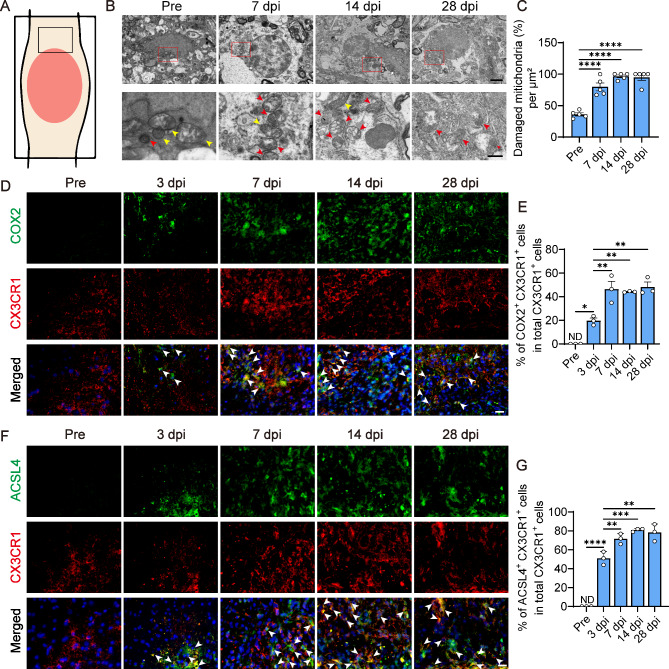
Excessive iron deposition can lead to ferroptosis, a form of iron-dependent cell death detrimental to neuronal survival. Microglia have been identified as having a high capacity for iron deposition, yet it remains unclear whether microglia undergo ferroptosis while phagocytosing excessive amounts of iron after spinal cord injury (SCI). Here, we observed scattered iron around the epicenter of the injured spinal cord at 7 days post-injury (dpi) in mice, which then accumulated in the lesion core at 14 dpi. Concurrently, microglia exhibited elevated expression of the iron-storage protein ferritin and were found to undergo ferroptosis between 7 and 28 dpi. Additionally, we noted a gradual decrease in glycosylated lysosomal membrane protein (GLMP) which is associated with iron metabolism in microglia undergoing ferroptosis. In situ injection of AAV9-Cx3cr1-shGlmp-eGFP to knock down GLMP specifically in microglia resulted in a significant increase in iron deposition and ferroptosis, leading to an expanded lesion area, aggravated neuronal loss, and subsequent inhibition of functional restoration. Our findings highlight the crucial role of GLMP in mitigating iron overload and ferroptosis in microglia, thereby contributing to axon retention and locomotor recovery after SCI.
过量的铁沉积会导致铁死亡,这是一种依赖铁的细胞死亡形式,对神经元存活有害。小胶质细胞已被确定具有较高的铁沉积能力,但脊髓损伤(SCI)后,小胶质细胞在吞噬过量铁时是否会发生铁死亡仍不清楚。在这里,我们观察到小鼠在损伤后7天(dpi)时,受损脊髓震中周围有散在的铁,然后在14 dpi时在损伤核心中积累。同时,小胶质细胞中铁储存蛋白铁蛋白的表达升高,并且在7至28 dpi之间发生铁死亡。此外,我们注意到糖基化溶酶体膜蛋白(GLMP)逐渐减少,该蛋白与发生铁死亡的小胶质细胞中的铁代谢有关。原位注射AAV9-Cx3cr1-shGlmp-eGFP以特异性敲减小胶质细胞中的GLMP,导致铁沉积和铁死亡显著增加,导致损伤面积扩大、神经元损失加重,以及随后对功能恢复的抑制。我们的研究结果突出了GLMP在减轻小胶质细胞中铁过载和铁死亡方面的关键作用,从而有助于SCI后的轴突保留和运动恢复。