Valjakka Juha S, Paasonen Jaakko, Salo Raimo A, Paasonen Ekaterina, Stenroos Petteri, Gureviciene Irina, Kettunen Mikko, Idiyatullin Djaudat, Tanila Heikki, Michaeli Shalom, Mangia Silvia, Gröhn Olli
A. I. Virtanen Institute for Molecular Sciences, University of Eastern Finland, Kuopio, Finland.
Center for Magnetic Resonance Research, University of Minnesota, Minneapolis, USA.
J Cereb Blood Flow Metab. 2025 May;45(5):855-870. doi: 10.1177/0271678X251314682. Epub 2025 Jan 23.
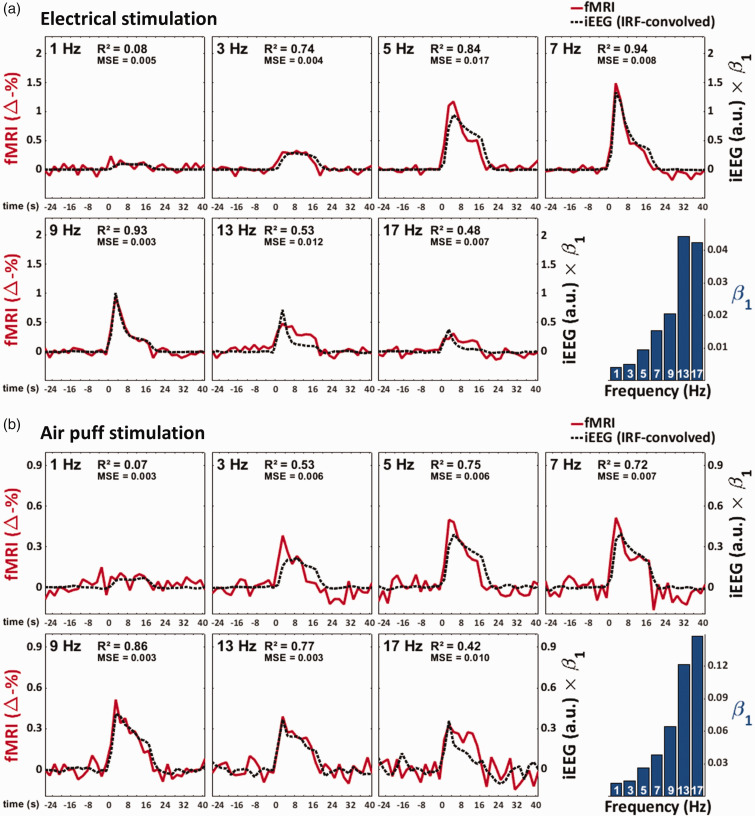
Zero echo time (zero-TE) pulse sequences provide a quiet and artifact-free alternative to conventional functional magnetic resonance imaging (fMRI) pulse sequences. The fast readouts (<1 ms) utilized in zero-TE fMRI produce an image contrast with negligible contributions from blood oxygenation level-dependent (BOLD) mechanisms, yet the zero-TE contrast is highly sensitive to brain function. However, the precise relationship between the zero-TE contrast and neuronal activity has not been determined. Therefore, we aimed to derive a function to model the temporal dynamics of the zero-TE fMRI signal in response to neuronal activity. Furthermore, we examined the correlation of zero-TE fMRI with neuronal activity across stimulation frequencies. To these ends, we performed simultaneous electrophysiological recordings and zero-TE fMRI in rats subjected to whisker stimulation. The presented impulse response function provides a basis for the statistical modeling of neuronal activity-induced changes in the zero-TE fMRI signal. The temporal characteristics of the zero-TE fMRI response were found to be consistent with the previously postulated non-BOLD hemodynamic origin of the functional contrast. The zero-TE fMRI signal was well predicted by electrophysiological recordings, although systematic stimulation-dependent residuals were also observed, suggesting nonlinearities in neurovascular coupling. We conclude that zero-TE fMRI provides a robust proxy for neuronal activity.
零回波时间(零TE)脉冲序列为传统功能磁共振成像(fMRI)脉冲序列提供了一种安静且无伪影的替代方案。零TE fMRI中使用的快速读出(<1毫秒)产生的图像对比度受血氧水平依赖(BOLD)机制的影响可忽略不计,但零TE对比度对脑功能高度敏感。然而,零TE对比度与神经元活动之间的确切关系尚未确定。因此,我们旨在推导一个函数来模拟零TE fMRI信号响应神经元活动的时间动态。此外,我们研究了零TE fMRI与不同刺激频率下神经元活动的相关性。为此,我们对接受触须刺激的大鼠同时进行了电生理记录和零TE fMRI检查。所呈现的脉冲响应函数为神经元活动引起的零TE fMRI信号变化的统计建模提供了基础。发现零TE fMRI响应的时间特征与先前假设的功能对比度的非BOLD血液动力学起源一致。尽管也观察到了与刺激相关的系统残差,表明神经血管耦合存在非线性,但电生理记录能很好地预测零TE fMRI信号。我们得出结论,零TE fMRI为神经元活动提供了一个可靠的指标。