Wang Yongbin, Xi Yue, Li Yanyan, Zhou Peiping, Xu Chunjie
Department of Epidemiology and Health Statistics, School of Public Health, Xinxiang Medical University, Xinxiang, China.
Beijing Key Laboratory of Antimicrobial Agents/Laboratory of Pharmacology, Institute of Medicinal Biotechnology, Chinese Academy of Medical Sciences & Peking Union Medical College, Beijing, China.
J Glob Health. 2025 Jan 24;15:04012. doi: 10.7189/jogh.15.04012.
The implementation of non-pharmaceutical interventions (NPIs) during the COVID-19 pandemic may inadvertently influence the epidemiology of tuberculosis (TB). (TB). However, few studies have explored how NPIs impact the long-term epidemiological trends of TB. We aimed to estimate the impact of NPIs implemented against COVID-19 on the medium- and long-term TB epidemics and to forecast the epidemiological trend of TB in Henan.
We first collected monthly TB case data from January 2013 to September 2022, after which we used the data from January 2013 to December 2021 as a training data set to fit the Bayesian structural time series (BSTS) model and the remaining data as a testing data set to validate the model's predictive accuracy. We then conducted an intervention analysis using the BSTS model to evaluate the impact of the COVID-19 pandemic on TB epidemics and to project trends for the upcoming years.
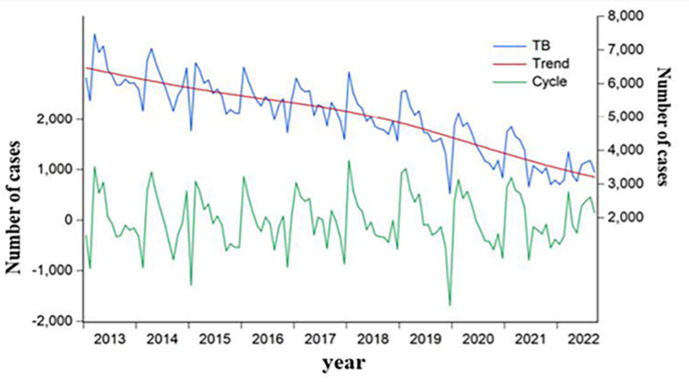
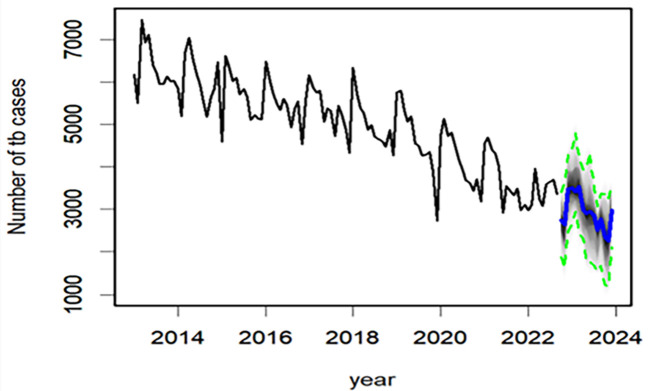
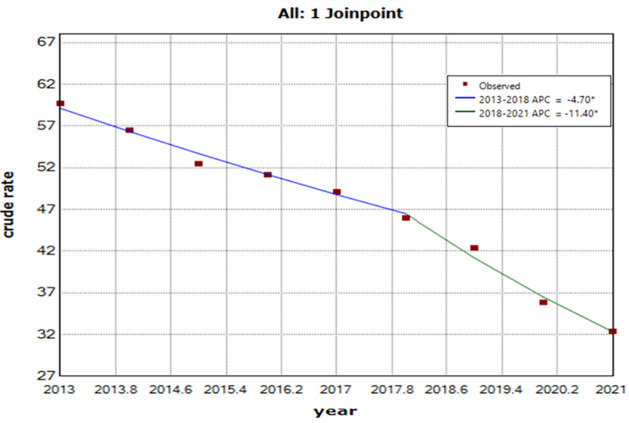
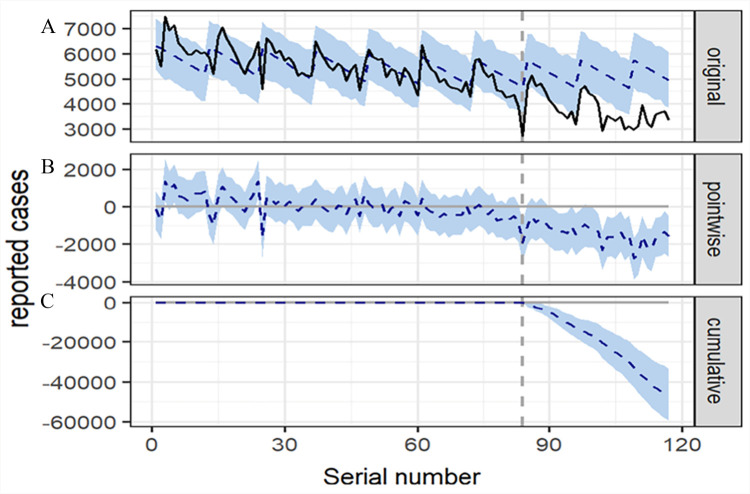
A total of 590 455 TB cases were notified from January 2013 to September 2022, resulting in an annual incidence rate of 57.4 cases per 100 000 population, with a monthly average of 5047 cases (5.35 cases per 100 000 population). The trend in TB incidence showed a significant decrease during the study period, with an annual average percentage change of -7.3% (95% confidence interval (CI) = -8.4, -6.1). The BSTS model indicated an average monthly reduction of 25% (95% CI = 17, 32) in TB case notifications from January 2020 to December 2021 due to COVID-19 (probability of causal effect = 99.80%, P = 0.002). The mean absolute percentage error in the forecast set was 14.86%, indicating relatively high predictive accuracy of the model. Furthermore, TB cases were projected to total 43 584 (95% CI = 29 471, 57 291) from October 2022 to December 2023, indicating a continued downward trend.
COVID-19 has had medium- and long-term impacts on TB epidemics, while the overall trend of TB incidence in Henan is generally declining. The BSTS model can be an effective option for accurately predicting the epidemic patterns of TB, and its results can provide valuable technical support for the development of prevention and control strategies.
在新冠疫情期间实施的非药物干预措施(NPIs)可能会对结核病(TB)的流行病学产生意外影响。然而,很少有研究探讨非药物干预措施如何影响结核病的长期流行趋势。我们旨在评估针对新冠疫情实施的非药物干预措施对结核病中长期流行的影响,并预测河南省结核病的流行趋势。
我们首先收集了2013年1月至2022年9月的月度结核病病例数据,之后将2013年1月至2021年12月的数据作为训练数据集来拟合贝叶斯结构时间序列(BSTS)模型,其余数据作为测试数据集来验证模型的预测准确性。然后,我们使用BSTS模型进行干预分析,以评估新冠疫情对结核病流行的影响,并预测未来几年的趋势。
2013年1月至2022年9月共报告了590455例结核病病例,年发病率为每10万人口57.4例,月平均为5047例(每10万人口5.35例)。在研究期间,结核病发病率呈显著下降趋势,年平均变化百分比为-7.3%(95%置信区间(CI)=-8.4,-6.1)。BSTS模型表明,由于新冠疫情,2020年1月至2021年12月结核病病例报告平均每月减少25%(95%CI=17,32)(因果效应概率=九九点八零%,P=0.002)。预测集中的平均绝对百分比误差为14.86%,表明模型具有较高的预测准确性。此外,预计2022年10月至2023年12月结核病病例总数为43584例(95%CI=29471,57291),表明呈持续下降趋势。
新冠疫情对结核病流行产生了中长期影响,而河南省结核病发病率的总体趋势普遍下降。BSTS模型可以成为准确预测结核病流行模式的有效选择,其结果可为防控策略的制定提供有价值的技术支持。