• 文献检索
  • 文档翻译
  • 深度研究
  • 学术资讯
  • Suppr Zotero 插件Zotero 插件
  • 邀请有礼
  • 套餐&价格
  • 历史记录
应用&插件
Suppr Zotero 插件Zotero 插件浏览器插件Mac 客户端Windows 客户端微信小程序
定价
高级版会员购买积分包购买API积分包
服务
文献检索文档翻译深度研究API 文档MCP 服务
关于我们
关于 Suppr公司介绍联系我们用户协议隐私条款
关注我们

Suppr 超能文献

核心技术专利:CN118964589B侵权必究
粤ICP备2023148730 号-1Suppr @ 2026

文献检索

告别复杂PubMed语法,用中文像聊天一样搜索,搜遍4000万医学文献。AI智能推荐,让科研检索更轻松。

立即免费搜索

文件翻译

保留排版,准确专业,支持PDF/Word/PPT等文件格式,支持 12+语言互译。

免费翻译文档

深度研究

AI帮你快速写综述,25分钟生成高质量综述,智能提取关键信息,辅助科研写作。

立即免费体验

新冠后持续性嗅觉功能障碍及其与自主神经系统功能的关联:一项病例对照研究

Persistent Post-COVID-19 Olfactory Dysfunction and Its Association with Autonomic Nervous System Function: A Case-Control Study.

作者信息

Ayoub Lojine, Almarzouki Abeer F, Al-Raddadi Rajaa, Bendary Mohamed A

机构信息

Department of Physiology, Faculty of Medicine, Rabigh Branch, King Abdulaziz University, Rabigh 21911, Saudi Arabia.

Department of Clinical Physiology, Faculty of Medicine, King Abdulaziz University, Jeddah 21589, Saudi Arabia.

出版信息

Diseases. 2024 Dec 28;13(1):4. doi: 10.3390/diseases13010004.

DOI:10.3390/diseases13010004
PMID:39851468
原文链接:https://pmc.ncbi.nlm.nih.gov/articles/PMC11765322/
Abstract

BACKGROUND

Following the Coronavirus Disease 2019 (COVID-19) pandemic, many patients have reported ongoing smell and taste issues. This study aims to investigate the prevalence of olfactory and gustatory dysfunction among patients with a history of COVID-19 and its association with autonomic dysfunction and disability.

PATIENT AND METHODS

This case-control study included a COVID-19 group (n = 82) and a control group (n = 82). Olfactory dysfunction, including parosmia and taste problems, was explored using self-reports and the Quick Smell Identification Test (QSIT). The association between post-COVID-19 disability severity and taste and smell alterations was also analyzed. Moreover, autonomic function was evaluated using the Composite Autonomic Symptom Scale-31 (COMPASS-31) to assess the association between autonomic and olfactory dysfunction.

RESULTS

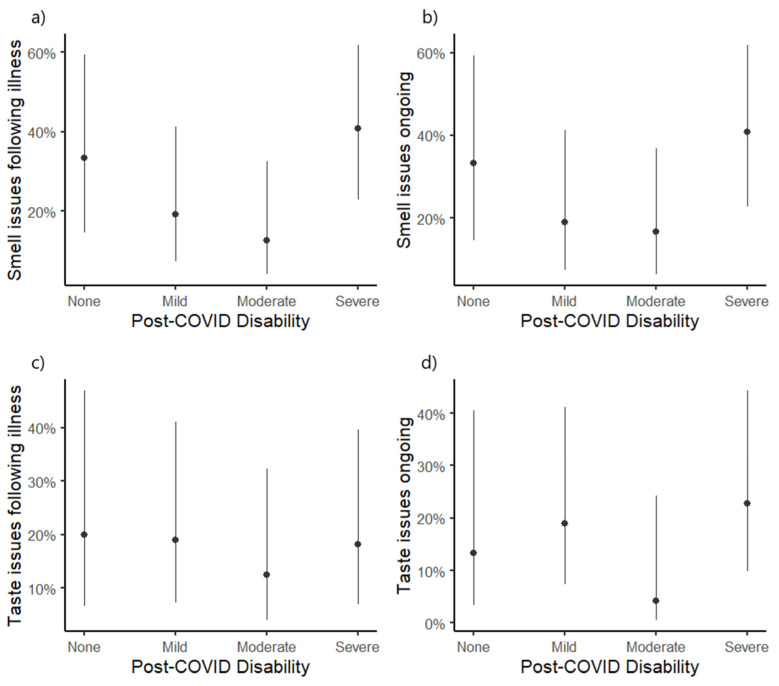
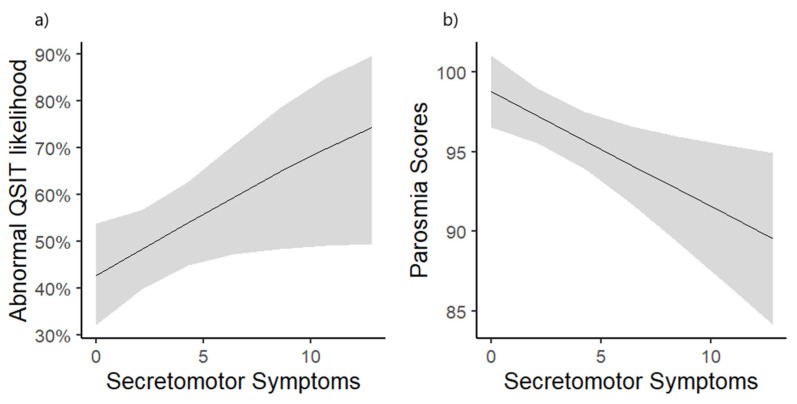
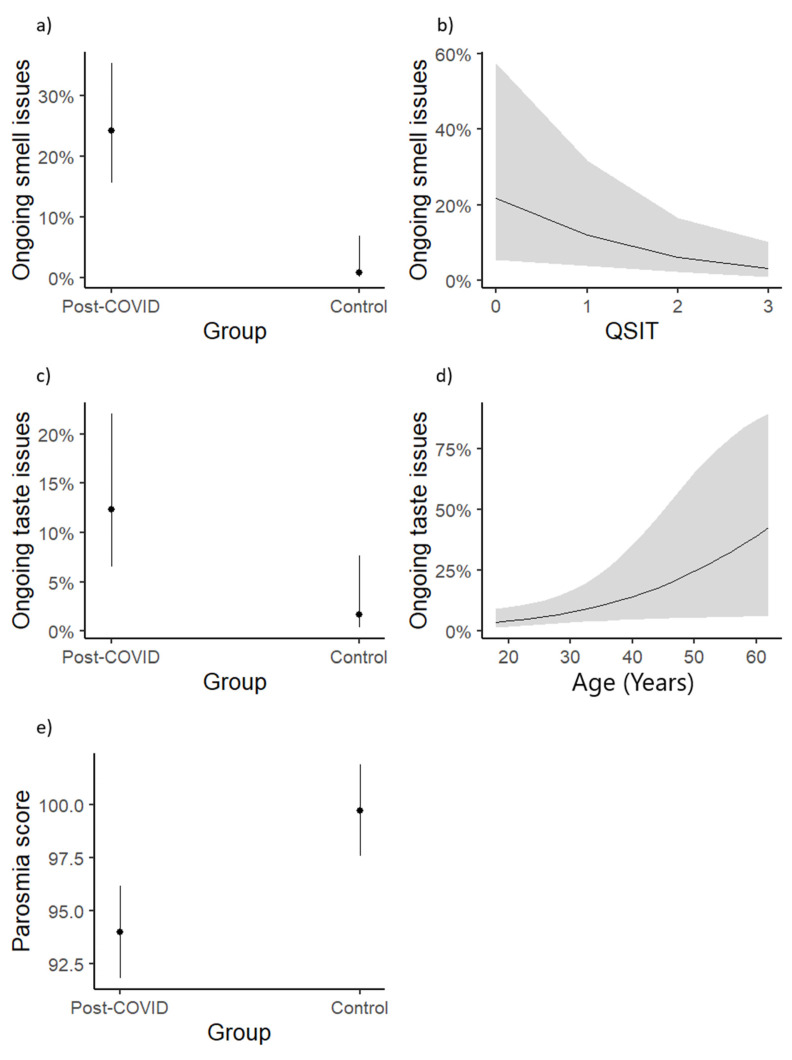
Significantly higher rates of ongoing smell (26.8%) and taste (14.6%) dysfunction were reported for the post-COVID-19 group compared to the control group. Post-COVID-19 patients reported 36.6 times more smell issues and 8.22 times more taste issues than controls. Parosmia scores were significantly worse in the post-COVID-19 group, while QSIT scores showed no significant difference between the groups. However, those with worse QSIT scores exhibited significantly more ongoing smell issues. No significant association was observed between disability and altered smell or taste. Higher secretomotor dysfunction scores were significantly associated with abnormal QSIT scores and worse parosmia scores; the other domains of the COMPASS-31 scale showed no significant associations.

CONCLUSIONS

The findings indicated a potential link between autonomic and olfactory dysfunction. Further studies are needed to elucidate the mechanisms underlying persistent olfactory and autonomic dysfunction in post-COVID-19 patients.

摘要

背景

在2019冠状病毒病(COVID-19)大流行之后,许多患者报告存在持续的嗅觉和味觉问题。本研究旨在调查有COVID-19病史的患者中嗅觉和味觉功能障碍的患病率及其与自主神经功能障碍和残疾的关联。

患者与方法

本病例对照研究包括一个COVID-19组(n = 82)和一个对照组(n = 82)。使用自我报告和快速嗅觉识别测试(QSIT)来探究嗅觉功能障碍,包括嗅觉异常和味觉问题。还分析了COVID-19后残疾严重程度与味觉和嗅觉改变之间的关联。此外,使用复合自主神经症状量表-31(COMPASS-31)评估自主神经功能,以评估自主神经功能与嗅觉功能障碍之间的关联。

结果

与对照组相比,COVID-19后组报告的持续嗅觉功能障碍(26.8%)和味觉功能障碍(14.6%)发生率显著更高。COVID-19后患者报告的嗅觉问题是对照组的36.6倍,味觉问题是对照组的8.22倍。COVID-19后组的嗅觉异常评分明显更差,而两组之间的QSIT评分无显著差异。然而,QSIT评分较差的患者存在的持续嗅觉问题明显更多。未观察到残疾与嗅觉或味觉改变之间存在显著关联。较高的分泌运动功能障碍评分与异常的QSIT评分和更差的嗅觉异常评分显著相关;COMPASS-31量表的其他领域未显示出显著关联。

结论

研究结果表明自主神经功能与嗅觉功能障碍之间存在潜在联系。需要进一步研究以阐明COVID-19后患者持续性嗅觉和自主神经功能障碍的潜在机制。
https://cdn.ncbi.nlm.nih.gov/pmc/blobs/d838/11765322/40715c000aa9/diseases-13-00004-g003.jpg
https://cdn.ncbi.nlm.nih.gov/pmc/blobs/d838/11765322/24d017e2f613/diseases-13-00004-g001.jpg
https://cdn.ncbi.nlm.nih.gov/pmc/blobs/d838/11765322/8e0839f06875/diseases-13-00004-g002.jpg
https://cdn.ncbi.nlm.nih.gov/pmc/blobs/d838/11765322/40715c000aa9/diseases-13-00004-g003.jpg
https://cdn.ncbi.nlm.nih.gov/pmc/blobs/d838/11765322/24d017e2f613/diseases-13-00004-g001.jpg
https://cdn.ncbi.nlm.nih.gov/pmc/blobs/d838/11765322/8e0839f06875/diseases-13-00004-g002.jpg
https://cdn.ncbi.nlm.nih.gov/pmc/blobs/d838/11765322/40715c000aa9/diseases-13-00004-g003.jpg

相似文献

1
Persistent Post-COVID-19 Olfactory Dysfunction and Its Association with Autonomic Nervous System Function: A Case-Control Study.新冠后持续性嗅觉功能障碍及其与自主神经系统功能的关联:一项病例对照研究
Diseases. 2024 Dec 28;13(1):4. doi: 10.3390/diseases13010004.
2
Interventions for the prevention of persistent post-COVID-19 olfactory dysfunction.预防持续性 COVID-19 后嗅觉功能障碍的干预措施。
Cochrane Database Syst Rev. 2022 Sep 5;9(9):CD013877. doi: 10.1002/14651858.CD013877.pub3.
3
Interventions for the prevention of persistent post-COVID-19 olfactory dysfunction.预防 COVID-19 后持续性嗅觉功能障碍的干预措施。
Cochrane Database Syst Rev. 2021 Jul 22;7(7):CD013877. doi: 10.1002/14651858.CD013877.pub2.
4
Psychophysical assessment of olfactory and gustatory function in post-mild COVID-19 patients: A matched case-control study with 2-year follow-up.轻度新冠康复患者嗅觉和味觉功能的心理物理学评估:一项为期2年随访的配对病例对照研究。
Int Forum Allergy Rhinol. 2023 Oct;13(10):1864-1875. doi: 10.1002/alr.23148. Epub 2023 Mar 15.
5
A follow-up on quantitative and qualitative olfactory dysfunction and other symptoms in patients recovering from COVID-19 smell loss.COVID-19 嗅觉丧失患者康复后嗅觉功能和其他症状的定量和定性随访。
Rhinology. 2022 Jun 1;60(3):207-217. doi: 10.4193/Rhin21.415.
6
COVID-19-Related Quantitative and Qualitative Olfactory and Gustatory Dysfunction: Long-Term Prevalence and Recovery Rate.COVID-19 相关的定量和定性嗅觉及味觉功能障碍:长期患病率和恢复率。
ORL J Otorhinolaryngol Relat Spec. 2023;85(2):67-71. doi: 10.1159/000525861. Epub 2022 Sep 5.
7
A quick test to objectify smell and taste dysfunction at home: a proof of concept for the validation of the chemosensory perception test.一种在家中客观化嗅觉和味觉障碍的快速测试:用于验证化学感觉感知测试的概念验证。
Chem Senses. 2023 Jan 1;48. doi: 10.1093/chemse/bjad033.
8
Olfactory Dysfunction, Headache, and Mental Clouding in Adults with Long-COVID-19: What Is the Link between Cognition and Olfaction? A Cross-Sectional Study.新冠后综合征成年患者的嗅觉功能障碍、头痛与思维模糊:认知与嗅觉之间有何联系?一项横断面研究。
Brain Sci. 2022 Jan 24;12(2):154. doi: 10.3390/brainsci12020154.
9
Olfactory-related Quality of Life Adjustments in Smell Loss during the Coronavirus-19 Pandemic.新冠疫情期间嗅觉丧失相关的生活质量调整。
Am J Rhinol Allergy. 2022 Mar;36(2):253-260. doi: 10.1177/19458924211053118. Epub 2021 Oct 27.
10
Visual Analogue Scale for the Evaluation of Olfactory and Gustatory Dysfunction of COVID-19 Patients in Northwestern Greece.用于评估希腊西北部新冠病毒肺炎患者嗅觉和味觉功能障碍的视觉模拟量表
Cureus. 2023 Mar 20;15(3):e36413. doi: 10.7759/cureus.36413. eCollection 2023 Mar.

本文引用的文献

1
Receptors Involved in COVID-19-Related Anosmia: An Update on the Pathophysiology and the Mechanistic Aspects.与 COVID-19 相关的嗅觉丧失的受体:病理生理学和机制方面的最新进展。
Int J Mol Sci. 2024 Aug 5;25(15):8527. doi: 10.3390/ijms25158527.
2
COVID-19 olfactory dysfunction: associations between coping, quality of life, and mental health.COVID-19 嗅觉功能障碍:应对方式、生活质量和心理健康之间的关系。
Rhinology. 2024 Oct 1;62(5):526-536. doi: 10.4193/Rhin23.356.
3
Parosmia in patients with post-infectious olfactory dysfunction in the era of COVID-19-associated olfactory impairment.
新冠病毒相关嗅觉障碍流行时期,感染后嗅觉障碍患者的嗅觉异常。
HNO. 2024 Sep;72(9):649-656. doi: 10.1007/s00106-024-01470-7. Epub 2024 Jun 27.
4
Stellate ganglion block for treating post-COVID-19 parosmia.星状神经节阻滞治疗新冠后嗅觉障碍。
Int Forum Allergy Rhinol. 2024 Jun;14(6):1088-1096. doi: 10.1002/alr.23314. Epub 2024 Jan 16.
5
Assessment of anosmia/hyposmia in post-COVID-19 patients: a cross-sectional study in an eastern province of Saudi Arabia.评估 COVID-19 后患者的嗅觉丧失/嗅觉减退:沙特阿拉伯东部省份的一项横断面研究。
Acta Biomed. 2023 Dec 5;94(6):e2023259. doi: 10.23750/abm.v94i6.15130.
6
Prevalence of long-lasting loss of smell and taste after coronavirus disease 2019 infection in Saudi Arabia.沙特阿拉伯2019冠状病毒病感染后嗅觉和味觉长期丧失的患病率。
J Family Community Med. 2023 Oct-Dec;30(4):295-299. doi: 10.4103/jfcm.jfcm_58_23. Epub 2023 Oct 13.
7
"The burden of post-acute COVID-19 symptoms in a multinational network cohort analysis".“多国网络队列分析中的 COVID-19 后急性症状负担”。
Nat Commun. 2023 Nov 17;14(1):7449. doi: 10.1038/s41467-023-42726-0.
8
Dysautonomia and small fiber neuropathy in post-COVID condition and Chronic Fatigue Syndrome.新冠后遗症和慢性疲劳综合征中的自主神经功能紊乱和小纤维神经病。
J Transl Med. 2023 Nov 15;21(1):814. doi: 10.1186/s12967-023-04678-3.
9
The immune mechanism of the nasal epithelium in COVID-19-related olfactory dysfunction.COVID-19 相关嗅觉功能障碍中鼻上皮的免疫机制。
Front Immunol. 2023 Jul 17;14:1045009. doi: 10.3389/fimmu.2023.1045009. eCollection 2023.
10
Olfactory Dysfunction following COVID-19 and the Potential Benefits of Olfactory Training.新冠病毒感染后的嗅觉功能障碍及嗅觉训练的潜在益处
J Clin Med. 2023 Jul 18;12(14):4761. doi: 10.3390/jcm12144761.