Tariq Hafiza Kashaf, Liang Zihao, Rabiu Lawan, Ibrahim Abdulrahman, Mohamady Farouk Abdalsalam Nada, Li Rong, Yang Qiong, Wan Xiaochun, Yan Dehong
Guangdong Immune Cell Therapy Engineering and Technology Research Center, Center for Protein and Cell-Based Drugs, Institute of Biomedicine and Biotechnology, Shenzhen Institutes of Advanced Technology, Chinese Academy of Sciences, Shenzhen 518055, China.
University of Chinese Academy of Sciences, Beijing 100864, China.
Cells. 2025 Jan 13;14(2):108. doi: 10.3390/cells14020108.
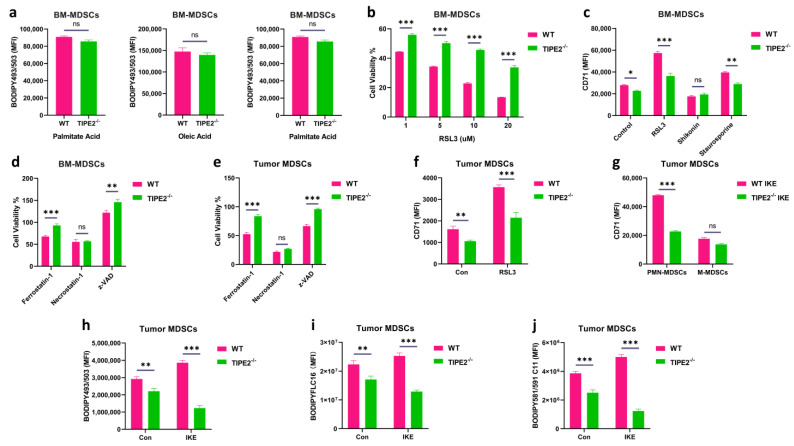
Although immune checkpoint blockade (ICB) therapy has attained unprecedented clinical success, the tolerance and immune suppression mechanisms evolved by tumor cells and their tumor microenvironment (TME) hinder its maximum anti-cancer potential. Ferroptosis therapy can partially improve the efficacy of ICB, but it is still subject to immune suppression by myeloid-derived suppressor cells (MDSCs) in the TME. Recent research suggests that an MDSC blockade can unleash the full therapeutic potential of the combined therapy of ferroptosis and ICB in liver cancer treatment. However, whether blocking the intrinsic ferroptosis pathways of MDSCs can relieve imidazole ketone erastin (IKE)-initiated ferroptosis-induced immune suppression and ultimately trigger the optimal therapeutic effect of the combined ferroptosis and ICB therapy is still unknown. Here, we report that TIPE2, a phospholipid transfer protein, regulated the ferroptosis susceptibility in MDSCs through reprogramming lipid peroxidation-related phosphatidylethanolamine (PE) and phosphatidylcholine (PC) species composition. TIPE2-deficient MDSCs resisted IKE-induced ferroptosis by up-regulating SLC7A11 and GPX4, and dissolved ferroptosis-induced immunosuppressive function by down-regulating lipid ROS whilst encouraging T cell proliferation and infiltration into tumor tissues to improve ferroptosis therapy. More importantly, TIPE2-deficient MDSCs achieved the full anti-tumor therapeutic potential of IKE-induced ferroptosis therapy and a PD-L1 blockade. These findings indicate that TIPE2 confers the ferroptosis sensitivity of MDSCs, and combining the targeting of the TIPE2 of MDSCs, ferroptosis therapy, and ICB is a novel therapeutic option for cancer treatment.
尽管免疫检查点阻断(ICB)疗法已取得了前所未有的临床成功,但肿瘤细胞及其肿瘤微环境(TME)所进化出的耐受和免疫抑制机制阻碍了其最大抗癌潜力的发挥。铁死亡疗法可部分提高ICB的疗效,但仍受到TME中髓源性抑制细胞(MDSC)的免疫抑制作用。最近的研究表明,阻断MDSC可释放铁死亡与ICB联合疗法在肝癌治疗中的全部治疗潜力。然而,阻断MDSC的内在铁死亡途径是否能缓解咪唑酮厄拉斯汀(IKE)引发的铁死亡诱导的免疫抑制,并最终触发铁死亡与ICB联合疗法的最佳治疗效果仍不清楚。在此,我们报告,磷脂转移蛋白TIPE2通过重新编程脂质过氧化相关的磷脂酰乙醇胺(PE)和磷脂酰胆碱(PC)种类组成来调节MDSC中的铁死亡易感性。TIPE2缺陷的MDSC通过上调SLC7A11和GPX4抵抗IKE诱导的铁死亡,并通过下调脂质ROS溶解铁死亡诱导的免疫抑制功能,同时促进T细胞增殖和浸润到肿瘤组织中以改善铁死亡疗法。更重要的是,TIPE2缺陷的MDSC实现了IKE诱导的铁死亡疗法和PD-L1阻断的完全抗肿瘤治疗潜力。这些发现表明,TIPE2赋予了MDSC铁死亡敏感性,联合靶向MDSC的TIPE2、铁死亡疗法和ICB是癌症治疗的一种新的治疗选择。